Vikram Seth - A Suitable Boy
Здесь есть возможность читать онлайн «Vikram Seth - A Suitable Boy» весь текст электронной книги совершенно бесплатно (целиком полную версию без сокращений). В некоторых случаях можно слушать аудио, скачать через торрент в формате fb2 и присутствует краткое содержание. Год выпуска: 2012, Издательство: Orion Publishing Co, Жанр: Современная проза, на английском языке. Описание произведения, (предисловие) а так же отзывы посетителей доступны на портале библиотеки ЛибКат.
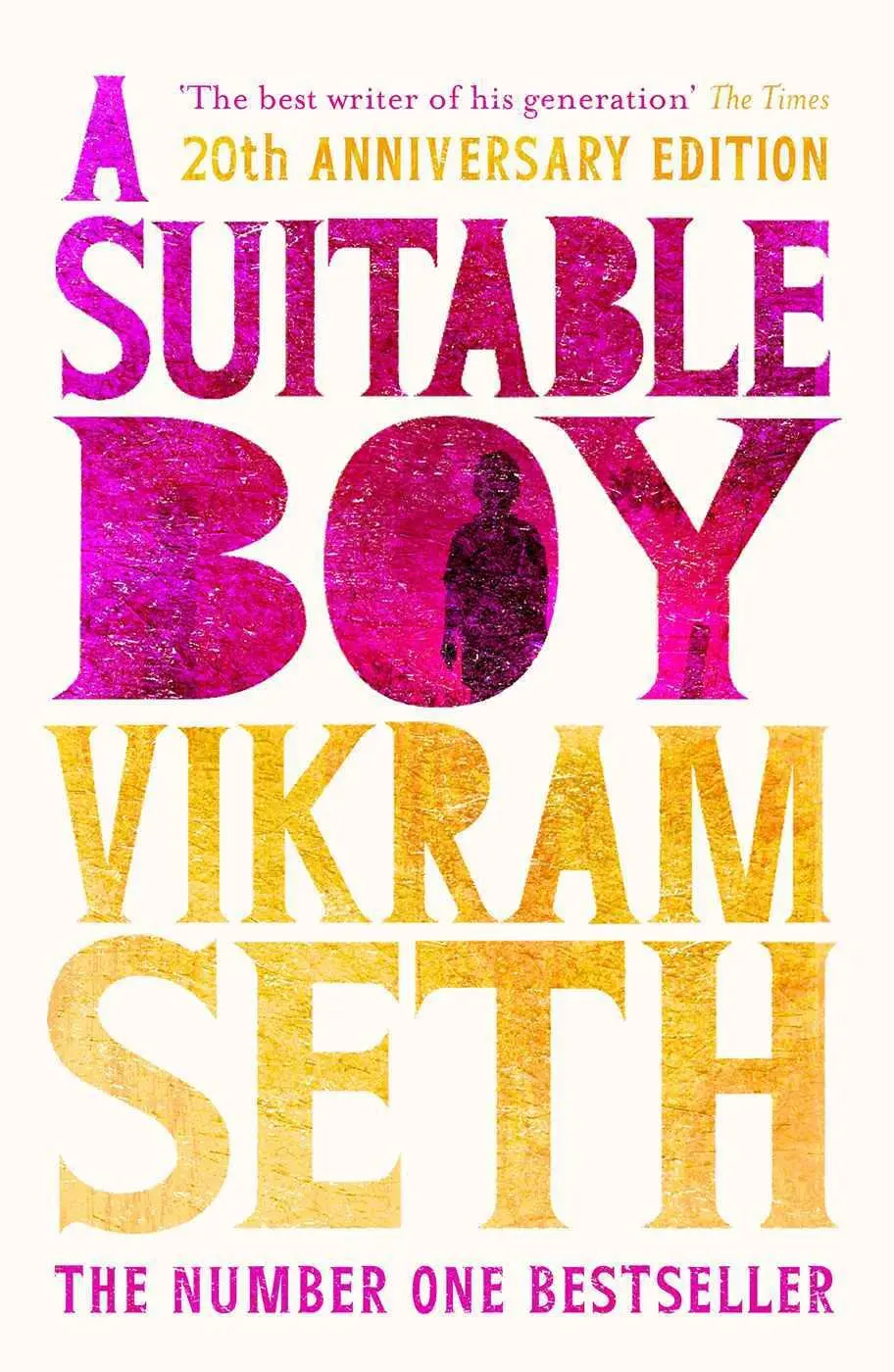
- Название:A Suitable Boy
- Автор:
- Издательство:Orion Publishing Co
- Жанр:
- Год:2012
- ISBN:нет данных
- Рейтинг книги:5 / 5. Голосов: 1
-
Избранное:Добавить в избранное
- Отзывы:
-
Ваша оценка:
A Suitable Boy: краткое содержание, описание и аннотация
Предлагаем к чтению аннотацию, описание, краткое содержание или предисловие (зависит от того, что написал сам автор книги «A Suitable Boy»). Если вы не нашли необходимую информацию о книге — напишите в комментариях, мы постараемся отыскать её.
A Suitable Boy — читать онлайн бесплатно полную книгу (весь текст) целиком
Ниже представлен текст книги, разбитый по страницам. Система сохранения места последней прочитанной страницы, позволяет с удобством читать онлайн бесплатно книгу «A Suitable Boy», без необходимости каждый раз заново искать на чём Вы остановились. Поставьте закладку, и сможете в любой момент перейти на страницу, на которой закончили чтение.
Интервал:
Закладка:
‘Welcome,’ he said calmly. ‘Come in. What brings you here? I’ve told you that the strike won’t come in the way of fulfilling your order,’ he added, anticipating a possible reason for Kedarnath’s presence.
A little girl of about five, Jagat Ram’s daughter, sat on the step. Now she began singing ‘Lovely walé aa gayé! Lovely walé aa gayé!’ and clapped her hands.
It was Kedarnath’s turn to look surprised — and not entirely pleased. Her father, a little disconcerted, corrected her: ‘These are not the people from Lovely, Meera — now go and tell your mother we need some tea.’
He turned to Kedarnath and said, ‘Actually, I was expecting the people from Lovely.’ He did not feel the need to volunteer any further information.
Kedarnath nodded. The Lovely Shoe Shop, one of the more recent shops to appear just off Nabiganj, had a good selection of women’s shoes. Normally the man who ran the shop would have got the Bombay middlemen to supply him, as Bombay was where most women’s shoes in the country were produced. Now he was obviously looking close to home for his supplies, and tapping a source that Kedarnath would have been happier tapping — or at least mediating — himself.
Dismissing the subject from his mind for the moment, he said, ‘This is Mr Haresh Khanna, who is originally from Delhi, but is working for CLFC in Kanpur. He has studied footwear manufacture in England. And, well, I have brought him here to show him what work our Brahmpur shoemakers are capable of, even with their simple tools.’
Jagat Ram nodded, quite pleased.
There was a small wooden stool near the entrance of the workshop, and Jagat Ram asked Kedarnath to sit down. Kedarnath in turn invited Haresh to sit, but Haresh courteously declined. He sat down instead on one of the small stone platforms at which no one was working. The artisans stiffened, looking at him in displeasure and astonishment. Their reaction was so palpable that Haresh quickly got up again. Clearly he had done something wrong and, being a direct man, he turned to Jagat Ram and said, ‘What’s the matter? Can’t one sit on those?’
Jagat Ram had reacted with similar resentment when Haresh had sat down, but the straightforwardness of Haresh’s query — and his obvious lack of intention to offend anyone — caused him to respond mildly.
‘A workman calls his work-platform his rozi or “employment”; he does not sit on it,’ he said quietly. He did not mention that each man kept his rozi immaculately polished, and even said a brief prayer to it before beginning his day’s work. To his son he said, ‘Get up — let Haresh Sahib sit down.’
A boy of fifteen got up from the chair near the sewing machine, and despite Haresh’s protests that he did not want to interrupt anyone’s work he was made to sit down. Jagat Ram’s youngest son, who was seven, came in with three cups of tea.
The cups were thick and small, chipped here and there on their white surface, but clean. There was a little talk of this and that, of the strike in Misri Mandi, of the claim by a newspaper that the smoke from the tannery and the Praha Shoe Factory were damaging the Barsaat Mahal, of the new municipal market-tax, of various local personalities.
After a while, Haresh became impatient, as he tended to do when he was sitting idle. He got up to look around the workshop and find out what everyone was doing. A batch of women’s sandals was being made; they looked quite attractive with their green and black plaited leather straps.
Haresh was indeed surprised at the skill of the workmen. With rudimentary tools — chisel and knife and awl and hammer and foot-operated sewing machine — they were producing shoes that were not far below the quality of those made by the machines of CLFC. He told them what he thought of their skill and the quality of their product, given the limitations under which they worked; and they warmed to him.
One of the bolder workmen — Jagat Ram’s younger brother, a friendly, round-faced man — asked to see Haresh’s shoes, the maroon brogues that he was wearing. Haresh took them off, mentioning that they were not very clean. In fact they were by now completely splattered and caked with mud. They were passed around for general admiration and examination.
Jagat Ram read out the letters painstakingly and spelt ‘Saxone’. ‘Saksena from England,’ he explained with some pride.
‘I can see that you make men’s shoes as well,’ said Haresh. He had noticed a large clump of wooden lasts for men hanging grape-like from the ceiling in a dark corner of the room.
‘Of course,’ said Jagat Ram’s brother with a jovial grin. ‘But there’s more profit in what few others can do. It’s much better for us to make women’s shoes—’
‘Not necessarily,’ said Haresh, whipping out — to everyone’s, including Kedarnath’s, surprise — a set of paper patterns from his briefcase. ‘Now, Jagat Ram, tell me, are your workmen skilled enough to give me a shoe — also a brogue — based on these patterns?’
‘Yes,’ said Jagat Ram, almost without thinking.
‘Don’t say yes so quickly,’ said Haresh, though he was pleased by the ready and confident response. He too enjoyed taking up challenges as much as he enjoyed throwing them down.
Jagat Ram was looking at the patterns — they were for a size 7 winged brogue — with great interest. Just by looking at the flat pieces of thin cardboard that made up the patterns — the fine punched design, the shape of the toe, the vamp, the quarters — the whole shoe came to vivid, three-dimensional shape before his eyes.
‘Who is making these shoes?’ he asked, his forehead creased with curiosity. ‘They are somewhat different from the brogues you are wearing.’
‘We are, at CLFC. And if you do a good job, you may be too — for us.’
Jagat Ram, though clearly very surprised and interested by Haresh’s statement, did not say anything for a while in response, but continued to examine the patterns.
Pleased with the dramatic effect of his sudden production of the patterns, Haresh said: ‘Keep them. Look over them today. I can see that those lasts hanging there are non-standard, so I’ll send you a pair of size 7 standard lasts tomorrow. I’ve brought a couple of pairs to Brahmpur. Now then, apart from the lasts, what will you need? Let’s say, three square feet of leather, calf leather — let’s make that maroon as well—’
‘And lining leather,’ said Jagat Ram.
‘Right; suppose we say natural cow, also three square feet — I’ll get that from town.’
‘And leather for the sole and insole?’ asked Jagat Ram.
‘No, that’s readily available and not very expensive. You can manage that. I’ll give you twenty rupees to cover costs and time — and you can get the material for the heels yourself. I’ve brought a few counters and toe-puffs of decent quality — they are always a problem — and some thread; but they’re at the house where I’m staying.’
Kedarnath, though his eyes were closed, raised his eyebrows in admiration at this enterprising fellow who had had the foresight to think of all these details before he left on a brief out-of-town trip intended mainly for purchasing materials. He was, however, concerned that Jagat Ram might be taken over by Haresh and that he himself might be cut out. The mention of the Lovely Shoe Shop came back to worry him as well.
‘Now, if I came over tomorrow morning with these things,’ Haresh was saying, ‘when could you let me have the shoes?’
‘I think I could have them ready in five days,’ said Jagat Ram.
Haresh shook his head impatiently.
‘I can’t stay in town for five days just for a pair of shoes. How about three?’
‘I’ll have to leave them on the lasts for at least seventy-two hours,’ said Jagat Ram. ‘If you want me to make a pair of shoes which retain their shape, you know that that is a minimum.’
Читать дальшеИнтервал:
Закладка:
Похожие книги на «A Suitable Boy»
Представляем Вашему вниманию похожие книги на «A Suitable Boy» списком для выбора. Мы отобрали схожую по названию и смыслу литературу в надежде предоставить читателям больше вариантов отыскать новые, интересные, ещё непрочитанные произведения.








Обсуждение, отзывы о книге «A Suitable Boy» и просто собственные мнения читателей. Оставьте ваши комментарии, напишите, что Вы думаете о произведении, его смысле или главных героях. Укажите что конкретно понравилось, а что нет, и почему Вы так считаете.