Vikram Seth - A Suitable Boy
Здесь есть возможность читать онлайн «Vikram Seth - A Suitable Boy» весь текст электронной книги совершенно бесплатно (целиком полную версию без сокращений). В некоторых случаях можно слушать аудио, скачать через торрент в формате fb2 и присутствует краткое содержание. Год выпуска: 2012, Издательство: Orion Publishing Co, Жанр: Современная проза, на английском языке. Описание произведения, (предисловие) а так же отзывы посетителей доступны на портале библиотеки ЛибКат.
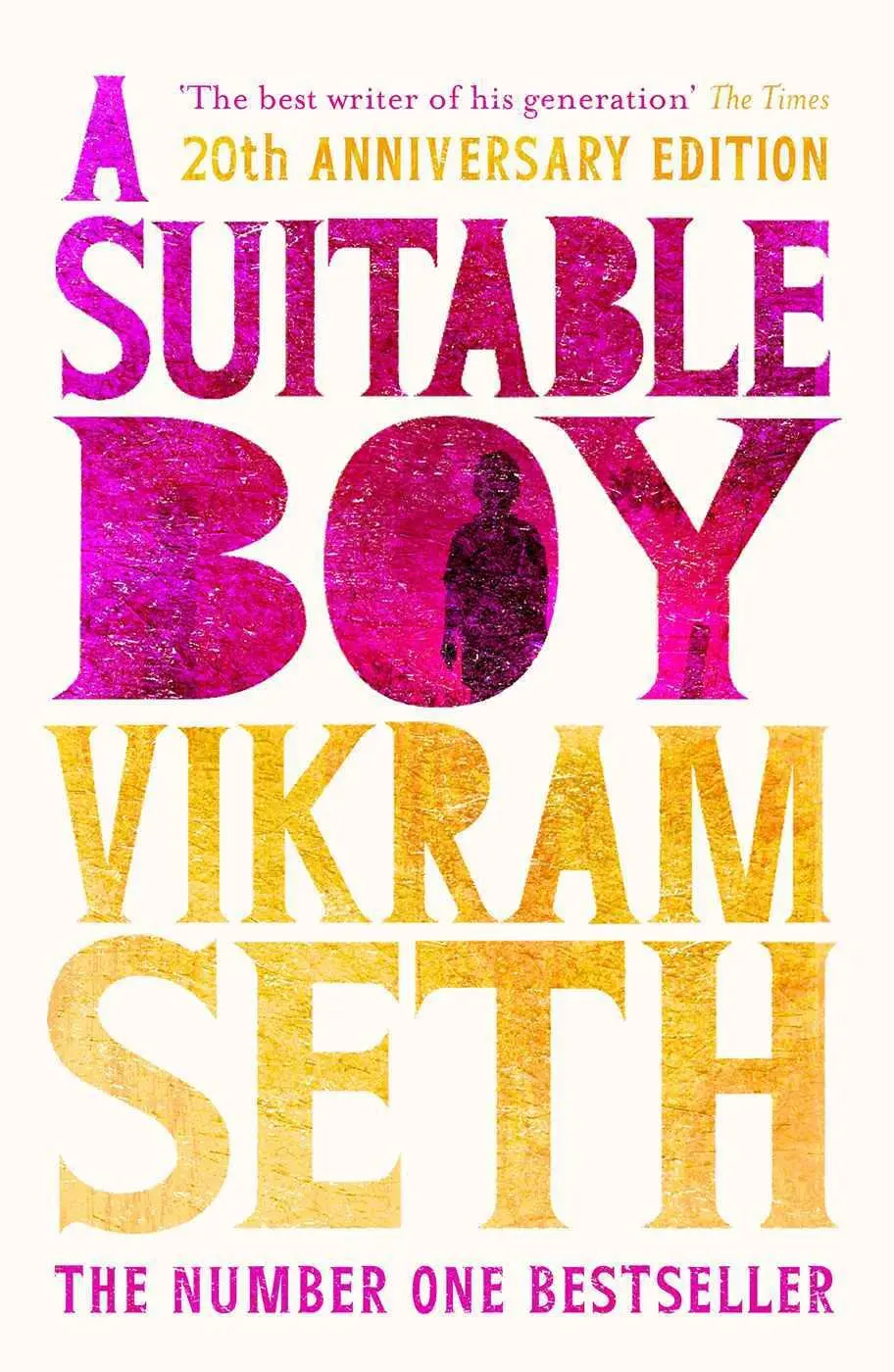
- Название:A Suitable Boy
- Автор:
- Издательство:Orion Publishing Co
- Жанр:
- Год:2012
- ISBN:нет данных
- Рейтинг книги:5 / 5. Голосов: 1
-
Избранное:Добавить в избранное
- Отзывы:
-
Ваша оценка:
A Suitable Boy: краткое содержание, описание и аннотация
Предлагаем к чтению аннотацию, описание, краткое содержание или предисловие (зависит от того, что написал сам автор книги «A Suitable Boy»). Если вы не нашли необходимую информацию о книге — напишите в комментариях, мы постараемся отыскать её.
A Suitable Boy — читать онлайн бесплатно полную книгу (весь текст) целиком
Ниже представлен текст книги, разбитый по страницам. Система сохранения места последней прочитанной страницы, позволяет с удобством читать онлайн бесплатно книгу «A Suitable Boy», без необходимости каждый раз заново искать на чём Вы остановились. Поставьте закладку, и сможете в любой момент перейти на страницу, на которой закончили чтение.
Интервал:
Закладка:
Did she even like this poem, she wondered. The thought of Amit sweating disturbed her — he was to her a disembodied and comforting spirit, and it was best that he remained that way. By now it had been dark for more than an hour, and Lata could imagine him lying on his bed, hearing the papiha sing its triple note, and tossing restlessly from side to side.
She looked at the personalized inscription again. She wondered why he had used the word ‘carve’ in the final line. Was it simply to chime — in a slightly overdone manner, she could not help feeling — with the ‘swerve’ and ‘curve’ of the previous line? A poem could hardly be carved. But this was probably just poetic licence, like the bird’s wings beating a tattoo, or the claim that he was drunk on words.
Then, suddenly, and for no apparent reason at all, for she was not looking out for such a curious feature as this, she realized, with simultaneous delight and dismay, how carved, how personalized the inscription indeed was, and why, after all, he had not written her name above the poem. It went far beyond the reference to pineapples, to the moment in the cemetery that they had shared. She had only to look down the first letters of each of the four lines in each of the four quatrains to realize how inextricably bound she was not merely to the sentiment but to the very structure of Amit’s poem.
Part Fourteen
14.1
Mahesh Kapoor left for his farm in Rudhia in early August in the company of Maan. Now that he was no longer a Minister, he had a little more free time for his own pursuits. Apart from supervising the work on the farm itself — the main activity at present was the transplantation of rice — he had two other purposes in leaving Brahmpur. The first was to see if Maan, who had proved himself uninterested and unsuccessful in working in Banaras, might possibly be happier and more effectively employed in running the farm. The second was to ascertain from where he could best fight a candidate from the Congress Party for an Assembly seat in the coming General Elections — now that he himself had left it and joined the newly formed Peasants’ and Workers’ Peoples’ Party — the KMPP for short. The obvious rural choice was the constituency that contained his farm — which was in the Rudhia subdivision of Rudhia District. As he walked around his fields, his mind turned once more to Delhi and the great figures of the strife-ridden Congress Party vying with each other for power on the national stage.
Rafi Ahmad Kidwai, the wise, wily and playful politician from U.P., who had been responsible for a spate of resignations from the Congress, including Mahesh Kapoor’s, was anathema to the Hindu-chauvinist right wing of the party — partly because he was Muslim, partly because he had twice orchestrated opposition to the attempts of Purushottamdas Tandon to become President of the Congress Party. Tandon had been narrowly defeated in 1948, and had narrowly won in 1950—in a dubiously fought battle made more bitter by the knowledge that whoever controlled the Congress Party machine in 1951 would have control over the selection of candidates for the forthcoming General Elections.
Tandon — a barefooted, bearded, austere and rather intolerant man, seven years Nehru’s senior and, like him, from Allahabad — now headed the organization of the Congress Party. He had chosen his Working Committee largely from the party bosses of the individual states and their supporters, for in most of the states the party machinery was already in the control of the conservatives. Since Tandon had insisted that the Congress President’s choice of his Working Committee should be unfettered, he did not include — and had indeed refused to include — either his defeated opponent Kripalani — or Kidwai, who had planned Kripalani’s campaign. Prime Minister Nehru, already upset by Tandon’s election, which he rightly interpreted as a victory not only for Tandon but for Sardar Patel, his own great conservative rival, had at first refused to join a Working Committee that excluded Kidwai. But in the interests of unity, because he saw the Congress as the only cohesive force in the localized and divided web of Indian politics, he swallowed his objections and joined it.
Nehru sought to protect his policies as Prime Minister from any possible onslaught by the activist Congress President by proposing party resolutions on each of his main policies, all of which had been overwhelmingly passed by the assembled party. But passing resolutions by acclamation was one thing, controlling the personnel of the party — and the selection of candidates — another. Nehru was left with the uneasy sense that the lip service that was being paid to the policies of his government would change once the right wing got its own slate of MLAs and MPs into Parliament and the state legislatures. Nehru’s vast popularity would be used to win the elections, and then he would be left stranded and impotent.
The death of Sardar Patel, a couple of months after Tandon was elected, had left the right wing without its greatest strategist. But Tandon proved to be a formidable opponent in his own right. In the name of discipline and unity he attempted to suppress dissenting groups within the party, such as the Democratic Front established by Kidwai and Kripalani (the so-called K-K Group), which were outspoken in their criticism of his leadership. Stay in the party and support the Working Committee, they were warned, or get out. Unlike his compliant predecessor in the job, Tandon also insisted that the party organization as represented by its President had every right to advise, and indeed control, the policies of the Congress Government headed by Nehru — down to the question of banning hydrogenated cooking oil. And on every important issue his views were diametrically opposed to those of Nehru or his supporters — men such as Kripalani and Kidwai or, closer to Brahmpur, Mahesh Kapoor.
Apart from economic differences, the Nehruites and the Tandonites saw the Muslim question in an entirely different light. Throughout the year there had been a great deal of mutual snarling by India and Pakistan across their borders. It had appeared several times that war might be imminent over the problem of Kashmir. While Nehru saw war as a disastrous possibility for the two poor countries, and attempted to come to some kind of understanding with the Pakistani Prime Minister Liaquat Ali Khan, many embittered members of his party were in favour of war with Pakistan. One member of his Cabinet had resigned, formed his own Hindu revivalist party, and was even talking of conquering Pakistan and reuniting it by force with India. What made things worse was the steady stream of refugees, mainly now from East Pakistan into Bengal, that put an unsupportable burden upon the state. They were fleeing because of ill treatment and insecurity in Pakistan, and several hardliners in India suggested under a theory of reciprocity that for each Hindu migrant from Pakistan a Muslim should be expelled from India. They saw matters in terms of Hindus and Muslims, of collective guilt and collective revenge. So successfully indeed had the two-nation theory — the Muslim League’s justification for Partition — taken root in their own minds that they saw Muslim citizens of India as Muslims first and Indians only incidentally; and were willing to visit upon their heads punishment for the actions of their co-religionists in the other country.
Such talk repelled Nehru. The thought of India as a Hindu state with its minorities treated as second-class citizens sickened him. If Pakistan treated its minority citizens barbarically, that was no reason for India to do so. He had, after Partition, personally pleaded with a number of Muslim civil servants to remain in India. He had accepted, if not exactly welcomed, into the Congress fold, a number of leaders who had belonged to the Muslim League, which had virtually ceased to exist in India. He had attempted to reassure Muslims who, because of ill treatment and a sense of insecurity, were still migrating to West Pakistan through Rajasthan and other border states. He had preached against communal enmity in every speech he had given — and Nehru was much given to speeches. He had refused to countenance any of the retaliatory actions urged on him by many of the dispossessed Hindu and Sikh refugees from Pakistan, by the right-wing parties, and by the right wing of his own party. He had tried to soften some of the more draconian decisions of the Custodian-General of Evacuee Property, who had often acted more in the interests of those who hankered after evacuee property than of the evacuees themselves. He had signed a pact with Liaquat Ali Khan which had reduced the likelihood of war with Pakistan. All these actions infuriated people who saw Nehru as a rootless, deracinated Indian, whose sentimental creed was a pro-Muslim secularism, and who was divorced from the majority of his own Hindu citizenry.
Читать дальшеИнтервал:
Закладка:
Похожие книги на «A Suitable Boy»
Представляем Вашему вниманию похожие книги на «A Suitable Boy» списком для выбора. Мы отобрали схожую по названию и смыслу литературу в надежде предоставить читателям больше вариантов отыскать новые, интересные, ещё непрочитанные произведения.








Обсуждение, отзывы о книге «A Suitable Boy» и просто собственные мнения читателей. Оставьте ваши комментарии, напишите, что Вы думаете о произведении, его смысле или главных героях. Укажите что конкретно понравилось, а что нет, и почему Вы так считаете.