Christine Schutt - All Souls
Здесь есть возможность читать онлайн «Christine Schutt - All Souls» весь текст электронной книги совершенно бесплатно (целиком полную версию без сокращений). В некоторых случаях можно слушать аудио, скачать через торрент в формате fb2 и присутствует краткое содержание. Год выпуска: 2008, Издательство: Houghton Mifflin Harcourt, Жанр: Современная проза, на английском языке. Описание произведения, (предисловие) а так же отзывы посетителей доступны на портале библиотеки ЛибКат.
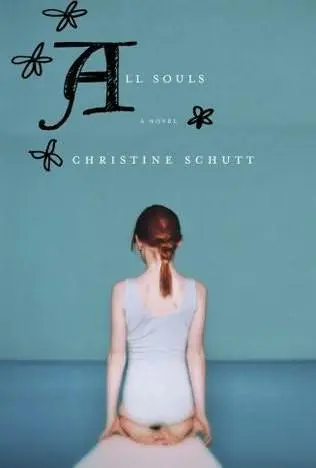
- Название:All Souls
- Автор:
- Издательство:Houghton Mifflin Harcourt
- Жанр:
- Год:2008
- ISBN:нет данных
- Рейтинг книги:3 / 5. Голосов: 1
-
Избранное:Добавить в избранное
- Отзывы:
-
Ваша оценка:
All Souls: краткое содержание, описание и аннотация
Предлагаем к чтению аннотацию, описание, краткое содержание или предисловие (зависит от того, что написал сам автор книги «All Souls»). Если вы не нашли необходимую информацию о книге — напишите в комментариях, мы постараемся отыскать её.
National Book Award Finalist Christine Schutt has created a wickedly original tale of innocence, daring and illness.
All Souls — читать онлайн бесплатно полную книгу (весь текст) целиком
Ниже представлен текст книги, разбитый по страницам. Система сохранения места последней прочитанной страницы, позволяет с удобством читать онлайн бесплатно книгу «All Souls», без необходимости каждый раз заново искать на чём Вы остановились. Поставьте закладку, и сможете в любой момент перейти на страницу, на которой закончили чтение.
Интервал:
Закладка:
She was well now, wasn't she? Anna Mazur was uncertain. Her brother had died, remember. Yes.
Yes, Car, Car Forestal. Most of the named prizes went to seniors. Sarah Saperstein won the Milton Weiner Science Prize. Her friend Ny, the Dr. Jerome Kronenberg Mathematics Prize. Ufia Abiola won the Sophia Mutti Modern Languages Prize; Kitty Johnson, the William Wadsley Essay Prize, for an essay on King Lear she wrote in the spring.
Somehow Alex Decrow had managed to work a rainbow chiffon scarf about her hair, and it fluttered in her rushed walk to accept a prize for improvement in physical education. Was the prize a joke? Alex could hardly breathe for smoking! Seniors in the front row laughed. The scarf and the prize and how she put it past them.
"Mostly, it was attitude," Alex explained after Prize Day was over.
Lisa Van de Ven said to no one in particular in the exiting throng, "I want to do something with my life."
"Speak for yourself," Suki said — to Lisa?
Unattached
Tim Weeks said, "Alex Decrow's prize in PE, who would have guessed?"
Anna Mazur took a packet of Kleenex from her purse and pulled out one, two, three Kleenexes and blew into the bunch of them.
"Anna," he said, "I think I have disappointed you, and I am sorry."
"Oh," she said, "it's just the end of the school year is all."
Gillian Warring, sprung from out of nowhere with silly intentions, took Tim Weeks by surprise. "If it weren't for you," the girl said. Her headband was sliding backward and off, and filaments of colorless hair stood up around her face. The girl was rosy and pretty, a plinging string of a girl with life and more life. She was smiling at Tim Weeks, who held up his arms as if ambushed but smiled and told the girl how he knew, he wasn't surprised, and the girl might have talked longer but for friends — and her parents!
"I never thought Gillian had any parents," Anna Mazur said, then, "Oh, that was bitchy of me," and she cried.
Tim Weeks pulled her out of the crowd and in a corner of the vestibule told her he was stoned. He was too stoned for any of this.
So the pixilated face was a card trick. "You're not naturally cheerful and loquacious?"
He might have elaborated, but he had elaborated. More than once Tim Weeks had admitted he liked teaching middle school, and he liked teaching at Siddons. Beyond the school's doors was for him vacancy, silence, sickness. Beyond the doors the women he knew in school changed; conversations were full of holes; nothing felt finished but about to begin and about to begin, and then of course it didn't; he stalled. This did not mean Tim Weeks could not feel love; he could — he did. He felt affection for many people. "Do you want to know why I think I'm successful at this work? It's because I'm their age; I think the way a twelve-year-old might think. Look inside any school and you'll find characters like me, Anna. Like most teachers, I'm more comfortable around kids than grown-ups. I like them better. I have more to say to them. And middle school. Kids are at their funniest then. Middle school is the best part of school." The way the girls slung themselves against objects and other people; the way they bruised and healed so quickly.
"Middle school," Tim Weeks said in a voice that sounded like a lover's. Rough expressions he had heard could be beautiful. What do you look like on the inside without any clothes?
Siddons
"Are you still in a snit about the white dresses?" Miss Hodd wanted to know.
"Edith Wharton would not approve," Mr. O'Brien said. "Poor Edith! She was left to learn at home with a governess, you'll recall, and the really good books were forbidden her in her father's library…"
Mr. Gates, Mrs. Archibald, Mr. Quinn and Mr. Santiago and Mr. Johnston, Mrs. Riley, Dr. Meltzer, Jade, who taught dance, Mr. Principia, Rose, Denny, and Jorge, from the cooking staff, Mariana Papadakios, who costumed plays, and Miss Barns, who directed them, the math team, Phil and Judy, the librarians, Lucy Caldwater and Helena Miser and Mrs. Cohen, the entire physical education department, swimming downstream, en masse, Bilba, from the music department, and Peter Hoy, who ran technology, were some of the guests on their way to the fancy faculty luncheon. Mr. Carson, Señora Valdez, and Anna Mazur were one group walking up Madison Avenue. Tim Weeks had told Anna Mazur he would be there just as soon as he was finished signing yearbooks.
Mrs. Van de Ven explained she had come early for a back-row seat where she would not be seen by the girls marching in, and there she had discreetly sat through Prize Day. She had come not because Lisa was winning a prize — Lisa was not, Mrs. Van de Ven knew it or she would have been called — but Mrs. Van de Ven had come to applaud the entire senior class and their teachers for their efforts and accomplishments. "And your daughter," Mrs. Van de Ven said to Mr. Dell, "your daughter is here. That's wonderful."
Her wonderful sounded hollow to him, though Mr. Dell could appreciate the sound of disappointment: how to explain Lisa's empty arms on June 11, 1997? Lisa was graduating, was going to… where was she going to? Astra hadn't said and Mrs. Van de Ven did not say, which seemed to Mr. Dell unlike Lettie Van de Ven, but he thanked her for her solicitous inquiries about his daughter. Astra was well; they were in holding mode, but she was well. She would be walking with her class.
"Yes, of course," Mrs. Van de Ven said, "I know." Mrs. Van de Ven was a class rep, so she knew; she knew a lot that was happening at school. Certainly, she knew about Astra. "Does she ever wear that wig you bought her?"
"She may have," he said. "I don't know."
Mrs. Van de Ven said, "There's so much we don't know about our children, isn't there?" These were the last days, weren't they? Never again high school, this school. Yes to the campaigns and annual funds, yes to the ten-year reunions, but never again this daily abrasion: the wonder it was possible to feel so much. Didn't Mr. Dell think that was so? Her own daughter had ruined her thumbnails with nervous sucking. "Some nights I thought to myself, she's just a baby." Then there was the club scene after spring vacation, the slacking off — the terrible slacking off — the smell of cigarettes in the clothes tossed about the room. Messy stacks of homework for weeks unmoved, untouched, and new books, novels from the spring electives — Families in Distress (poor choice) — their spines unbroken. "It's been hard," Mrs. Van de Ven said. "Honestly, I haven't known what to do, and Bill hasn't been any help. He flees to the office and stays late. We haven't had a dinner together, the three of us, in months it feels like. Not since the new year." Mrs. Van de Ven stood with Mr. Dell, who could have left her — she didn't have him in a corner — but he stayed to console her because she had started to cry.
"Tears of joy!" she insisted. "I'm going to miss my little girl."
CHF
That day was the last day I lived in my body. I retreated above the neck, and I've lived inside the "fire" in my head ever since. This was not the first time Car recognized herself in a play, although it was the first time she heard her own feelings expressed in the same images she had used all winter to describe the fever that was hardly purgatorial but a low-grade, constant wearing away. Nobody wakes up in the morning trying to burn.
Car walked Astra to her building, where they talked on the corner out from under the stage light of the iron-and-glass marquee. The play had been Astra's idea, but Car had known what it was about: a girl and her uncle in a car. What is it about uncles and fathers, Car wanted to know. "Have you ever loved somebody so intensely that you wanted to be inside them — literally, you wanted to slide down their throat? Something out of sci-fi, I know, but I'm serious, I've felt this way about my father. I've felt it for him and he's felt it for me, I'm sure, but then last spring. And now I haven't seen him in over a year. He comes to New York when I'm away with Mother. I went to his apartment the other day. I still have the key. I'd left the place a mess. I thought, let it look lived-in, let him see I've been here, but the other day — and I know he's got help — the place had been cleaned up, and there were no signs of me, but there were signs of him. I know. I know him. I know he was in New York." Car let herself be embraced, although it was easier to cry outside of someone's arms, and she did want to cry a little more. "It feels good to cry," she said. "There was a time last year when I thought I'd run out of the power to cry."
Читать дальшеИнтервал:
Закладка:
Похожие книги на «All Souls»
Представляем Вашему вниманию похожие книги на «All Souls» списком для выбора. Мы отобрали схожую по названию и смыслу литературу в надежде предоставить читателям больше вариантов отыскать новые, интересные, ещё непрочитанные произведения.


Обсуждение, отзывы о книге «All Souls» и просто собственные мнения читателей. Оставьте ваши комментарии, напишите, что Вы думаете о произведении, его смысле или главных героях. Укажите что конкретно понравилось, а что нет, и почему Вы так считаете.