Christine Schutt - All Souls
Здесь есть возможность читать онлайн «Christine Schutt - All Souls» весь текст электронной книги совершенно бесплатно (целиком полную версию без сокращений). В некоторых случаях можно слушать аудио, скачать через торрент в формате fb2 и присутствует краткое содержание. Год выпуска: 2008, Издательство: Houghton Mifflin Harcourt, Жанр: Современная проза, на английском языке. Описание произведения, (предисловие) а так же отзывы посетителей доступны на портале библиотеки ЛибКат.
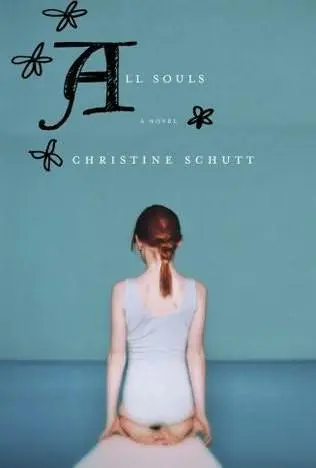
- Название:All Souls
- Автор:
- Издательство:Houghton Mifflin Harcourt
- Жанр:
- Год:2008
- ISBN:нет данных
- Рейтинг книги:3 / 5. Голосов: 1
-
Избранное:Добавить в избранное
- Отзывы:
-
Ваша оценка:
All Souls: краткое содержание, описание и аннотация
Предлагаем к чтению аннотацию, описание, краткое содержание или предисловие (зависит от того, что написал сам автор книги «All Souls»). Если вы не нашли необходимую информацию о книге — напишите в комментариях, мы постараемся отыскать её.
National Book Award Finalist Christine Schutt has created a wickedly original tale of innocence, daring and illness.
All Souls — читать онлайн бесплатно полную книгу (весь текст) целиком
Ниже представлен текст книги, разбитый по страницам. Система сохранения места последней прочитанной страницы, позволяет с удобством читать онлайн бесплатно книгу «All Souls», без необходимости каждый раз заново искать на чём Вы остановились. Поставьте закладку, и сможете в любой момент перейти на страницу, на которой закончили чтение.
Интервал:
Закладка:
Unattached
"Happy in this, she is not yet so old / But she may learn; happier than this, / She is not bred so dull but she can learn." Portia to Bassanio at the English Speaking Union Shakespeare contest, 1995. Anna Mazur had coached her in Miss Hodd's stead. (Poor Miss Hodd had been sick then.) Anna Mazur had coached Astra Dell, and Astra Dell had remembered the speech as well as the sonnet. One of their chief topics of conversation in the hospital had been Shakespeare and what plays Astra Dell knew and liked best. Her favorite was A Midsummer Night's Dream, which wasn't original, Astra knew, but Anna Mazur said, of course, it was a favorite of hers, too.
Favorites. Anna Mazur wanted to be a favorite.
"See what a memory she has!" Anna Mazur said to Tim Weeks.
"I heard," Tim Weeks said, and he saw how small Astra was, shrunk a little, her long sleeves loose over her hands, only fingertips visible. He stood with Miss Mazur and watched as Astra walked down the hall to her next class.
Anna Mazur said, "Her hair, at least it's growing. I almost said 'glowing.'"
Suki and Alex
The prom was in the future, along with a lot of other ceremonies from which someone would walk home with a corsage or a scroll or a secret-society pin. "I'd hoped to be invited," Suki said. Carlotta Forestal, Elizabeth Freer, and Katherine Johnson were the new inductees from the senior class to Cum Laude, the high school equivalent of Phi Beta Kappa; seniors made members in their junior year were Ufia Abiola, Sarah Saperstein, and Ny Song. A cardiologist, Siddons, class of '72, addressed the assembly. The cardiologist, at the beginning of her talk, asked if Siddons seniors still had the tea party with the headmistress in the Conservatory Garden.
No s from the audience.
Suki said to Alex, "So this person I hardly know asks me if I'm on Wellbutrin. I want to know what about me screams I really require heavy-duty anti-depressants." Something the cardiologist said — death? "All year it's been doctors. Astra's still not out of the woods, you know." Suki said, "Get me on Astra's video after this is over. I have something to say."
Siddons
Tea parties with the headmistress. Headmistress, that was a word from years ago.
"Too bad," Miss Hodd said, "it's prettier than head of school."
"You can't have it both ways," Mr. O'Brien said.
"I'm contradictory. I like the white dresses for graduation, too," Miss Hodd said.
"The girls should be in academic robes," Mr. O'Brien said.
"Oh," Miss F joined in, "white dresses."
"Comme une jeune fille," Madame Sagnier said.
Alex and Suki
Suki smoldered at the camcorder, and Alex turned it off. "I thought you had something to say."
"I thought I did, too, but Astra's being back has taken the punch out of this video." She considered. "I'm glad, of course. Did I sound like my mother just then?" Suki's mother said that most of what was true about human nature was ugly, and Suki cited, as an instance, the fact that Marlene Kovack had visited Astra Dell more than any of Astra's real friends. Marlene, who was not in most of Astra's classes, took it on herself to bring Astra's homework to the hospital.
Marlene
At graduation rehearsal the upper-school chorus bludgeoned "For the Beauty of the Earth" with its high notes never reached: "Lord of all, to thee we raise…" But the singing improved with "Jerusalem," and its familiar opening, "And did those feet in ancient time / Walk upon England's mountains green?" Lilies and smokestacks were the hymn's earliest associations for Astra Dell, next came images of Oxford and summer abroad and students in spinnakered capes blown down the High Street. Marlene sat next to Astra Dell in the church and considered Astra's view of the hymn and what Astra was saying about scones and clotted cream and being hungry—"You can't imagine how good it feels," Astra said. To be hungry and here in the church where they would graduate in two days. Astra was graduating. "There won't be a diploma until after I take exams, but then." Astra smiled. A small part of her had learned to keep what hopes she had to herself.
"I understand what you're saying," Marlene said, but she, herself, had changed. That night, with Francesca Fratini and Gillian Warring, when Gillian drank too much and was sick on the curb and Marlene tended to her, that night marked the start of something for Marlene. She began to wear her own accomplishment: a red sweatshirt with a perky badger across her chest. Marlene was going to Mad-town and she felt ready for the multitudes, but, first, she was looking forward to a summer of other nights, just like the one with Francesca and Gillian, nights with friends, confessions, and dramas. Not everyone was working every day. She wasn't! And she didn't start for another week, and the day after tomorrow she would be released, free! One of forty seniors from the class of 1997, Marlene would walk down the aisle of the church wearing a white A-line satin dress — not exactly summery, but a white dress that might serve a couple of occasions was hard to find — and a seed pearl necklace. And her hair? She pinned her hopes on the hairstylist; otherwise, she was wearing a helmet. Astra, Astra Dell was sitting next to her with her feathery scalp against the back of the pew, looking up, and the blue life-stuff at her temples seemed especially complicated and close to the surface.
Be real.
Marlene took out the journal and wrote. Be real. Don't ever become fake like the people that say hello in the elevator. The journal she had started for Astra, a log of lounge events, had long ago turned into something private, though she often wrote in public. She made promises to her self. I hope that years from now you won't look at this journal and skim it like a dream and laugh and read lines out loud to others. Remember it wasn't about the grades… live that way always, it's so much more worth it. Remember the days in the lounge, the music, the classes. Now her heart was caught up in Astra. I hope the girl I love now is not one of those fake people. I hope her magic lasts because of her humanity. I hope I wasn't in love with an idea.
Siddons
Mr. Dell had been at Prize Day every year for the past six years when prizes were first given out to students. Siddons pins and sports letters, all-around everything prizes— It's in the handbook, Grace had said. Year after year, perfect attendance, no school day missed until Grace died. Astra wasn't winning a prize this year, but Mr. Dell had come to the occasion to take Astra and Car out to lunch afterward, and when he saw Mrs. Forestal on the other side of the balcony, he knew Car was winning a prize, and that perhaps Mrs. Forestal might join them for lunch. Nice-enough woman, albeit seemingly bewildered and certainly expensive, she was very attractive in a slightly brittle way. He knew men who went in for that precision. Around him now were parents, some from his daughter's class and the Mortons' party. Dr. and Mrs. Saperstein, Mrs. Abiola. The Decrows! Some girls dared to look up at the balcony while others looked straight ahead at the long table with its pile of books in white paper, red ribbons.
Middle- and upper-school faculty sat in the choir stalls; however, Miss Mazur was late and so was Mr. Weeks. They stood in the back and watched for an hour and forty-five minutes as girls in perfect uniform — white shirt, pleated skirt, knee-highs, dark shoes — walked toward the ministerial center of the church to accept prize after prize, named and unnamed. Car Forestal, the Selfridge Prize, for four years of excellence in English. This came as no surprise, except that Astra Dell would surely have been in the running had she been well and in school all year.
Читать дальшеИнтервал:
Закладка:
Похожие книги на «All Souls»
Представляем Вашему вниманию похожие книги на «All Souls» списком для выбора. Мы отобрали схожую по названию и смыслу литературу в надежде предоставить читателям больше вариантов отыскать новые, интересные, ещё непрочитанные произведения.









Обсуждение, отзывы о книге «All Souls» и просто собственные мнения читателей. Оставьте ваши комментарии, напишите, что Вы думаете о произведении, его смысле или главных героях. Укажите что конкретно понравилось, а что нет, и почему Вы так считаете.