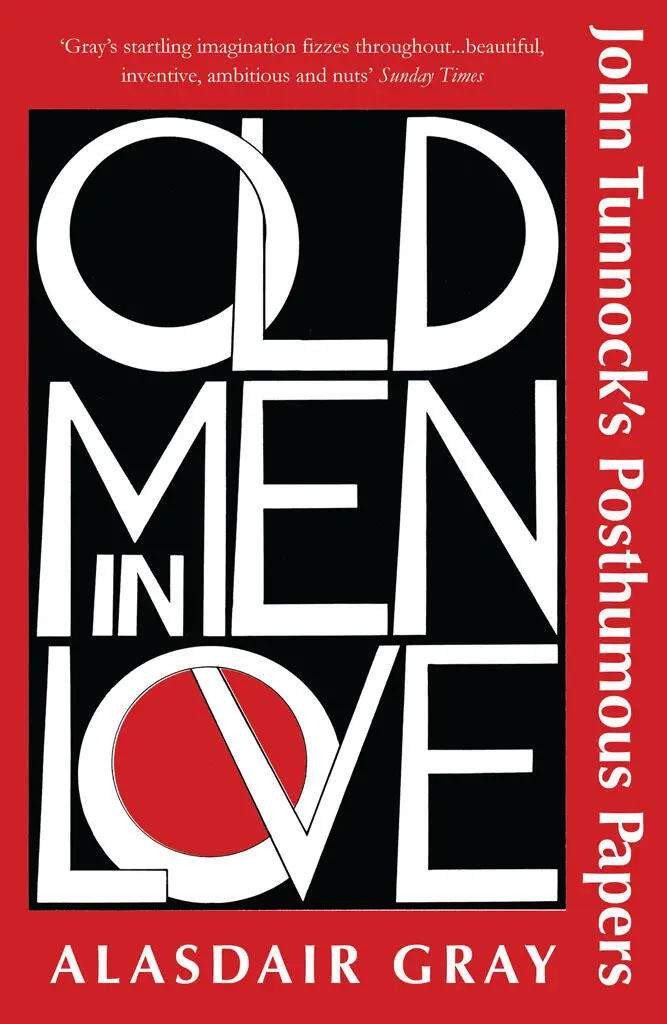
Alasdair Gray - Old Men in Love
Здесь есть возможность читать онлайн «Alasdair Gray - Old Men in Love» весь текст электронной книги совершенно бесплатно (целиком полную версию без сокращений). В некоторых случаях можно слушать аудио, скачать через торрент в формате fb2 и присутствует краткое содержание. Год выпуска: 2009, Издательство: Bloomsbury UK, Жанр: Современная проза, на английском языке. Описание произведения, (предисловие) а так же отзывы посетителей доступны на портале библиотеки ЛибКат.
- Название:Old Men in Love
- Автор:
- Издательство:Bloomsbury UK
- Жанр:
- Год:2009
- ISBN:нет данных
- Рейтинг книги:3 / 5. Голосов: 1
-
Избранное:Добавить в избранное
- Отзывы:
-
Ваша оценка:
Old Men in Love: краткое содержание, описание и аннотация
Предлагаем к чтению аннотацию, описание, краткое содержание или предисловие (зависит от того, что написал сам автор книги «Old Men in Love»). Если вы не нашли необходимую информацию о книге — напишите в комментариях, мы постараемся отыскать её.
"Our nearest contemporary equivalent to Blake, our sweetest-natured screwed-up visionary."-"London Evening Standard"
Alasdair Gray's unique melding of humor and metafiction at once hearken back to Laurence Sterne and sit beside today's literary mash-ups with equal comfort. "Old Men in Love" is smart, down-to-earth, funny, bawdy, politically inspired, dark, multi-layered, and filled with the kind of intertextual play that Gray delights in.
As with Gray's previous novel "Poor Things," several partial narratives are presented together. Here the conceit is that they were all discovered in the papers of the late John Tunnock, a retired Glasgow teacher who started a number of novels in settings as varied as Periclean Athens, Renaissance Florence, Victorian Somerset, and Britain under New Labour.
This is the first US edition (updated with the author's corrections from the UK edition) of a novel that British critics lauded as one of the best of Gray's long career. Beautifully printed in two colors throughout and featuring Gray's trademark strong design, "Old Men in Love" will stand out from everything else on the shelf. Fifty percent is fact and the rest is possible, but it must be read to be believed.
Alasdair Gray is one of Scotland's most well-known and acclaimed artists. He is the author of nine novels, including "Lanark," "1982 Janine," and the Whitbread and Guardian Prize-winning "Poor Things," as well as four collections of stories, two collections of poetry, and three books of nonfiction, including "The Book of Prefaces." He lives in Glasgow, Scotland.
Old Men in Love — читать онлайн бесплатно полную книгу (весь текст) целиком
Ниже представлен текст книги, разбитый по страницам. Система сохранения места последней прочитанной страницы, позволяет с удобством читать онлайн бесплатно книгу «Old Men in Love», без необходимости каждый раз заново искать на чём Вы остановились. Поставьте закладку, и сможете в любой момент перейти на страницу, на которой закончили чтение.
Интервал:
Закладка:
So by taxi to Glasgow Green where not one crowd but many crowds were moving between triumphal arch before High Court, the Clyde to the south and People’s Palace Museum in the east. 22 In many demonstrations weirdly dressed people are noticeable and reported by the press as typical. This multitude had hardly any. Most folk were pleasantly un-uniform and of every age. Young parents pushed toddlers in prams. Two boys of ten or eleven, with no apparent presiding adult, walked carefully side by side to display a single cardboard sandwich board with peace slogans written in fibre-tipped pens. The Eurydice Women’s Socialist Choir sang peace songs. A nice woman held up a sign saying I Trust No Bush But My Own. There was a group with a banner saying, Dumfries Ageing Hippies Against The War, a group of older folk whose banner announced THE TAYSIDE PENSIONERS’ FORUM. — told me Blair is proposing to abolish old age pensions because workers’ contributions are now too small. So New Labour will undo the Liberal Party’s People’s Budget of 1909? I am worse than an ostrich, I am Rip Van Winkle. Many held up printed placards saying Make War on Want, Not Iraq, Not In My Name Mr Blair, No Blood For Oil, and white cut-out polystyrene doves on the ends of little canes, and distributing radical party news sheets against the war and demanding Palestine liberation. Light brown people (who I refuse to call blacks) were over five per cent of the crowd.
There were no visible organizers so we joined the people at their thickest beside Greendyke Street where the march was scheduled to start, edging in until pressure of other bodies made movement impossible. In this cheerful, good-humoured crowd —— seemed to know everyone, pointing to musicians and actors I never heard of, besides the novelists A.L. Kennedy and Bernard MacLaverty, poets Aonghas MacNeacail and Liz Lochhead, the writer Angus Calder who was too far away for me to introduce myself. At last guidance came from the police who stood in a line between the crowd and the street. A small number moved aside and let us gradually through in numbers that started walking ten abreast, filling the width of the street without overlapping pavements on each side. We entered the procession about half a mile behind the leaders, from Greendyke Street marching up the Saltmarket to Glasgow Cross. Occasionally those around us burst into wild cheering inspired by folk waving encouragement from upper tenement and office windows. The stream of the march split neatly in two to pass the gawky clock tower of the Tollbooth, all that remains of Glasgow’s 17 thcentury town hall, magistrates’ court and city jail.
John Prebble’s book about the Glencoe massacre mentions that in 1692 two British Army officers were jailed in the Tollbooth. Before reaching Glencoe village they opened their sealed orders and, finding themselves commanded to put men, women and children to the sword, broke their swords, marched back to Fort William and told their commander that no decent officer should obey such an order. They were sent south by ship for court martial, but Prebble says there is no record of one so they may have been released without punishment. It occurred to me that a great anti-war memorial should be set on that tower commemorating soldiers who had bravely refused to obey wicked orders. Scotland’s city centres, castles, cathedrals, public parks are so full of war memorials to heroically obedient killers that visitors might think warfare had always been Scotland’s main export. Some of the most elaborate put up before 1918 commemorate a few officers and men who died in Africa, Egypt and Asia where they were part of regiments killing thousands of natives fighting on their own soil without the advantage of gunpowder. The company of so many people who wanted peace suddenly filled me with enthusiasm for this anti-war memorial. I thought it could also carry the names of the four British officers who resigned their commissions during the 1991 Bush war on Saddam Hussein’s Iraq — they were protesting against bombing Iraqis who could not fight back against cluster bombs “that minced up everything living within a three-mile airstrip.” I started explaining my great idea and it hardly left my mouth when —— said, “Don’t waste time thinking about it. No local government, no public body in Scotland will ever allow it.” But surely many folk in Scotland and England admire brave refusers and would agree with Berthold Brecht (or was it Heinrich Böll?) who said the worst German vice was obedience. Yet in 1991 I read that British and U.S. airmen enthusiastically queued to airstrike Iraqi ground troops. One bomber said that from above they looked like swarms of cockroaches.
From a helicopter that crossed back and forward above our march must also have looked like cockroaches as we went via Ingram Street to George Square. Our biggest roar went up as the Civic Chambers came in sight. Why were no Glasgow Town Councillors waving encouragement from the windows? Why were none in the procession holding up a banner saying GLASGOW COUNCILLORS AGAINST THE WAR? They could have marched behind the banner of Unison, the local government employees’ trade union. But in that case the Labour Party leaders might not let them stand at the next election, so they would lose their wages. From George Square we saw a silhouette of our procession crossing the summit of Blythswood Hill far far ahead.
I have always been a stranger to group emotions, fearing and disliking even the idea of them, and was surprized by a warm relaxed friendliness spreading through me because I was part of this miles-long peaceful procession of folk I have taught or drunk with in pubs all my life, the Scottish workers, tradespeople and professional folk I feel at home with. This sensation became so strong that it brought tears to my eyes, perhaps because a small brass band not far behind was playing familiar melancholy tunes, The Floo’ers o’ the Forest, The Auld Hoose, The Bonnie Banks of Loch Lomond. I began describing my sensations but —— said, “Yes, all these folk will suffer if our businessmen listen to an expert in Scottish Enterprise, a government body once called The Scottish Development Agency. He is advizing Scottish businesses to have their goods made by workers in eastern Europe or Asia. But crying about it won’t help.” At last we arrived in a desert of car parks covering the site
of the former Princess Dock, a basin surrounded by cranes where giant ships unloaded cargoes when Glasgow was a big international port and centre of manufacture only fifty years ago. The crowds already seemed more of a multitude than they had been on Glasgow Green and confronted a shining white building locally nicknamed The Armadillo, a huge apparently windowless metallic structure whose arched sections seem sliding out of each other. A line of yellow-jacketed policemen was looped protectively around it and I realized The Armadillo is the Scottish Conference Centre where Blair would now be addressing the Scottish Trades Unions. We stood listening to occasional storms of applause from a crowd around an open-topped double-decker bus near the river. That speech was inaudible to those not near the bus because loudspeakers had been banned, so the orator may have been a spokesman for the Church of Scotland, or for Scotland’s Asiatic Communities, or for the C.N.D. or for the Scottish Socialist Party because later I heard all of these made speeches and so (amazingly) did Glasgow’s Labour Lord Provost, a woman. After half an hour we left, moving against the flood of people still coming because the procession was much longer than its three-mile route.
I walked back home alone, needing peace to think about this wholly new experience. It cannot be ignored but how can I use it? Kelvingrove Park was crowded with others who had left the procession so I crossed it feeling safe from Hitler the Second. I called in at Tennants where Mastermind told me Blair had rescheduled his speech, delivering it before 10 o’clock when the procession left Glasgow Green and flying back to England before it arrived, adding, “No doubt when Blair dies the obituaries will praise his moral courage in ignoring the electorate’s opinion.”
Читать дальшеИнтервал:
Закладка:
Похожие книги на «Old Men in Love»
Представляем Вашему вниманию похожие книги на «Old Men in Love» списком для выбора. Мы отобрали схожую по названию и смыслу литературу в надежде предоставить читателям больше вариантов отыскать новые, интересные, ещё непрочитанные произведения.


Обсуждение, отзывы о книге «Old Men in Love» и просто собственные мнения читателей. Оставьте ваши комментарии, напишите, что Вы думаете о произведении, его смысле или главных героях. Укажите что конкретно понравилось, а что нет, и почему Вы так считаете.