Alasdair Gray - Unlikely Stories Mostly
Здесь есть возможность читать онлайн «Alasdair Gray - Unlikely Stories Mostly» весь текст электронной книги совершенно бесплатно (целиком полную версию без сокращений). В некоторых случаях можно слушать аудио, скачать через торрент в формате fb2 и присутствует краткое содержание. Год выпуска: 2003, Издательство: Canongate U.S., Жанр: Современная проза, на английском языке. Описание произведения, (предисловие) а так же отзывы посетителей доступны на портале библиотеки ЛибКат.
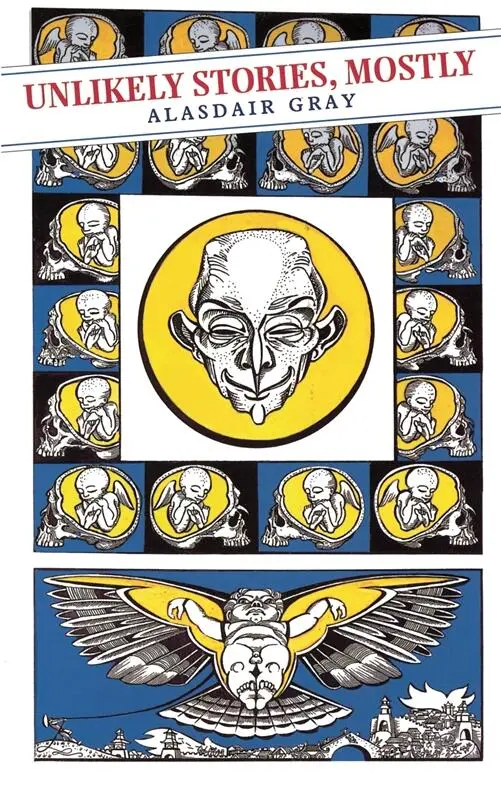
- Название:Unlikely Stories Mostly
- Автор:
- Издательство:Canongate U.S.
- Жанр:
- Год:2003
- ISBN:нет данных
- Рейтинг книги:4 / 5. Голосов: 1
-
Избранное:Добавить в избранное
- Отзывы:
-
Ваша оценка:
Unlikely Stories Mostly: краткое содержание, описание и аннотация
Предлагаем к чтению аннотацию, описание, краткое содержание или предисловие (зависит от того, что написал сам автор книги «Unlikely Stories Mostly»). Если вы не нашли необходимую информацию о книге — напишите в комментариях, мы постараемся отыскать её.
‘This anthology may be likened to a vast architectural folly imblending the idioms of the Greek, Gothic, Oriental, Baroque, Scottish Baronial and Bauhaus schools. Like one who, absently sauntering the streets of Barcelona, suddenly beholds the breathtaking grandeur of Gaudi’s Familia Sagrada, I am compelled to admire a display of power and intricacy whose precise purpose evades me. Is the structure haunted by a truth too exalted and ghostly to dwell in a plainer edifice? Perhaps. I wonder. I doubt.’ Lady Nicola Stewart, Countess of Dunfermline in The Celtic Needlewoman.
Alasdair Gray’s most playful book earned a place in this Classic Series by being in print since first published by Canongate in 1983. This completely amended edition has two new stories; also a postscript by the author and Douglas Gifford.
Unlikely Stories Mostly — читать онлайн бесплатно полную книгу (весь текст) целиком
Ниже представлен текст книги, разбитый по страницам. Система сохранения места последней прочитанной страницы, позволяет с удобством читать онлайн бесплатно книгу «Unlikely Stories Mostly», без необходимости каждый раз заново искать на чём Вы остановились. Поставьте закладку, и сможете в любой момент перейти на страницу, на которой закончили чтение.
Интервал:
Закладка:
or the True Alembick, demonstrating that a quin-cunxial chamber of reflecting plates, mathematically disposed, will enable to be wrought, at no cost, identical solid duplicates of any object laid therein, by the admission to it, at a point a beam of midsummer noonday sun. Unprinted.
7. TΗΕ HEROICK DEEDSANDSAYINGS OF THE GOOD GARGANTUA AND HIS SON PANTAGRUEL
a translation from the French, which, since their lexicons hold but three quarter of the words we can use, will be one third longer than the original, as if Doctor Rabelais had writ in English, with my resour ces. Not begun yet. 8. I recall not what this is Cocks crow, sky pales, I may now sleep a little pethaps.
CONTRA ME
Deeds Minerval:Lacking Scots printers my texts amass till convoyed South.
CONTRA SCOTIAM ARMS
What have we here? A Scotland racked, retching and rampant with intestinal dissent. How may a politic body rampantly menace others while bloodily rending itself? Regard us and know. Four armies prowl this realm prepared to fight 1. For King and Covenant, 2. For King against Covenant, 3. For Covenant against King, 4. Against both Covenant and King. This rebelion, here begun on a point of liturgy by Scottish blatterers of extemporaneous prayer, spread hence to the English who took to it on a matter of taxation and, fighting a two-sided rectilinear war, soon concluded in a clear conquest for the Cromwel parliament last year on Marston Moor. But the Northern Realm, where the Royal Steward was first betrayed, still holds the last loyalists to fight for him victoriously under that lapsed Covenanter the Marquess Montross. This fills me with a confusion of pride and regret. When will our turmoyles cease to involve us in stultifying self dissent? May we only win glory by serving the foreigner? If so our best hope is to be integered into one united Brittish Imperium, by imblending the Scottish Lords and Commons with the English as hath been done with the Welsh equivalent. But should that fail to grant us long prosperity of achievement, then our last hope is an enemy of the sort Cromwel is to the Irish, but less cunning; an enemy so crass, antagonistic and dully ignorant of Scotland’s state that we must needs all confront it together or sink into total penury and nonfunction. ARTS
At home our arts have come under the scourge of an uncontrolled Kirk whose hierarchical jurisdiction is neither monarchical, aristocratical or democratical, but a meer Plutarchy, Plutocracie or rather Plutomanie; so madly do they hale after money and the trash of this world, which I here ensample by but one instance. The great Doctor Liddel, astronomical disciple of Tycho Brahe and professor of the sciences of sensible immaterial objects in Heidelberg, bequeathed fourty pounds English money a year to Aberdeen university for the maintenance of a mathematical professor, with this proviso, that the nearest of his own kinsmen, caeteris paribus should be preferred before any other. The chair falling vacant when the Doctor’s nephew, Master Duncan Liddel, was of sufficient age and skil to exercise that duty, did the good Senators of Aberdeen attend the honest doctor’s will? No, forsooth, the oracle must first be consulted with; ministerian philoplutaries, my tongue forks it, I have mistaken it seems one word for another, I should have said philosophers, decide his uncle’s testament must be made void; for, say they, Master Duncan Liddel hath committed the hainous sin of fornication, he hath got a young lass with childe! Which presbyterian doctrine, had it bin enforced in the daies of Socrates, would have pearched him up on a penitentiary pew for having two wives at once (neither whereof, either Xanthippe or Myrto, was as handsome as Master Liddel’s Concubine) and cast all the later ages of man kind under a cloud of ignorance by quenching the light of Plato, Aristotle and Euclid, who would have betaken themselves to some other profession than philosophy, if the presbytery of Athens had supplyed the academical chair thereof with the bum of a more sanctified brother, whose zealous jobbernolism would have mudded and fowled at its source the world’s first clear fountain of pure learning. Such a sort was that covenanting gentleman who burnt a great many historical and philosophical books thinking they had been books of popery, because of the red letters he saw on their titles and inscriptions. The nation of Scotland hath produced many excellent spirits whose abilities, by the presbyterian’s persecutions, have been quite smothered, and hid as a candle under a bushel; while many excellent books have perished for want of able and skillful printers, the author happening to dy; whereupon the wife and children, to save a little money, make use of his papers, without any regard to the precious things in them, to fold perhaps their butter and cheese into. So unfortunate a thing is it that good spirit should be struck by presbytery into penury and have their writing fall into the hands of ignorants. That poverty is an enemy to the exercise of vertue, is not unknown to anyone acquainted with the sovereign power of money; and if the great men of the land would be pleased to salve that sore, which, possibly would not be expensive to them as either their hawks or hounds, then per-adventure by such gallant incitements, through a vertuous emulation who should most excel other, Scotland would produce, for philosophy, astronomy, natural magick, poesie and other such like faculties, as able men as ever were:
Duns Scotus*
Sacroboscus*
Reginaldus Scottish*
and other compatriots of these three great Scots, whose name I do not insert in the roll of the rest, because they flourished before 1600. Only one Scot; of able intellectual parts, that I ever knew, had his sound mind unmobilated by money, and that through the corruptions of courtiership: Sir William Alexander, afterward Earl of Sterlin, who made an insertion to Sir Philip Sidney’s Arcadia, and composed several tragedies. He was born a poet, and aimed to be a king; therefor would he have his royal title from King James, who was born a king and aimed to be a poet; so Jamie Steward bestows on him the sovereignty of that tract of polar ice and rock recently named Nova Scotia. Had they stopped there, it had been well; but like King Arthur, he must have his knights, though not limited to so small a number. Whosoever wished to be a gentleman and gave King Sterlin one hundred and fifty Sterling pounds, could at once flaunt the orange riban to testify he was Knight Baronet. The King nevertheless, not to stain his royal dignity by awarding honour to meer wealth, also gave them land for their money at six pence an acre, which could not be thought very dear, considering how pretilly in the respective legal parchments of disposition they were described as fruitful corne land, watered with pleasant rivers running alongst most excellent and spacious meadows; and if they lacked an abundance of oaken groves in the midst of very fertil plains, it was the scrivener or writer’s fault; for his majestie ordered that, on the receipt of three thousand Scots marks, there should be no deficiency in quantity or quality, in measure or goodness of land, with here and there most delicious gardens and orchards and whatever else would be content their fancies, as if they were purchasing ground in the Elysian Fieldes, or Ma-humet’s Paradise. And if the clerk writing the charter, on receipt of some small coin to himself, slipped in a thousand more acres than was agreed at first, he cared not. At last, when some two or three hundred Knights had among them purchased several million Neo-Caledonian acres, confirmed to them and their for ever under the great seal (the affixing thereof cost each of them but thirty pence more) finding that the company was not like to become more numerous, he bethought of a course more profitable for himself, and, without the advice of his Knights (who represented both his houses of parliament, clergy and all) like an absolute King indeed disponed heritably to the French both the dominion and property of the whole continent of that kingdom of Nova Scotia for a matter of five or six thousand pounds English.
Читать дальшеИнтервал:
Закладка:
Похожие книги на «Unlikely Stories Mostly»
Представляем Вашему вниманию похожие книги на «Unlikely Stories Mostly» списком для выбора. Мы отобрали схожую по названию и смыслу литературу в надежде предоставить читателям больше вариантов отыскать новые, интересные, ещё непрочитанные произведения.



Обсуждение, отзывы о книге «Unlikely Stories Mostly» и просто собственные мнения читателей. Оставьте ваши комментарии, напишите, что Вы думаете о произведении, его смысле или главных героях. Укажите что конкретно понравилось, а что нет, и почему Вы так считаете.