Laila Lalami - Secret Son
Здесь есть возможность читать онлайн «Laila Lalami - Secret Son» весь текст электронной книги совершенно бесплатно (целиком полную версию без сокращений). В некоторых случаях можно слушать аудио, скачать через торрент в формате fb2 и присутствует краткое содержание. Год выпуска: 2010, Издательство: Algonquin Books, Жанр: Современная проза, на английском языке. Описание произведения, (предисловие) а так же отзывы посетителей доступны на портале библиотеки ЛибКат.
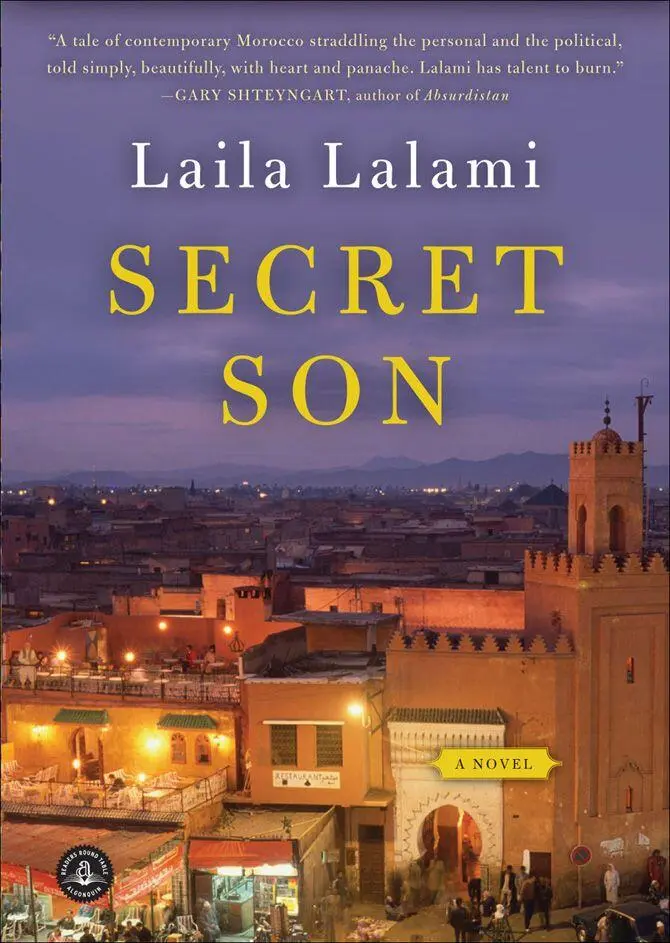
- Название:Secret Son
- Автор:
- Издательство:Algonquin Books
- Жанр:
- Год:2010
- ISBN:нет данных
- Рейтинг книги:5 / 5. Голосов: 1
-
Избранное:Добавить в избранное
- Отзывы:
-
Ваша оценка:
Secret Son: краткое содержание, описание и аннотация
Предлагаем к чтению аннотацию, описание, краткое содержание или предисловие (зависит от того, что написал сам автор книги «Secret Son»). Если вы не нашли необходимую информацию о книге — напишите в комментариях, мы постараемся отыскать её.
In the spirit of
and
, Laila Lalami’s debut novel looks at the struggle for identity, the need for love and family, and the desperation that grips ordinary lives in a world divided by class, politics, and religion.
Secret Son — читать онлайн бесплатно полную книгу (весь текст) целиком
Ниже представлен текст книги, разбитый по страницам. Система сохранения места последней прочитанной страницы, позволяет с удобством читать онлайн бесплатно книгу «Secret Son», без необходимости каждый раз заново искать на чём Вы остановились. Поставьте закладку, и сможете в любой момент перейти на страницу, на которой закончили чтение.
Интервал:
Закладка:
“I never noticed the tourist guides.”
“I guess there wouldn’t be any, in a small village.”
In Youssef’s village, there were no tourist guides, perhaps, but there were plenty of peddlers and smugglers, hustlers and hawkers, brokers and fixers, vendors and dealers, beggars and drifters — all the people who, in the end, made up the other, the greater half of the country. And when he thought of them, something stirred inside him, compelling him to answer. “What’s their crime, anyway?” he asked. He took a sip of his soda, trying to sound as confident as his father had. “The government has outlawed so many things; soon they’ll outlaw making a living.”
Benaboud looked up. “Good line,” he said, carefully writing it down.
“Don’t mind my cousin’s nephew,” Nabil said, returning to his seat. “You know what they say: if you’re not an idealist at twenty, you have no heart, and if you’re an idealist at thirty, you have no brains.”
Youssef was the first to laugh, because he knew it would please his father, and he always delighted in seeing his father’s pleasure. The conversation quickly turned to where it was supposed to lead: an article or a column that would shift the discussion of the government’s latest marketing campaign to a debate over tax breaks and incentives for hotel owners. They continued talking late into the evening, eventually moving away from business matters to personal. “And how old is your daughter now? Ayah, is it?” Nabil asked.
“Ayah, yes. She’s eleven. About to go into the sixth grade.”
“At Lycée Lyautey, I take it.”
“No, we couldn’t get her in. They put us on the waiting list.”
“I know the director. I can talk to him.”
“Really? We were told that we would not make it in this year because there were too many people ahead of us already.”
“Of course you can make it,” Nabil said, with the confidence of a man to whom rules did not apply. “I’ll talk to him. It’s nothing at all. You can’t take chances with your daughter’s education.”
It was already late by the time Farid Benaboud got up to leave, and he seemed to have forgotten Youssef’s name when he tried to shake his hand. Nabil reminded him, “Youssef, my cousin’s nephew.” So went the lie. They became good at it, both of them, Nabil doing the introductions most of the time, but Youssef chipping in when someone asked him who he was, with the exact role that his father had picked for him.

Youssef no longer avoided the doorman, the maid, or the cleaning lady. He began to exchange bonjours and smiles with his neighbors. He spent his days at the university, though his interest in his studies began to wane, his father’s remarks on public schools having turned him into a skeptic.
He was returning home one night when he saw one of his neighbors, the Filali son, from the eighth floor, go into the café across the street. Hoping to strike up a conversation, Youssef followed him.
Filali was seated at a table near the window, talking on his mobile phone. In what seemed like a nervous tic, he was repeatedly tucking a strand of hair behind his ear. Youssef took a seat at the next table; a waiter in a tight black shirt brought him a menu. Twenty different varieties of tea, and none looked good. He ordered an espresso and a slice of chocolate cake. He had been eating so many sweet things lately that his father had warned him against cavities, but he could not resist. He had put on two kilos; his mother said the extra weight suited him.
Filali was talking about getting his laptop fixed, complaining about the service at the computer repair shop. If only he would get off the phone, Youssef could start a conversation. He ate slowly, keeping watch on Filali out of the corner of his eye. When Filali hung up, Youssef turned to him: “Try taking it to the repair shop on Boulevard Zerktouni.”
“Pardon?” Filali said.
“I overheard you talking about your problems with your laptop. I took mine to the repair shop on Zerktouni, and they were able to fix it in two days.”
“Oh, really? Thanks.”
“I’m Youssef. I think we live in the same building, across the street.”
“Ziyad,” Filali said, offering his hand. “Thanks for the tip.” He texted something on his mobile phone, his thumb working quickly over the keypad, then turned to look at the door.
“You go to school around here?” Youssef asked.
But Filali did not answer. He smiled at a pretty girl who had just walked in. “Sorry I’m late,” she said, and sat down across from him, leaning over to kiss him on the cheeks. Youssef looked around the café, at the patrons absorbed in their own conversations. There was nothing to do but go home.
In June he sat for his second-year exams, which he barely passed. Still, he received a gift of five thousand dirhams from his father. Most of the money was spent on designer clothes, patent leather shoes, belts that came in felt bags, a mobile phone everyone coveted. He spent his summer days at the movies: when he saw everything at the Megarama, he went to the Dawliz, and when he had seen the shows there, he went to the Eden Club. He crisscrossed the city looking for films, and the ushers got used to his arrival, with his soda and his bars of chocolate.
And there were the girls — ah, the girls! How much easier it was to get their attention now. The first one he had met at a café, a brunette with heavy eyeliner and too-dark lipstick. He had taken her to a movie, and when he had opened his wallet to pay for the tickets, she had grinned like a child in front of a candy display. Later she nodded quickly when he asked if she wanted to have a drink in his apartment. And it was true what his friends said: if a girl goes home with you, she will sleep with you. He had barely tried to kiss her when she reached for his belt. They ended up on his bed, and when the moment came, he used one of the condoms he had taken from his father’s drawer. She would be the first of many, the combination of his looks and his new money working like magic.
And yet at night, when he lay down in the dark, in the terrible silence of that empty apartment, he thought of his mother, alone in her little house in Hay An Najat. She would be watching TV, knitting a sweater or folding laundry or shelling sunflower seeds or mending a sock or peeling the skins off boiled chickpeas — she could never stay still. Although he saw her every week at the hospital, he missed her presence at home, the sound of her breathing across the bedroom at night. He thought of Maati, strutting around the neighborhood, in his un-Islamic tank top, showing off his biceps. He thought of Amin, too. By this time of year, the three of them would have started going to the beach, playing volleyball, and smoking hashish whenever they could get any; they would buy bowlfuls of snails in spicy sauce from a vendor by the side of the road, or go home for plates of fried sardines. He wondered whether they were still doing all these things without him. And then his thoughts would circle back to his father. Youssef was ashamed to see he was more like a mistress than a son: he spent hours waiting for a man to show up and was happy only when they were together. What was becoming of him?
August came, and with it an unaccountable sense of gloom. At the Tahiti Beach Club, where he spent idle moments, Youssef could not see the seagulls in the blue sky or hear the breaking of the ocean’s waves without reflecting on the rootlessness of his new life. He usually sat alone at one of the tables, but even when he was with a girl, or with one of the young people who haunted the place, he never felt that he was one of the regulars. Most of the time, he was reduced to being an unwilling eavesdropper. He heard three socialites discuss vaginal reconstruction (“A cosmetic surgeon in Rabat is the person you should go to — I’ll give you his number”); two recently returned NYU students say how much they had missed home (“For me, Morocco is like the Shire in Tolkien’s novels — it’s so beautiful and quaint”); a professional cadre complain about his boss (“She has a degree from here and she thinks she knows better than I–I who went to Ponts et Chaussées”).
Читать дальшеИнтервал:
Закладка:
Похожие книги на «Secret Son»
Представляем Вашему вниманию похожие книги на «Secret Son» списком для выбора. Мы отобрали схожую по названию и смыслу литературу в надежде предоставить читателям больше вариантов отыскать новые, интересные, ещё непрочитанные произведения.











Обсуждение, отзывы о книге «Secret Son» и просто собственные мнения читателей. Оставьте ваши комментарии, напишите, что Вы думаете о произведении, его смысле или главных героях. Укажите что конкретно понравилось, а что нет, и почему Вы так считаете.