Norman Lock - American Meteor
Здесь есть возможность читать онлайн «Norman Lock - American Meteor» весь текст электронной книги совершенно бесплатно (целиком полную версию без сокращений). В некоторых случаях можно слушать аудио, скачать через торрент в формате fb2 и присутствует краткое содержание. Год выпуска: 2015, Издательство: Bellevue Literary Press, Жанр: Современная проза, на английском языке. Описание произведения, (предисловие) а так же отзывы посетителей доступны на портале библиотеки ЛибКат.
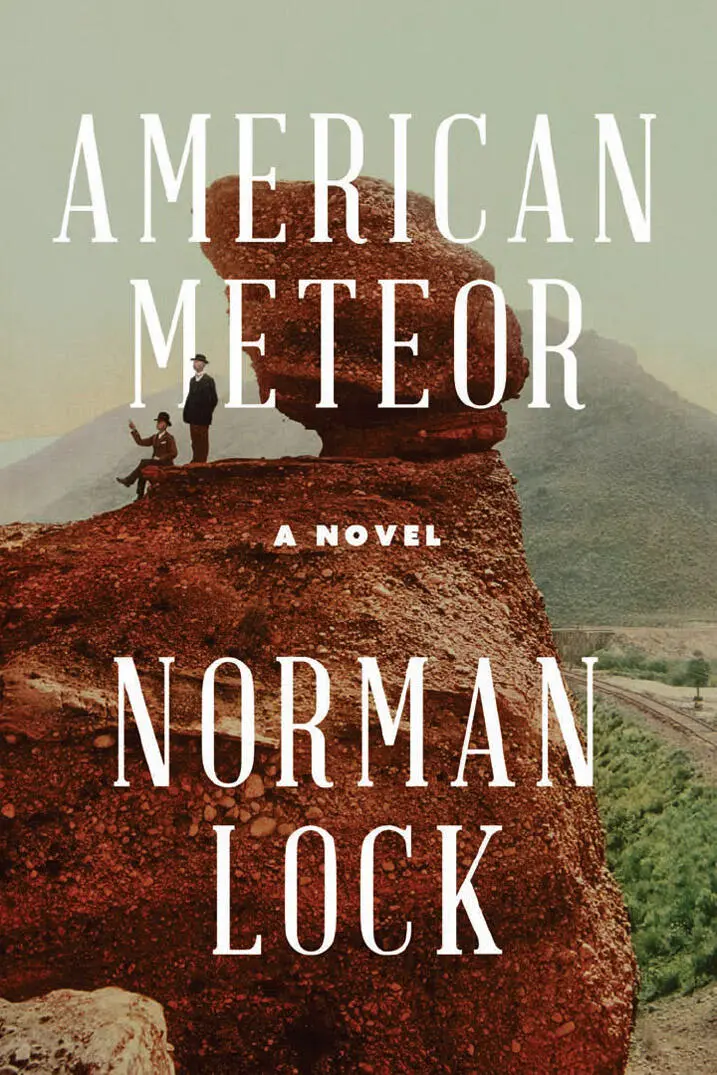
- Название:American Meteor
- Автор:
- Издательство:Bellevue Literary Press
- Жанр:
- Год:2015
- ISBN:нет данных
- Рейтинг книги:5 / 5. Голосов: 1
-
Избранное:Добавить в избранное
- Отзывы:
-
Ваша оценка:
American Meteor: краткое содержание, описание и аннотация
Предлагаем к чтению аннотацию, описание, краткое содержание или предисловие (зависит от того, что написал сам автор книги «American Meteor»). Если вы не нашли необходимую информацию о книге — напишите в комментариях, мы постараемся отыскать её.
By turns elegiac and comic,
is a novel of adventure, ideas, and mourning: a unique vision of America’s fabulous and murderous history.
American Meteor — читать онлайн бесплатно полную книгу (весь текст) целиком
Ниже представлен текст книги, разбитый по страницам. Система сохранения места последней прочитанной страницы, позволяет с удобством читать онлайн бесплатно книгу «American Meteor», без необходимости каждый раз заново искать на чём Вы остановились. Поставьте закладку, и сможете в любой момент перейти на страницу, на которой закончили чтение.
Интервал:
Закладка:
On the tenth of May, in 1869, the final track was laid and the last spikes hammered home — one gold, one silver, one an alloy of gold, silver, and iron — to celebrate the “wedding of the rails”: the meeting of the Union Pacific and the Central Pacific railroads, nearly a mile above sea level, at Promontory Summit, north of the Great Salt Lake. There’s nary a Chinaman to be seen in A. J. Russell’s famous photograph, although the final ten-mile stretch of track had been laid by a special crew of cone-hatted, blue-jacketed coolies, famous for their speed. Soon a person could travel by train from the Missouri River to Sacramento and onward by paddleboat to San Francisco Bay. If, as Durant once told me, the transcontinental railroad would be a great artery transecting America’s continental empire, then the tainted blood of the East could flow, unobstructed, into the healthy body of the West, carrying religion and civilization the way conquistadores brought God and syphilis to the Indians and the Mexicans. The natives, buffalo, riches, and gods of the Old West would drown in blood. On that May day, the West began its long, slow dying.
Cheats of every stripe would flood the Great Plains and California’s trackless groves with Bibles, patent medicines, whiskey, writs, moral tracts, and guns. As if the Almighty had raised the eastern seaboard from its basalt bed and tilted it, con men, cutthroats, grifters, quacks, swindlers, schemers, politicians, speculators, prospectors, profiteers, gamblers, fortune hunters, lawyers, counterfeiters, and killers tumbled west. A sour view of things, I grant you; but one borne out by the history of our age and of the age to come, when Trinity — not the Christians’, but Oppenheimer’s— will turn Alamogordo sand to glass. In the future, dead cities will molder behind rusting thorns no prince can ever penetrate; dirty bombs will engender tribes of lepers — not by germs, but by deadly atoms; and radioactive isotopes will be left to cool for an age or more, sealed in burial chambers with a pharaoh’s curse. Instead of a photographer, I should have been a prophet, howling in a wilderness of death. I seem to know the future: It came to me in dreams. Terrible ones! Pictures, words — not exactly those, but what you might see and hear if you had eyes like an owl’s and ears like a bat’s. I seem to be cognizant of what’s to come, Jay, without clearly understanding it. I’m like a man with his eyes closed, running his fingers over braille.
Also, on that tenth of May, I sent my medal back to Grant, now president of the United States, with a note in which I confessed the lie that had won it: “Inasmuch as I lost my eye to my own panic and carelessness, I am undeserving of the honor you bestowed on me with your own hands. Respectfully yours, Sergeant Stephen Moran, retired.” I struck out “Sergeant” and wrote “Private” in its place — the only rank to which I felt myself entitled. Grant sent the medal back to me, with a brief note of his own:
THE WHITE HOUSE WASHINGTON CITY
June 14, 1869
Dear Sergeant Moran,
If we were treated as we deserve, we’d all be in the hoosegow.
Sincerely,
U. S. Grant, President
I’d like to tell you that the occasion celebrated in the Utah high country sobered me; that it chastened me of pettiness and deceit. I’d like to think that I came to my senses in the clear air at the summit, with its austere view of distant mountains rising from an empty plateau. There is nothing like the West to solemnize a person’s mood, to burn away the meanness. I would like to believe I returned my medal for some exalted reason. But looking back, I don’t know why I did it. I can’t say that I really know why I did anything in those days. We come to know ourselves, if we ever do at all, too late.
PART TWO. Custer
I am the man, I suffered, I was there.
— Walt Whitman, Song of MyselfPromontory Summit, Utah Territory, May 10, 1869
While the locomotives panted for the steamy consummation of the wedding of the rails, I was looking for the true bridegrooms: the Chinese who had laid the final tracks. I had no interest in capturing the official flummery. I’d leave that to Hart, Savage, and Russell to fix expertly on their glass-plate negatives for eastern newspapers, souvenir postcards, and stereopticons. I don’t know why I wanted to take the Chinamen’s picture, but I suspect it had to do with Chen. On that long-gone May afternoon in Utah, I had no idea that the coolies were being feted out of sight by Jim Strowbridge in his private car. For all I knew, they might have been pitched off Promontory Summit, buried alive in one of their own excavations, or crated up for shipment to the land of their ancestors. Strowbridge was foreman for the Central Pacific, which had dug and dynamited its way from Sacramento, through the Sierra Nevada, to meet the Union Pacific near Ogden. Ever since finding out about his little soirée, I’ve been suspicious of the railroad’s motives in whisking the Chinese crew down the line and away from the festivities.
I took a few pictures for Durant, who was my patron, of sorts. I wasn’t much good yet as a photographer, and he could get all he needed from the famous cameramen in attendance. Still, I thought I’d better show him something for the railroad’s money: a little legerdemain of light and shadow. The camera and darkroom setup were expensive, and “What the Lord giveth, He taketh away.” If you’re not sufficiently appreciative. I didn’t want Durant to take back my camera. Photography had enthralled me since the day Kari and I got our portrait made at the hundredth meridian. I had what you might call an instinct for it. Edward Jackson said later that I had the makings of a first-class photographer. So I made several exposures of the two locomotives, cowcatchers kissing; of the dignitaries, chests puffed out; and of the Irish, squatting by the rails. They’d as much right to the honor as I did to my medal. Only one of the pictures turned out passably well: It showed the Union Pacific’s locomotive engineer reaching toward the Central Pacific’s man, holding a bottle of champagne. (You’ve probably seen Russell’s version.)
In spite of the rough crowd packed into the picture, beneath the engineers’ outstretched hands — one clutching a bottle, the other about to receive it — the photograph made me think of God in a tangle of angels, touching Adam’s finger with His, although both of those gents were staunch teetotalers and probably Methodists. I’d seen an engraving of Michelangelo’s famous fresco hanging in Stanton’s office. It looked as out of place as a nosebleed on a wedding dress. Unless Stanton pictured himself the Lord of Hosts, adjuring shirkers with His galvanic finger. Or maybe we were meant to see Abe Lincoln in that graven image, about to give “old Mars” a vivifying jolt. War and electricity do seem to be connected by a mystic chord. Whitman wrote in Leaves : “I sing the Body electric,/ The armies of those I love engirth me and I engirth them. ”
Durant had bought me the photographic equipment in answer to my proposition. I doubt he did it to further my education or to show his appreciation for my years of servility. No, he was not that sort of man. He did nothing in his life without a mental calculation determining the advantage to himself. Durant bought me my camera because it pleased him to think of himself doing it. I knew in advance just what terms of endearment I would use to express my gratitude. Four years in service as a steward taught me the protocols by which men meet men as something other than equals. But first, I’d have to pass an unholy night with him.
The Black Hills, Wyoming Territory, August 1868
Читать дальшеИнтервал:
Закладка:
Похожие книги на «American Meteor»
Представляем Вашему вниманию похожие книги на «American Meteor» списком для выбора. Мы отобрали схожую по названию и смыслу литературу в надежде предоставить читателям больше вариантов отыскать новые, интересные, ещё непрочитанные произведения.



Обсуждение, отзывы о книге «American Meteor» и просто собственные мнения читателей. Оставьте ваши комментарии, напишите, что Вы думаете о произведении, его смысле или главных героях. Укажите что конкретно понравилось, а что нет, и почему Вы так считаете.