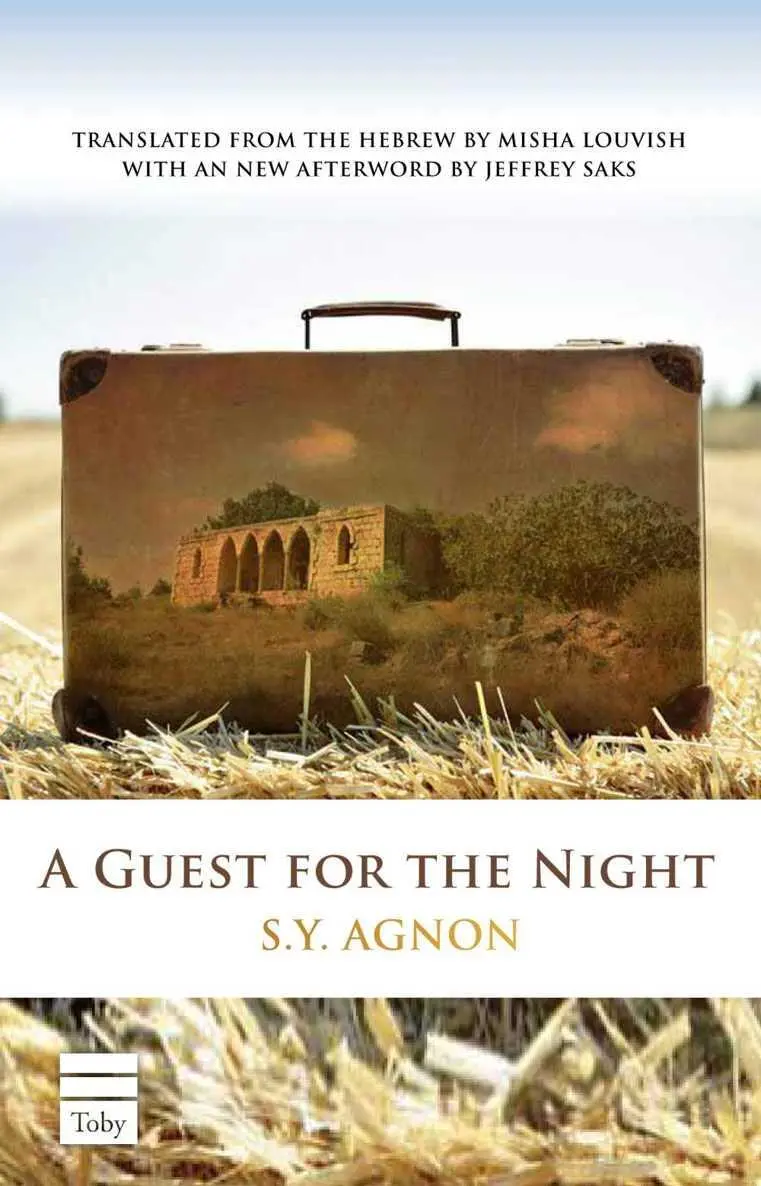
S. Agnon - A Guest for the NIght
Здесь есть возможность читать онлайн «S. Agnon - A Guest for the NIght» весь текст электронной книги совершенно бесплатно (целиком полную версию без сокращений). В некоторых случаях можно слушать аудио, скачать через торрент в формате fb2 и присутствует краткое содержание. Год выпуска: 2014, Издательство: The Toby Press, Жанр: Современная проза, на английском языке. Описание произведения, (предисловие) а так же отзывы посетителей доступны на портале библиотеки ЛибКат.
- Название:A Guest for the NIght
- Автор:
- Издательство:The Toby Press
- Жанр:
- Год:2014
- ISBN:нет данных
- Рейтинг книги:5 / 5. Голосов: 1
-
Избранное:Добавить в избранное
- Отзывы:
-
Ваша оценка:
A Guest for the NIght: краткое содержание, описание и аннотация
Предлагаем к чтению аннотацию, описание, краткое содержание или предисловие (зависит от того, что написал сам автор книги «A Guest for the NIght»). Если вы не нашли необходимую информацию о книге — напишите в комментариях, мы постараемся отыскать её.
depicts Jewish life in Eastern Europe after World War I. A man journeys from Israel to his hometown in Europe, saddened to find so many friends taken by war, pogrom, or disease. In this vanishing world of traditional values, he confronts the loss of faith and trust of a younger generation. This 1939 novel reveals Agnon’s vision of his people’s past, tragic present, and hope for the future.
Cited by National Yiddish Book Center as one of "The Greatest Works of Modern Jewish Literature".
A Guest for the NIght — читать онлайн бесплатно полную книгу (весь текст) целиком
Ниже представлен текст книги, разбитый по страницам. Система сохранения места последней прочитанной страницы, позволяет с удобством читать онлайн бесплатно книгу «A Guest for the NIght», без необходимости каждый раз заново искать на чём Вы остановились. Поставьте закладку, и сможете в любой момент перейти на страницу, на которой закончили чтение.
Интервал:
Закладка:
After cutting the bread he sings, “All who sanctify the Sabbath day.” His voice chokes; it is not a voice but a kind of echo, like the sound that comes from wet wood as it burns. But the enthusiasm pent up in his heart makes a chant for itself, a kind of melody that stops short before it can sound out. His face is sad and his shoulders quiver, and sometimes he gropes with his hand under the table like a man seeking support. Meanwhile his wife sits opposite with her hands on her bosom, looking at him sometimes with affection and sometimes with concern. And when he reaches the verse “Their righteousness shall shine forth like the light of the seven days,” she rises and brings him his soup, and at the same time Krolka comes in and brings the wife her soup. Then Krolka goes back to the kitchen and brings me my vegetable soup. “When I sit like this with my husband on Sabbath eves,” says the innkeeper’s wife to me, “with our table set and the white cloth spread on the table and candles burning, I say to myself in wonder: Considering all the troubles that have come upon us — for my husband was in the war and was in danger of death at any moment — I really should not have had strength to endure, and not only have I endured all the troubles, but I have the happiness of welcoming the Sabbath in peace.”
As for her sons and daughters, Mrs. Zommer says that whenever her husband, who was far away from his children all through the war and did not have the worry of them, sees them doing something wrong, he is angry at once. But she, who had the worry of them all the time and saw them growing up, does not pick upon them for every little trifle. On the contrary, she thanks God that they have come as far as they have. Didn’t they run about in the streets of Vienna for a long time like nobody’s children, refusing to accept authority? And when they did accept her authority she was not free to look after them, because all day she was busy working, never stopping except to bring the work to her customers, get her pay, and buy food. Sometimes she would stand all night until morning at the door of a shop, waiting for the shopkeeper to open up and give her her ration. When she was fortunate enough to get it, she would prepare a meal for herself and her children, and they would eat together and be happy, and obey her and stay at home with her. If she was not fortunate enough to get her ration, the children would defy her and go out to the coffeehouses to beg for their food, and she did not have the heart to keep them at home when their stomachs were empty.
And how was it that she came back with nothing, when she had money and food tickets? Because the bullies would push her aside and take their ration first, so that when her turn came the shopkeeper would close his store and say, “There’s nothing left.” In those days men had lost their feelings; everyone robbed and stole in order to eat. Once she stood all night in front of the shop and returned in the morning empty-handed. She got into a streetcar and wept, because there was no food left in the house and nothing for her children to eat. An old Gentile saw her and asked, “Why are you so sad, madam?” She answered him that her husband had gone to the war, leaving her all by herself with four children to support; that she made bags and knapsacks for the soldiers, and yesterday she had stopped work to fetch food; she had stood all night in front of the shop, but when her turn came to buy a man snatched away the ration card and took her share. The old man sighed at the wickedness of men and said to her kindly, “Don’t be so sad, madam; if he snatched the card he did not snatch the money.” “What is the use of the money if it does not buy food?” she replied. “Well said, madam,” said he, filling his pipe, “What is the use of money? When children are hungry, we cannot say to them, ‘You are hungry, sit down and chew the money.’” As she was about to leave, he whispered to her, “Come with me, come with me to my house; maybe I can give you a sack of potatoes for your money.” So she went with him until they reached the outskirts of the town and got on a streetcar in which they traveled until it stopped. Then they got out and walked for as far as they walked and reached the place that they reached. All the time the Gentile spoke to her kindly and said such pleasant things as she had never heard from anyone in Vienna. While they were talking he sang the praises of his potatoes. They were good and heavy, he said, not like the potatoes they sold in the market, which were light as feathers. When they reached his house he asked her, “How much money do you have?” She told him. He filled his pipe, puffed a while, and said, “I’m afraid you don’t have the strength to carry all I will give you for your money.” “Don’t be afraid, sir,” said she. “God will give me strength for the sake of my children, so that they should not go hungry.” “Blessings on your head,” said he, “for not turning your mind away from our God in heaven. For that I will give you a piece of cheese as a gift.” So she gave him all her money and wanted to take the sack. But the Gentile said to his servant or his son, “Take the sack and carry it to the streetcar, and don’t move away before you get it on the streetcar.” So the man took the sack and went with her, while the old man and his wife parted from her very affectionately and said, “Go in peace, madam, and think kindly of us.” She was sorry she had given all her money for the potatoes and left herself with only enough to pay the fare, so that she had nothing to give the fellow who had taken so much trouble for her. “Never mind,” said he, “never mind,” and he said farewell, wishing her pleasure in the food. After some time she reached home tired and weary, because she had stood outside all night and because the sack was heavy. But her joy gave her strength, and she rallied. She assembled her children and said to them, “Just wait a little while, children, and I will cook you some potatoes, and while they are cooking I will give you a piece of cheese!” The children fell upon the sack and opened it with loud cries of joy. When they opened it they found a block of plaster, and under the plaster clods of earth.
My host sat as usual and said nothing. Ever since I have known him he has not uttered a single superfluous word; he does not mention the days of the war, although he was in the army from the beginning to the end. Like him, most of the people in the town who have survived the war never mention it — though their wives recall those days on every possible occasion.
I have already remarked that the innkeeper’s sons and daughters do not eat at the hour of the meal. This does not mean that they make a point of not coming in for the Sabbath eve meal with their parents; sometimes they come and sometimes not. In any case, they do not come together, nor do they come to hear the Kiddush; they usually arrive in the middle of the meal and sit down to eat as on any other day.
Babtchi comes in from wherever she comes, throws down her hat and her bag, wriggles out of her coat, pats her hair with her left hand, takes a chair, sits down, and snatches up her food. Sometimes her father raises his eyes to look at her, though more than looking at her he gazes at her things, which she has scattered here and there. Then he closes his eyes again and fingers his prayer book in silence, or goes back to singing the Sabbath hymns. When Rachel comes, he shifts his chair and asks, “Where have you been for the Kiddush? Did you hear it or didn’t you? Why don’t you answer me?” Whether she replies or not, it is not good. One way or other, he gives her a scolding; then he puts his hand on his prayer book with the hole in it, waits a bit, and sings his hymns.
If Dolik or Lolik comes, their father raises his eyes and looks to see whether their heads are covered. On weekdays he does not care if they sit bareheaded, but at the Sabbath meal he is strict. Once Dolik forgot and did not cover his head, and his father scolded him. “Are you still selling hats,” said Dolik, “that you keep trying to fit me with one?” His father rose, took the young man’s hat, put his two bent thumbs inside it, and pushed it down angrily on his son’s head, until Dolik howled “Ouch!”
Читать дальшеИнтервал:
Закладка:
Похожие книги на «A Guest for the NIght»
Представляем Вашему вниманию похожие книги на «A Guest for the NIght» списком для выбора. Мы отобрали схожую по названию и смыслу литературу в надежде предоставить читателям больше вариантов отыскать новые, интересные, ещё непрочитанные произведения.












Обсуждение, отзывы о книге «A Guest for the NIght» и просто собственные мнения читателей. Оставьте ваши комментарии, напишите, что Вы думаете о произведении, его смысле или главных героях. Укажите что конкретно понравилось, а что нет, и почему Вы так считаете.