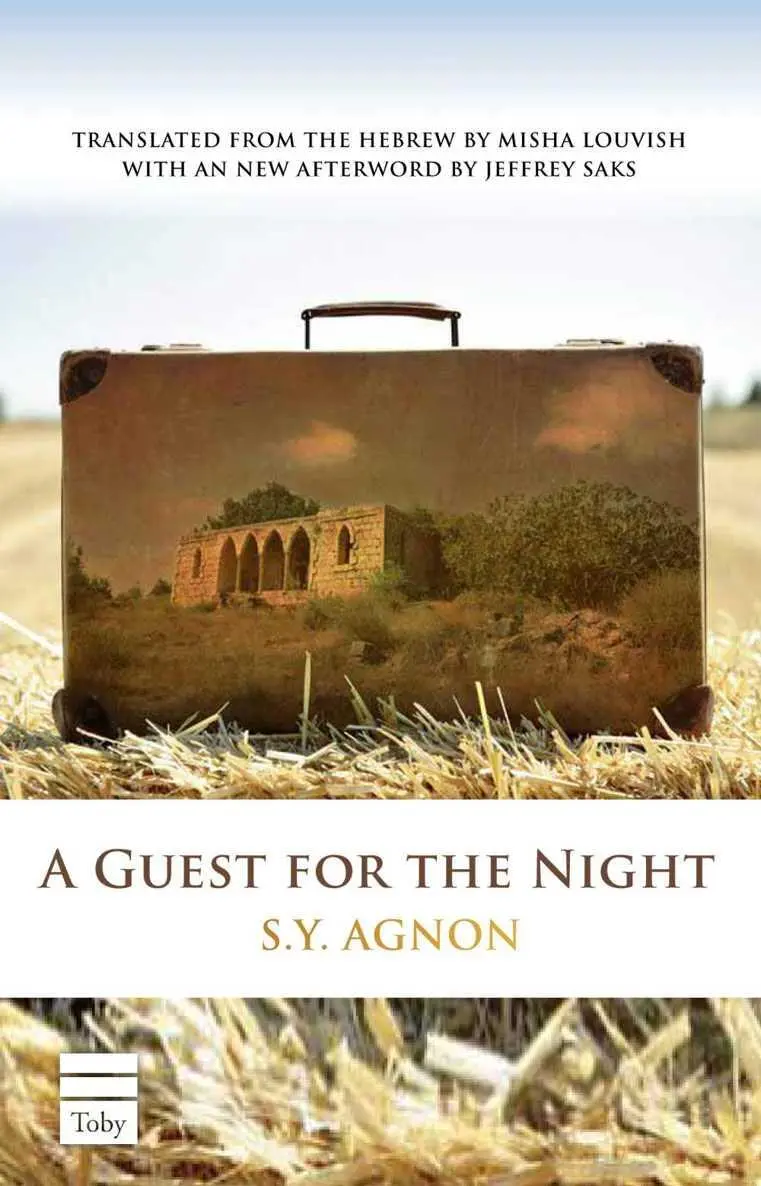
S. Agnon - A Guest for the NIght
Здесь есть возможность читать онлайн «S. Agnon - A Guest for the NIght» весь текст электронной книги совершенно бесплатно (целиком полную версию без сокращений). В некоторых случаях можно слушать аудио, скачать через торрент в формате fb2 и присутствует краткое содержание. Год выпуска: 2014, Издательство: The Toby Press, Жанр: Современная проза, на английском языке. Описание произведения, (предисловие) а так же отзывы посетителей доступны на портале библиотеки ЛибКат.
- Название:A Guest for the NIght
- Автор:
- Издательство:The Toby Press
- Жанр:
- Год:2014
- ISBN:нет данных
- Рейтинг книги:5 / 5. Голосов: 1
-
Избранное:Добавить в избранное
- Отзывы:
-
Ваша оценка:
A Guest for the NIght: краткое содержание, описание и аннотация
Предлагаем к чтению аннотацию, описание, краткое содержание или предисловие (зависит от того, что написал сам автор книги «A Guest for the NIght»). Если вы не нашли необходимую информацию о книге — напишите в комментариях, мы постараемся отыскать её.
depicts Jewish life in Eastern Europe after World War I. A man journeys from Israel to his hometown in Europe, saddened to find so many friends taken by war, pogrom, or disease. In this vanishing world of traditional values, he confronts the loss of faith and trust of a younger generation. This 1939 novel reveals Agnon’s vision of his people’s past, tragic present, and hope for the future.
Cited by National Yiddish Book Center as one of "The Greatest Works of Modern Jewish Literature".
A Guest for the NIght — читать онлайн бесплатно полную книгу (весь текст) целиком
Ниже представлен текст книги, разбитый по страницам. Система сохранения места последней прочитанной страницы, позволяет с удобством читать онлайн бесплатно книгу «A Guest for the NIght», без необходимости каждый раз заново искать на чём Вы остановились. Поставьте закладку, и сможете в любой момент перейти на страницу, на которой закончили чтение.
Интервал:
Закладка:
Letters have arrived from our brethren who left Szibucz — every word drenched in tears and every letter crying “Woe!” After they left Szibucz they wandered for days on the roads and went from one place to the next, until their money was exhausted and they had to beg alms from the sons of men, who are sparing with alms but generous with abuse. At last they got on a ship and went out to sea, and the sea threatened to drown them, for this ship was rickety and unfit for the voyage; some believe that the owner intended to sink it, so as to take the insurance money and get himself a new one. (I have heard that articles written about this ship did not mention that it was full of Jews.) When the travelers escaped from the sea to dry land, the land devoured them. Every place to which they made their way cast them out as soon as they arrived. When prominent Jews made representation on their behalf to the nobles and masters of the city, they would be left alone for a day or two, and finally be sent to another city; there the same thing happened. All countries became Gehenna for them, but in Gehenna the wicked are punished on weekdays and rest on Sabbath, while these never had any rest; the wicked are taken out of Gehenna when someone gives charity in memory of their souls, but these suffered soul-destroying torments and were thrust deeper into Gehenna. Grievous were the tribulations of the war, but in the war there were enemies and friends; now the whole world has become their enemy. In the war the Emperor supplied your necessities; now the kings condemn us to hunger.
Freide the Kaiserin comes to me with a letter from her son. All those who had read out the letter to her were hard men, and they had read it in a tone of admonition, piercing her flesh, as it were, with red-hot needles. But I, says Freide, have a good heart and a gentle voice — she still remembers how I used to call her “Feidi”—I would not be cruel to her; I would read to her her son’s letter gently, not like those who read it to provoke her.
I cannot remember all of the letter — only a few lines, and they went like this: “Not even the threat of death itself could force good tidings from me — there is only bad news to tell, for God and men have robbed me of rest and made me forget that I am a man. But alas that I am a man, for no one in the land will have mercy on me, and a dog is happier than I, for people have pity on dogs — but me they drive away. I came to a city and said: Here I shall dwell; from the fruit of my labor I shall eat bread, whether little or much, and also send something to you, my bereaved and unfortunate mother. But they came and drove me away and said: Go. So I went to another city, and there too I found no rest. For hardly had I set foot on its soil when they cried out against me and lowered my honor to the dust and said: Be off with you — go! Thus it shall be done to a man who wants to eat a crust of bread, for from his womb his Maker made a jest of him and a derision; though he has not sinned against his God, except in worshipping Him. To what shall I compare myself, to what shall I liken myself, my forlorn mother? For I have become like the mud of the streets, which every passer-by wipes off his boots. The sun shines on me as on them, and the stars of evening twinkle, but, alas, the star of my fortune is darkened and the sun brings no healing to a man lost and unfortunate. Woe is me, Mother, that you bore me, a prey to human beasts.”
Let us leave our sorely tried brethren and hope that the Almighty will have pity on them and deliver them from trouble to tranquillity and from darkness into light, and may we receive good tidings, for the greater the evil the greater the hope. And now let us speak in praise of the Sabbath, which has been given us.
I am not one of those all of whose days are Sabbath; I say that ever since the world was created we have never had a day of rest. After the servitude in Egypt we served the golden calf and became servants to all the kings of East and West. Now we are weary of toil, and what is wrong with our seeking a day that is all Sabbath and rest?
That first Sabbath in our old Beit Midrash went like this. My hostess donated two coverings for the tables, and I bought a third for the table at which I study. I spread the cloths on the three tables and lit the two lamps and the candles, and all the people of the Beit Midrash came to pray. Between ourselves, they all came in weekday clothes, because they have no clothes for the Sabbath. But you could see a change in them. This is the change that takes place on the eve of Sabbath at dark, for man was born on Sabbath eve so that he should enter the Sabbath pure. Had he not sinned, all his days would have been Sabbath. So when the Sabbath arrives the soul remembers that first Sabbath in the Garden of Eden and changes for the better.
One of our friends, Shlomo Shamir, chanted the Welcome to the Sabbath with the melody that is customary among us. And when he pronounced the blessing “Who spreadest over us the tabernacle of peace,” it seemed as if the Holy One, blessed be He, Himself, in person, were spreading over us His tabernacle of peace. But this peace was still that of a tabernacle, which is a temporary dwelling, but when he said, “And the children of Israel shall keep the Sabbath,” it seemed as if we had entered into a permanent dwelling, in which was everlasting peace. And I do not exaggerate when I say that we could see with our own eyes the Holy One, blessed be He, making a covenant of peace with Israel for all eternity.
That Shlomo Shamir who led the prayers, an upholsterer by trade, knows how to read the Torah and lead the prayers. By virtue of his praying he once won a medal for valor. How? Once some Jewish soldiers were holding a service on the Days of Awe, and Shlomo led the prayers. The commander of his regiment passed by and heard him praying. “Corporal Shamir is a brave man,” he said to his companions, and told them to give him a medal for valor.
After the service the worshippers wished each other a peaceful and pleasant Sabbath and went home quietly. I too went to my home, namely my hotel, for I live in the Land of Israel and my home is many hundreds of miles from here, and I am only a guest for the night.
I have already described my weekday table at the beginning of the book, so surely it is fitting that I tell of the Sabbath table.
On Sabbath eves, only the three of us sit together: my host, his wife, and I, because his sons and daughters come in for the meal whenever they feel like it, and they do not feel like coming just at the moment when their father is reciting the Kiddush and singing the Sabbath hymns. When there is a guest, if he is an observer of the Sabbath he eats with us and we can pronounce together the Invitation to the Grace, which is said when three observant Jews are present; if he is not, Krolka sets him at a table by himself. On weekdays everyone is the innkeeper’s master, but on Sabbath he is his own master. On weekdays, when a man’s livelihood is measured out to him, he must look after his livelihood and humble himself before those on whom he depends; on Sabbath, when the Holy One, blessed be He, Himself covers the cost of the Sabbath, a man is free from the servitude of business and the yoke of others.
The hotelkeeper is not in the habit of going to synagogue on Sabbath eve, for he finds it difficult to walk because of his rheumatism; his own synagogue is far from his home and he does not go to another synagogue nearby because he does not wish to change from one holy place to another. He welcomes the Sabbath at home and waits for me before beginning the meal.
When I come in he puts his little prayer book in front of him and recites the Kiddush, his glass in his hand and the prayer book open. He is over fifty years old: for thirty years, no doubt, he has said the Kiddush on Sabbath eves, and every year has its fifty Sabbaths, so go and reckon how many times he has recited it; but still he has to hold his prayer book open during the Kiddush. First, because his heart is troubled and he is afraid he might make a mistake; and second, because a miracle happened to him through his prayer book and he was saved from death. During the war a bullet was fired at him while his prayer book was over his heart; the bullet struck the prayer book and pierced the pages until it came to the page of the Kiddush for Sabbath eve.
Читать дальшеИнтервал:
Закладка:
Похожие книги на «A Guest for the NIght»
Представляем Вашему вниманию похожие книги на «A Guest for the NIght» списком для выбора. Мы отобрали схожую по названию и смыслу литературу в надежде предоставить читателям больше вариантов отыскать новые, интересные, ещё непрочитанные произведения.












Обсуждение, отзывы о книге «A Guest for the NIght» и просто собственные мнения читателей. Оставьте ваши комментарии, напишите, что Вы думаете о произведении, его смысле или главных героях. Укажите что конкретно понравилось, а что нет, и почему Вы так считаете.