Philipp Meyer - The Son
Здесь есть возможность читать онлайн «Philipp Meyer - The Son» весь текст электронной книги совершенно бесплатно (целиком полную версию без сокращений). В некоторых случаях можно слушать аудио, скачать через торрент в формате fb2 и присутствует краткое содержание. Год выпуска: 2013, Издательство: Ecco, Жанр: Современная проза, на английском языке. Описание произведения, (предисловие) а так же отзывы посетителей доступны на портале библиотеки ЛибКат.
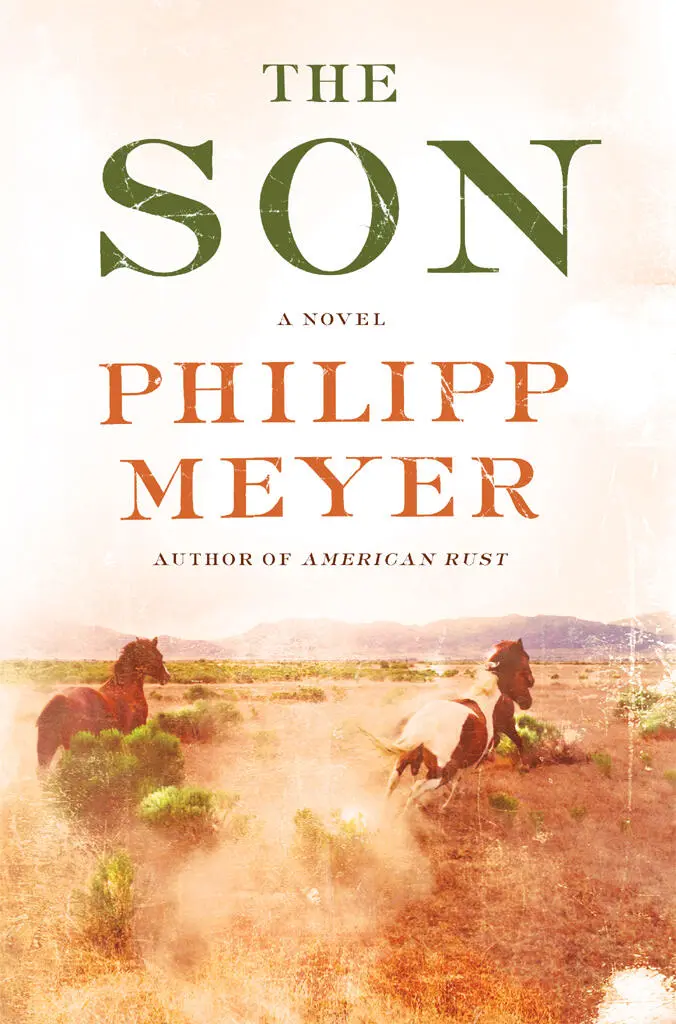
- Название:The Son
- Автор:
- Издательство:Ecco
- Жанр:
- Год:2013
- ISBN:нет данных
- Рейтинг книги:3 / 5. Голосов: 1
-
Избранное:Добавить в избранное
- Отзывы:
-
Ваша оценка:
The Son: краткое содержание, описание и аннотация
Предлагаем к чтению аннотацию, описание, краткое содержание или предисловие (зависит от того, что написал сам автор книги «The Son»). Если вы не нашли необходимую информацию о книге — напишите в комментариях, мы постараемся отыскать её.
Part epic of Texas, part classic coming-of-age story, part unflinching portrait of the bloody price of power, The Son is an utterly transporting novel that maps the legacy of violence in the American West through the lives of the McCulloughs, an ambitious family as resilient and dangerous as the land they claim.
Spring, 1849. The first male child born in the newly established Republic of Texas, Eli McCullough is thirteen years old when a marauding band of Comanche storm his homestead and brutally murder his mother and sister, taking him captive. Brave and clever, Eli quickly adapts to Comanche life, learning their ways and language, answering to a new name, carving a place as the chief's adopted son, and waging war against their enemies, including white men-complicating his sense of loyalty and understanding of who he is. But when disease, starvation, and overwhelming numbers of armed Americans decimate the tribe, Eli finds himself alone. Neither white nor Indian, civilized or fully wild, he must carve a place for himself in a world in which he does not fully belong-a journey of adventure, tragedy, hardship, grit, and luck that reverberates in the lives of his progeny.
Intertwined with Eli's story are those of his son, Peter, a man who bears the emotional cost of his father's drive for power, and JA, Eli's great-granddaughter, a woman who must fight hardened rivals to succeed in a man's world.
Phillipp Meyer deftly explores how Eli's ruthlessness and steely pragmatism transform subsequent generations of McCulloughs. Love, honor, children are sacrificed in the name of ambition, as the family becomes one of the richest powers in Texas, a ranching-and-oil dynasty of unsurpassed wealth and privilege. Yet, like all empires, the McCoulloughs must eventually face the consequences of their choices.
Harrowing, panoramic, and vividly drawn, The Son is a masterful achievement from a sublime young talent.
The Son — читать онлайн бесплатно полную книгу (весь текст) целиком
Ниже представлен текст книги, разбитый по страницам. Система сохранения места последней прочитанной страницы, позволяет с удобством читать онлайн бесплатно книгу «The Son», без необходимости каждый раз заново искать на чём Вы остановились. Поставьте закладку, и сможете в любой момент перейти на страницу, на которой закончили чтение.
Интервал:
Закладка:
If several hours (which feel like weeks) pass in which I have not seen her, I’ll pick up a few worthless papers and stroll around the house as if on an errand, and, if the door to the library is open, I will go and pretend to find some book or pamphlet, for instance, The Record of Registered Brands (1867)— or something equally useless — but of course María does not know better. She thinks I am being diligent, and we’ll speak for half an hour, and then she’ll apologize for interfering with my work and take her things and go elsewhere, while meanwhile all my blood, or whatever vital force that is in me, sinks down into the earth.
Today I was in the kitchen, eating a plum, and she walked in and asked what I was doing and without answering, I impulsively offered her the plum, from which I had already taken two bites, and without hesitation she took it and had a dainty bite, looking at me the entire time. Then she abruptly left. I put the plum to my mouth and held it there until common sense forced me to eat the rest of it.
I cannot imagine making love to her. It seems disrespectful somehow. Every evening she plays the piano; I have moved the divan into the parlor (it properly belongs there, I lied to her) so that I can close my eyes and feel how close she is. She seems to think this a proper time for us to keep company, as she never tries to escape. Cannot stop reliving the moment in the library (her hand on mine), I curse myself for not responding, for not returning her touch or even leaning against her — this is likely the reason she has not done it again. Or perhaps she was simply being sympathetic, and the world I have invented for us exists only in my own mind. Just the thought leaves me hollowed out.
JULY 6, 1917
My father’s deadline for María to leave has come and gone. Was beginning to feel better until he found me this morning.
“Pete, I am going to Wichita Falls. I will be back in one week, at which point the Garcia woman will have made her absquatulation. I have always let you do whatever you want, but this…” He looked around my office, as if the right words might be found among my books. “… this is not adjunctive to the forwarding of the design.”
“What are you doing in Wichita Falls?” I said.
“Don’t worry your head over it.”
“There is nothing she can do to us.”
“This has gone on long enough. There is one person on earth who cannot be here and you have brought her into this house.”
“You are not going to change my mind,” I said.
“Every day I see you now you’re out on a dike. You think I don’t notice that for ten years you don’t bother to wash and now you’re wearing collars?”
I didn’t say anything.
“This ain’t a grass widow you get to tap free, son. This one will cost us the ranch.”
“You may leave now,” I said.
He didn’t move.
“Get out of my office.”
LATER I COME across María in the library. I am pretending to look for a book, when she says, apropos of nothing: “How is your work going?”
“I’m not really working,” I say.
She smiles, then gets serious again.
“Consuela tells me things.”
“Whatever she is telling you, I won’t let it happen.”
“Peter.” She shrugs and looks out the window, past the trees. I look at the skin along her neck, her collarbones, the edge of one shoulder, I look at her arms, still thin. “… I shouldn’t be here anyway. This is the last place I should be, in fact.”
“I’ll take care of my father.”
“That’s not what I mean.”
“Where else do you have?”
She shrugs and it is quiet and I watch her face changing. After a moment she decides something. “Do you have time to sit? If you are not really working?”
She is on her chair facing the window. I go to the couch.
“Don’t worry about my father,” I say.
She stands up and comes over and sits next to me. She touches my wrist.
“Sooner or later, I’ll have to leave. Days or weeks, it doesn’t matter.”
“It does to me.”
She touches my cheek. We are so close and I wait for something to happen, but it doesn’t. When I open my eyes she is still looking at me. I lean forward, then stop myself; she is still looking at me, and I kiss her, just barely. Then I lean back. I am seeing spots.
She puts her fingers through my hair.
“You have good hair,” she says. “And yet your father is bald. And he is short, and you are tall.”
I can feel her breath.
“You will forget me,” she says.
“I won’t.”
I wait for something to happen. We’re leaning against each other. I work myself up and turn to kiss her again, but she only gives her cheek.
“I want to,” she says. But then she stands up and walks out of the room.
Chapter Thirty-seven. Eli McCullough, 1852
Afew weeks later Judge Wilbarger’s wife and I were lying naked on her couch, in my mind to spite the judge, in her mind because she was high on laudanum and being naked on the couch was a comfortable place to be. She had sent the Negroes to Austin on errands. She had the sort of face you saw in old books; it was pale and very delicate and I guessed that at one point she’d been the kind of woman that men would have killed to be with. And I guessed that she knew this, and knew it was not true anymore.
“How old are you, really?”
“Nineteen,” I said.
“I don’t care, you know. I just want to know more about you.”
“Seventeen,” I said.
She looked at me.
“Sixteen.”
“Will the number keep going down?”
“No, it’s sixteen.”
“I’ll take that. It’s the perfect age.”
“Is it?”
“For you it is.”
She was quiet. I wondered how it was that a woman like her would ever end up with a man like the judge. I wondered if she had loved him. Then I was thinking about the Comanches.
“Are you mad at me?”
“No,” I said. Then I said, “Why don’t you go back?”
“To England? I’m very respectable here.” She laughed. “No, of course I’m not. But what would I do there?”
“Better than Bastrop, probably.”
“Probably.”
I was looking at her smooth belly and wondering if she’d ever had children, but something told me not to ask, so instead I said, “I don’t understand why you won’t go back. Even I don’t like this place.”
“It’s complicated,” she said. “I can’t explain it.”
IN THE MEANTIME, being in town so much, I began to see the same kid over and over until I was sure he was following me. I knew his name was Tom Whipple; he was thirteen or fourteen, but barely five feet tall and lazy eyed to boot. Finally I caught him waiting for me around the judge’s house, which I took for a bad sign. I followed him home and waylaid him in the woods behind his house.
Though I had him on the ground, for some reason he didn’t look afraid. “You’re the wild Indian,” he said.
“I am.”
“Well, the Indians killed my father. I guess now you’ll kill me, too.”
“You have been following me,” I said.
“They say you go around stealing horses from people.”
“I borrow them.”
“They say you kill people’s chickens and hogs.”
“I quit doing that weeks ago.”
“They say that someone is going to shoot you.”
I snorted. “Well, I would like to see them try it. I could whip every one of these alfalfa desperados.”
“My daddy was a Ranger,” he said.
I’d been in town long enough to know this wasn’t true; his father had been a surveyor, and the whole party had been killed by Comanches. Or so it was told. Most people couldn’t tell an Apache from a Comanche from a white man dressed in buckskin.
Читать дальшеИнтервал:
Закладка:
Похожие книги на «The Son»
Представляем Вашему вниманию похожие книги на «The Son» списком для выбора. Мы отобрали схожую по названию и смыслу литературу в надежде предоставить читателям больше вариантов отыскать новые, интересные, ещё непрочитанные произведения.



Обсуждение, отзывы о книге «The Son» и просто собственные мнения читателей. Оставьте ваши комментарии, напишите, что Вы думаете о произведении, его смысле или главных героях. Укажите что конкретно понравилось, а что нет, и почему Вы так считаете.