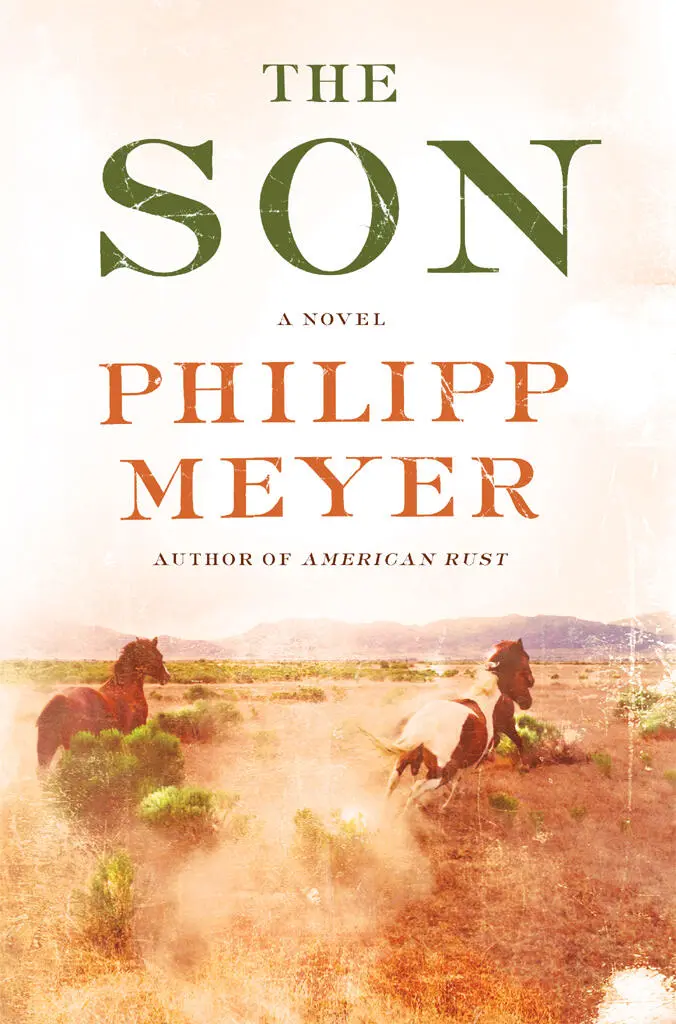
Philipp Meyer - The Son
Здесь есть возможность читать онлайн «Philipp Meyer - The Son» весь текст электронной книги совершенно бесплатно (целиком полную версию без сокращений). В некоторых случаях можно слушать аудио, скачать через торрент в формате fb2 и присутствует краткое содержание. Год выпуска: 2013, Издательство: Ecco, Жанр: Современная проза, на английском языке. Описание произведения, (предисловие) а так же отзывы посетителей доступны на портале библиотеки ЛибКат.
- Название:The Son
- Автор:
- Издательство:Ecco
- Жанр:
- Год:2013
- ISBN:нет данных
- Рейтинг книги:3 / 5. Голосов: 1
-
Избранное:Добавить в избранное
- Отзывы:
-
Ваша оценка:
The Son: краткое содержание, описание и аннотация
Предлагаем к чтению аннотацию, описание, краткое содержание или предисловие (зависит от того, что написал сам автор книги «The Son»). Если вы не нашли необходимую информацию о книге — напишите в комментариях, мы постараемся отыскать её.
Part epic of Texas, part classic coming-of-age story, part unflinching portrait of the bloody price of power, The Son is an utterly transporting novel that maps the legacy of violence in the American West through the lives of the McCulloughs, an ambitious family as resilient and dangerous as the land they claim.
Spring, 1849. The first male child born in the newly established Republic of Texas, Eli McCullough is thirteen years old when a marauding band of Comanche storm his homestead and brutally murder his mother and sister, taking him captive. Brave and clever, Eli quickly adapts to Comanche life, learning their ways and language, answering to a new name, carving a place as the chief's adopted son, and waging war against their enemies, including white men-complicating his sense of loyalty and understanding of who he is. But when disease, starvation, and overwhelming numbers of armed Americans decimate the tribe, Eli finds himself alone. Neither white nor Indian, civilized or fully wild, he must carve a place for himself in a world in which he does not fully belong-a journey of adventure, tragedy, hardship, grit, and luck that reverberates in the lives of his progeny.
Intertwined with Eli's story are those of his son, Peter, a man who bears the emotional cost of his father's drive for power, and JA, Eli's great-granddaughter, a woman who must fight hardened rivals to succeed in a man's world.
Phillipp Meyer deftly explores how Eli's ruthlessness and steely pragmatism transform subsequent generations of McCulloughs. Love, honor, children are sacrificed in the name of ambition, as the family becomes one of the richest powers in Texas, a ranching-and-oil dynasty of unsurpassed wealth and privilege. Yet, like all empires, the McCoulloughs must eventually face the consequences of their choices.
Harrowing, panoramic, and vividly drawn, The Son is a masterful achievement from a sublime young talent.
The Son — читать онлайн бесплатно полную книгу (весь текст) целиком
Ниже представлен текст книги, разбитый по страницам. Система сохранения места последней прочитанной страницы, позволяет с удобством читать онлайн бесплатно книгу «The Son», без необходимости каждый раз заново искать на чём Вы остановились. Поставьте закладку, и сможете в любой момент перейти на страницу, на которой закончили чтение.
Интервал:
Закладка:
Prairie Flower was one of the first to get sick. She hadn’t touched the dead man, but I had. I hoped it was just a fever, but then her mouth felt strange, there was a kind of roughness around her lips, which I tried to smooth away.
A FEW WEEKS into the epidemic, a pair of young Comanches in their best war paint rode up to the camp calling out that the raiding party, including Escuté and N uukaru, had won a great victory, many scalps and horses, not a single man lost.
The messengers stopped at the edge of the village and Toshaway, who had the first of the red marks on his face, limped out to meet them, carrying his bow and quiver.
“The band is sick,” he said. “You have to go somewhere else.”
The messengers protested; they didn’t want to be denied their victory, and finally Toshaway told them he would shoot anyone who came into the camp, including his own sons, as it would be a more merciful death than the tasía .
Later that day the raiders appeared. They rode to within a few hundred yards of the camp and the people who were still able came out to wave their good-byes. Toshaway stood leaning on his bow. Two riders broke from the group and everyone squinted to see who they were. It was N uukaru and Escuté. They came within fifty paces and then Toshaway nocked an arrow and fired it into the ground in front of them.
“We’ll wait for you in the Yamparikas’ territory,” said Escuté.
“We will not see you there,” said Toshaway. “But I will see you in the happy hunting grounds.”
Another young tek uniwap u came forward.
“I have stated my mind,” said Toshaway. “I will kill any man who comes into this village.”
“Where is Gets Fat?” said the young man.
“She’s sick,” said someone.
He continued to ride forward.
Toshaway shot an arrow past his head.
“You can kill me if you want, Toshaway, but either way I am going to die in this camp with my wife.”
Toshaway thought about it. Then he aimed his bow at the other raiders.
“The rest of you will leave now,” he said.
A few of the other tek uniwap u, not sure what they ought to do, not wanting to look like cowards, began to ride forward, but Escuté and N uukaru held them back. Even the very sick had come out from their tipis; they gathered at the edge of the camp and began to call out to the young men, first telling them to stay back and then telling them things they wanted them to know, family news, old secrets, things they should have said a long time ago, things that had happened since the raiders had gone.
Finally, after all the messages had been shouted across the distance, the riders kicked their horses and began to ululate and the entire band, for the last time, called back with their own war whoops, until they filled the air, and the riders shook their bows and lances, and turned their horses, and disappeared across the prairie.
BY THE FOURTH week the boils covered Prairie Flower’s entire face — there was nothing left I could recognize, she had become the sickness itself. Each morning our pallet would be soaked from her breaking sores; but finally the boils began to shrink and scab and it seemed she would heal.
“I am not going to be beautiful anymore,” she said. She was crying.
“You’ll still be beautiful,” I told her.
“I don’t want to live if my face is ruined.”
“You’ll heal,” I said. “Don’t pick.”
That night her fever broke and she began to breathe easily. I watched her for a long time. When the sun woke me up my arm was numb — all her weight was on it — and when I tried to wake her she wouldn’t move.
IT WAS A clear warm day but only a few people were about. Toshaway was lying in his hammock, eyes closed, face to the light. The bumps on his skin were just starting to swell.
“Do I look bad?” he said.
“I’ve seen worse.”
“Yes. And soon I will look worse.” He spat. “Tiehteti. What an absurd way to die.”
“The strong always survive.”
“Is this known among the whites?”
“Yes.”
“You are lying.”
“Maybe not,” I said.
“Now it’s only maybe.” He closed his eyes again. “It’s not dignified.”
I wasn’t sure if he was talking about my lie or the sickness.
“When I was younger,” he said, “the son of our paraibo became very sick. He had always been small but he was growing thinner every day, and no matter what medicine was made, he did not get better. Finally the paraibo asked if I might do him a favor. He made a purification ritual, washed and dressed his son for battle, gave him his own shield, the chief’s shield, and then we all went to a mountain, and my friend and I did battle with the chief’s son, just the three of us alone, and we killed him. And in that way, we took a pointless death and made it into a brave death.”
“I’m not going to kill you.”
“You could not anyway,” he said. He grinned. “At least not yet.”
“But someday.” I didn’t mean it, but I knew it was what he wanted to hear.
“Come over here, if you don’t mind touching me.”
I sat on the ground.
“You smell,” he said.
“Prairie Flower just died.”
“Ah, Tiehteti.” He took my hand. “I am so sorry. And meanwhile you have been letting me talk.” He began to cry. “I am so sorry, my poor son. I am so sorry, Tiehteti.”
AFTER I BURIED Prairie Flower I began to go to the other tipis. There was a surplus of the dead. Pizon died that afternoon and I helped his son bury him. A week later I buried his wife and two weeks later I buried his son. Entire families passed in the same night and now I went tipi to tipi, tying the flaps shut if I had buried everyone. I buried Red Bird, Fat Wolf, Hates Work — whose dead face I kissed, imagining the scabs were not there — Lazy Feet and two of his slaves, Hard to Find, Two Bears Walking, Always Visiting Someone, Hisoo-ancho and his three children, whose names I never learned, Sun Eagle, Big Fall by Tripping. Black Dog, Little Mountain and her husband. Lost Again, who died in the arms of Big Bear, who was not her husband. I buried Hukiyani and In the Woods. Humaruu and Red Elk. Piitsuboa, White Elm, Ketumsa. The other names I didn’t know, or had forgotten.
I SLEPT IN my own tipi but spent my days with Toshaway. He and his two wives were all sick, the three of them on one pallet. There was a good supply of firewood and it was warm.
“Come over here, Tiehteti,” said Sit utsi.
I did. I sat with my back against their pallet, and my feet near the fire, and she stroked my hair. I began to close my eyes. Watsiwannu was asleep, closer to the end than the others. Toshaway was murmuring. I couldn’t tell if he knew I was there. But a little while later, he said: “Tiehteti, the next band you go to, if this happens to them, I want you to ride to the whites and tell the army where their camp is, and tell them to bring the mountain howitzers. Do you understand?”
“Yes.”
“That is an order,” he said. “From your war chief.”
I nodded.
“Will you go back to the whites now?” said Sit utsi.
“Of course not.”
“Do the whites get this disease?”
“Yes, but they make medicine on people who do not have it, and it keeps them from becoming infected.”
“This was done to you?” said Toshaway.
“When I was a child.”
“So what do you think of the Comanche medicine?” he said. Then he began to laugh. Then Sit utsi began to laugh as well.
“You will lead our people to a good place,” she said.
“Do not let him get ahead of himself,” said Toshaway. “First he must dig.” He lifted his head to look at me. “That is your only job. You must dig.”
Читать дальшеИнтервал:
Закладка:
Похожие книги на «The Son»
Представляем Вашему вниманию похожие книги на «The Son» списком для выбора. Мы отобрали схожую по названию и смыслу литературу в надежде предоставить читателям больше вариантов отыскать новые, интересные, ещё непрочитанные произведения.




Обсуждение, отзывы о книге «The Son» и просто собственные мнения читателей. Оставьте ваши комментарии, напишите, что Вы думаете о произведении, его смысле или главных героях. Укажите что конкретно понравилось, а что нет, и почему Вы так считаете.