Jack O'Connell - The Skin Palace
Здесь есть возможность читать онлайн «Jack O'Connell - The Skin Palace» весь текст электронной книги совершенно бесплатно (целиком полную версию без сокращений). В некоторых случаях можно слушать аудио, скачать через торрент в формате fb2 и присутствует краткое содержание. Год выпуска: 2011, Издательство: MysteriousPress.com/Open Road, Жанр: Современная проза, Триллер, на английском языке. Описание произведения, (предисловие) а так же отзывы посетителей доступны на портале библиотеки ЛибКат.
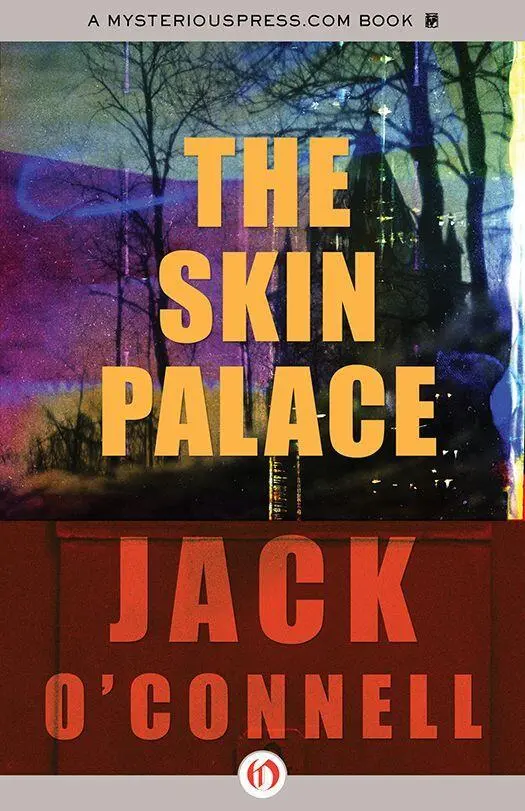
- Название:The Skin Palace
- Автор:
- Издательство:MysteriousPress.com/Open Road
- Жанр:
- Год:2011
- ISBN:нет данных
- Рейтинг книги:3 / 5. Голосов: 1
-
Избранное:Добавить в избранное
- Отзывы:
-
Ваша оценка:
The Skin Palace: краткое содержание, описание и аннотация
Предлагаем к чтению аннотацию, описание, краткое содержание или предисловие (зависит от того, что написал сам автор книги «The Skin Palace»). Если вы не нашли необходимую информацию о книге — напишите в комментариях, мы постараемся отыскать её.
The Skin Palace — читать онлайн бесплатно полную книгу (весь текст) целиком
Ниже представлен текст книги, разбитый по страницам. Система сохранения места последней прочитанной страницы, позволяет с удобством читать онлайн бесплатно книгу «The Skin Palace», без необходимости каждый раз заново искать на чём Вы остановились. Поставьте закладку, и сможете в любой момент перейти на страницу, на которой закончили чтение.
Интервал:
Закладка:
And then she’s knocked to the street. She doesn’t even see her attacker. She instinctively cradles the camera into her chest as she goes down full on the knees. Before she can get up, someone behind her starts screaming, “Cops,” and she pivots on her behind and brings the camera back to her eye in time to see a line of police racing the Roaches to the already ravaged appliance store. She shoots a bunch of frames of the charge. She freezes a gangboy swinging a fungo bat at a masked cop. She nails the cop knocking the bat from the kid’s hands with an arcing swing of his night-stick across the gangboy’s arms. She captures the breaking of the kid’s elbow, the free-fall to the street.
Suddenly, she’s making little movies, cinema reduced to its minimal essence, series of shots, four and five frames to a complete sequence. And all of it pure violence. Everyone is fighting everyone else and there’s very little sense of allegiances, of side against side. What appears to have started out as a classic protest event — amplified speeches setting cause against cause — has almost instantly degenerated into a fine definition of anarchy. Every man for himself and God against all. There’s blood everywhere and the Roaches have managed to set fire to the appliance mart.
Sylvia finds a pocket of clearing and runs across the street, gets her back against the wall of Herzog’s and starts focusing in on the flames. From the glass-shattered entryway of the mart, a cop and a Roach come rolling into the street, locked in a full-body clench, the cop trying to secure a hold around the Roach’s neck, the Roach squirming low, grabbing the cop waist-level and throwing short jabs to the groin. They spin out into the street, the cop rolling at the right moment to settle into an upright position on the Roach’s chest. And then he starts in with a cut-down billy club, first battering the kid’s head until the body goes prone and then grabbing the club with a hand at either end and coming down on the windpipe. Sylvia should be screaming and running into the street. But she’s just keeping her right index finger on the shutter release. Cementing the image. Exposing this suffocation to chemical-treated paper. Freezing the horrible instant.
Until the scene through the viewfinder goes black and the camera gets smashed back into her face and she’s back down on the sidewalk and now she’s screaming and looking up at another, younger cop, his face both terrified and furious. He’s hovering over her like he’s not sure what to do for a second, then he reaches down and grabs the camera, but Sylvia doesn’t let go, she’s got both hands on the shoulder strap and it’s five seconds of a pathetic and absurd tug of war and she doesn’t know why he hasn’t just let loose with his club again, but before the idea can occur, one of the Palace bouncers tackles the cop and before Sylvia can stand back up, someone has her under the arms and pulls her hard, backwards, her legs dragging across the sidewalk, back through a doorway and inside to the lobby of Herzog’s.
Then she’s released and she stays on the ground but rolls over onto her knees. She looks up to see a large man with an enormous bald head which he bows toward her as he extends a hand to help her to her feet. She gets up on her own, dazed and just starting to feel the pain in her right eye.
“I’m afraid,” the man says, “you are going to have what they once called a shiner.”
Sylvia brings a hand up to her eye, tries to touch it gingerly, then she brings the hand down to her chest and says, “My camera.”
The bald man nods and says, “My people will try to retrieve it. We’ll see what we can do. Are you from the Spy?”
She looks up at him, suddenly feeling shaky and nauseated.
“Are you going to be all right?” he asks.
She tries to say no, but all she can do is take halting breaths.
“Come,” he says. “It’s all right. You are safe now. Come to my office. You’ll be fine. We’ll wait out this incident upstairs.”
He takes her by the arm and she lets him guide her through the center of a wide lobby and up a curving staircase that opens to a balcony. They break left down a corridor and finally turn through a set of double doors and into a large, airy, brick-walled room where he deposits her on a black leather couch.
She leans forward, tilts her head down near her knees, focuses on her feet. She tries to ignore the growing pain in her eye and concentrate on her breathing. After a minute she’s able to look up and ask, “Is there a phone?”
The man is at the front window, hands clasped behind him. Without looking back he says, “The phones are out of service,” and for the first time Sylvia realizes there’s an accent, possibly German.
She puts her head in her hands and says, “I should have listened to Perry.”
With this the bald man turns to face her.
“Your husband? He warned you against traveling to the Canal Zone? Yes?”
“Not my husband. But yes, he warned me.”
He walks to the couch. “And you argued that it was part of your job. That you owed the risk to your paper.”
“My paper?”
“Who will be more angry? he asks. “The boyfriend or the editor?”
“I don’t work for the newspaper,” Sylvia says.
He sits down on the couch next to her.
“You’re not the photographer for the Spy?”
She shakes her head no and the nausea surges. She lowers her head again. The man gets up without a word and walks back to the window.
“The foolish bastards,” he says, rubbing a large hand over the crest of his skull. “I called them a half hour ago.”
“I’m sorry to disappoint you,” she says. “But thank you for pulling me out of there.”
He turns and stares at her, his face expressionless. Then he crosses the room again and says, “Trust me, Miss. You are far from disappointing.”
He bows modestly and adds. “I am Hugo Schick. Welcome to me theatre.”
“You own this place?”
“For quite some time now. Have you ever been inside before?” he leans down toward her and squints his eyes a bit. “Feel free to lie.”
It’s a second before she realizes he’s joking.
“Just once,” she says. “About two years ago. My boyfriend and I came. You know, just to see what it was like.”
He straightens up and frowns. “And you didn’t care for it? You didn’t like the film?”
“No, it was fine,” she says, too defensively. “It’s just, you know, you see one of those … I mean, it was funny. It was all right.”
He stares at her and then shrugs and starts to walk back to the window, saying over his shoulder, “I think we may be stranded here for some time. The police are having quite a time restoring order down there.”
He moves to a cabinet behind his desk and Sylvia hears a clink of glass. He returns to the couch and hands her a miniature crystal champagne glass filled with a green-colored liquid.
“Absinthe,” he says softly. “I get it from some dear friends in New Orleans. They keep a close eye on the wormwood content. Drink. It will calm you.”
She swallows it down and for the first time sits back on the couch and breathes normally. He sits down in a matching chair and crosses his legs.
“I’ll do everything in my power,” he says, “to retrieve your camera.”
“That’s very kind of you, Mr. Schick.”
“Please, Hugo. And I can call you?”
“Sylvia,” she says, somehow embarrassed by the sound of her own name. “Sylvia Krafft.”
“A wonderful name. A very dramatic name. Yes. I will say it suits you.”
“I’ll take that as a compliment.”
“As it was intended,” he says. “Now tell me, Sylvia. If you are not from the paper, what are you doing down here, pointing a camera around in the middle of this tumult? Is this a hobby for you, finding war zones and recording them?”
Читать дальшеИнтервал:
Закладка:
Похожие книги на «The Skin Palace»
Представляем Вашему вниманию похожие книги на «The Skin Palace» списком для выбора. Мы отобрали схожую по названию и смыслу литературу в надежде предоставить читателям больше вариантов отыскать новые, интересные, ещё непрочитанные произведения.








Обсуждение, отзывы о книге «The Skin Palace» и просто собственные мнения читателей. Оставьте ваши комментарии, напишите, что Вы думаете о произведении, его смысле или главных героях. Укажите что конкретно понравилось, а что нет, и почему Вы так считаете.