Tash Aw - Five Star Billionaire
Здесь есть возможность читать онлайн «Tash Aw - Five Star Billionaire» — ознакомительный отрывок электронной книги совершенно бесплатно, а после прочтения отрывка купить полную версию. В некоторых случаях можно слушать аудио, скачать через торрент в формате fb2 и присутствует краткое содержание. Год выпуска: 2013, Издательство: Spiegel & Grau, Жанр: Современная проза, на английском языке. Описание произведения, (предисловие) а так же отзывы посетителей доступны на портале библиотеки ЛибКат.
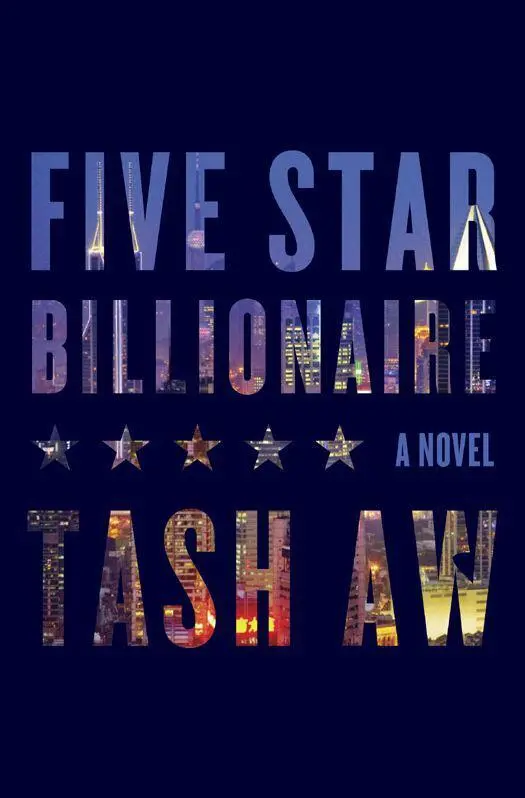
- Название:Five Star Billionaire
- Автор:
- Издательство:Spiegel & Grau
- Жанр:
- Год:2013
- ISBN:нет данных
- Рейтинг книги:3 / 5. Голосов: 1
-
Избранное:Добавить в избранное
- Отзывы:
-
Ваша оценка:
Five Star Billionaire: краткое содержание, описание и аннотация
Предлагаем к чтению аннотацию, описание, краткое содержание или предисловие (зависит от того, что написал сам автор книги «Five Star Billionaire»). Если вы не нашли необходимую информацию о книге — напишите в комментариях, мы постараемся отыскать её.
the dazzling kaleidoscopic new novel by the award-winning writer Tash Aw, offers rare insight into China today, with its constant transformations and its promise of possibility.
Five Star Billionaire — читать онлайн ознакомительный отрывок
Ниже представлен текст книги, разбитый по страницам. Система сохранения места последней прочитанной страницы, позволяет с удобством читать онлайн бесплатно книгу «Five Star Billionaire», без необходимости каждый раз заново искать на чём Вы остановились. Поставьте закладку, и сможете в любой момент перейти на страницу, на которой закончили чтение.
Интервал:
Закладка:
He nodded. “Um, ya ,” he said. Sitting in the driver’s seat with no one beside him, he felt like a chauffeur; he had not even demurred when they climbed into the backseat together, leaving him to drive. Their “coupled-ness” was unshakable; there was no point in resisting it. As he looked at them in the rearview mirror, their eyes shaded by jet-black sunglasses, heads tilting toward each other, Justin felt old. He was only twenty-six or twenty-seven, barely more than six years older than Yinghui, yet he had a job and an office, his life already so firmly entrenched that he would never be able to change it. C.S. and Yinghui still occupied that wonderful terrain on the other side of the fence between youth and adulthood, Justin thought, and he envied them because their lives would always be colorful and full of change, even when they were no longer young in age.
Only once did he succeed in making Yinghui laugh, and even then he couldn’t be sure if it was intentional. He had just returned to the capital after a long drive up the East Coast, all the way to Kota Bharu, where he had been inspecting some family concerns — a vast housing development in the countryside for the new middle class, who wanted to leave their flimsy timber-and-concrete dwellings to live in neat, clean streets of low brick houses bounded by chain-link fences. It had been a tiring trip, and not particularly productive, but vital nonetheless. Palms needed to be greased — one or two officials who had the potential to be uncooperative — and cordial relations maintained. Justin had traveled up there with Sixth Uncle to host a dinner or two, discreetly handing out expensive gifts before making the all-day drive back down to KL. When he got home, he found Yinghui sitting on the front step of the porch, a large sheet of paper spread out in front of her, on which she was making rough drawings.
“Plans for my café,” she said. “Not sure if it’ll ever happen, but it would be fun, I think. C.S. needs somewhere to host his literary gatherings, and I could bake the cakes. Can you imagine — me, baking cakes? That would surprise everyone. But I kind of like the idea.”
“What about the business side?” he asked. She did not seem to Justin to have a clue about finances or the simple mechanics of making money, and it panicked him to imagine her running a business. Her world was entirely cerebral — she inhabited the books she read and had no concept of providing service in return for money. She would lose everything.
“That’ll just sort itself out, won’t it?” she said, laughing. “C.S. says that if I want to do it, I should go ahead. He says business is fundamentally simple when you strip it down to its basics. Once deconstructed, you can see that it’s philosophically unchallenging. That’s why no businessman is ever a great genius.”
“I see.”
“Anyway, how was Kelantan? Beautiful?”
He nodded. “Yes,” he agreed. She held his gaze steadily in her wide-eyed fashion, expecting him to elaborate — waiting for further details, waiting. “Beautiful,” he repeated. He searched his brain for thoughts that had occurred to him during his trip there, but all he had seen was a huge residential project of cheap, boxy houses, and the only people he had spoken to were local officials with whom he had made small talk about food and fishing. “Backward,” he said suddenly. He did not know where the word came from or if he actually thought that Kelantan was backward, but he was glad nonetheless that he’d come up with an observation.
Her face opened up into a smile. “Beautiful and backward. I like that! What a great description. The poetic gene must run in the family.”
From then on, every time she described a place she’d visited — some parts of Indonesia or India — she would say, “Beautiful and backward,” and nod knowingly to Justin. Sometimes she would say, “As Justin says, ‘Beautiful and backward.’ ” The three of them even began to describe people they met as Beautiful and Backward — the glamorous trophy wives of rich men in KL (“there goes another B&B”). For a while Justin felt part of Yinghui’s life, as if she had finally taken him into her world. He knew that he only hovered on the periphery of this world, but it did not matter; it was enough for him.
Around this time he was charged with the dealings of the New Cathay Movie Theatre, the first and most famous of the dozen or so cinemas to have been built in KL during the 1920s and ’30s. Already, most of them had been forgotten, falling into a state of disrepair or torn down in the beginning of the boom years that had begun in the eighties and carried on steadily, but the New Cathay still stood. Small fig trees sprouted from cracks in the masonry on its roof, the ornate plasterwork of scrolling leaves that adorned the façade was cracking in many places, and the handsome columns that flanked the cinema were streaked with lines of black moss where the moisture leaked from the drainpipes. Whereas once it had always seemed splendidly bathed in sunlight, it now lay permanently in the shadows, crowded on all sides by the high-rise office blocks that had sprung up around it.
Yet, in spite of its dereliction, the New Cathay continued to screen films every day of the week, as if refusing to acknowledge the changes taking place around it. Audiences had dwindled, of course, and when Justin stopped by early one Friday evening to see for himself how dire the situation was, he found only one other person in the audience: an old Indian man, who had fallen asleep despite the pounding music of the Bollywood film that was showing. Justin stayed for fifteen minutes, watching the colorful images dance across the screen, before wandering back out into the street. Office workers dressed in smart gray slacks and white shirts were hurrying to dinner, high-spirited in anticipation of the weekend; teenagers in uniforms were rushing to catch their buses home after an afternoon of hanging around the shopping malls. No one showed any interest in the New Cathay.
It had not always been like this. Justin could still remember when, once a month, his parents would take C.S. and him to the New Cathay to see a film on a Sunday afternoon — that rarest of treats: a family outing. Even as recently as the late seventies, the New Cathay would show the newest films, despite the establishment of big modern cinemas elsewhere in town. Justin remembered watching King Kong and — could this be right? — Star Wars at the New Cathay, in addition to the numerous Chinese classics in the great tradition of the Shaw Brothers studios. But the films were immaterial. What he loved was sitting in the best seats — in the middle of the front row — his newspaper cone of steamed groundnuts in one hand, a bottle of Fanta in the other; his parents silently staring at the screen, as if they were young lovers; a sense of togetherness, away from the silent disputes; the old Indian jaga who would give him bags of rambutans from his garden after the movie. Those evenings represented for Justin an illusion of stability, of ordinariness. It was not long, of course, before Justin was old enough to see these outings for what they were, a temporary relief from the unvoiced unhappiness that lay underneath, but still he would go along with the pretense; each time, he would gratefully accept the bag of rambutans, even though he didn’t especially like them, for they were part of this small ritual of normality.
His family had acquired the cinema in the late 1940s, when postwar fatigue had not yet been replaced with pre-independence fervor, when nerves were still raw and money scarce. There had been rumors that the New Cathay had been used for Japanese propaganda films and now no one wanted it. The owner had fled to Thailand during the war and did not want to come back, and the only person who had any money to buy the place was Justin’s grandfather, one of the few Chinese to have survived the war with his fortune intact, if not — this was always said in hushed tones — actually increased. Once bought, the cinema was smartened up, its fine masonry restored and repainted, the seats inside replaced with vinyl-covered ones from America. For a decade, maybe more, from the mid-fifties until just after Justin’s birth, it enjoyed a second heyday, with audiences streaming in nightly to watch Technicolor films in modern comfort. But by the time Justin was old enough to be taken on those family outings, the cinema was past its prime, and, throughout the eighties and into the nineties, the huge multiscreen cinemas in the giant shopping malls ensured the demise of the New Cathay.
Читать дальшеИнтервал:
Закладка:
Похожие книги на «Five Star Billionaire»
Представляем Вашему вниманию похожие книги на «Five Star Billionaire» списком для выбора. Мы отобрали схожую по названию и смыслу литературу в надежде предоставить читателям больше вариантов отыскать новые, интересные, ещё непрочитанные произведения.

![Scott O’Hara - Five-Star Fugitive [= Border Town Girl]](/books/432138/scott-o-hara-five-thumb.webp)







Обсуждение, отзывы о книге «Five Star Billionaire» и просто собственные мнения читателей. Оставьте ваши комментарии, напишите, что Вы думаете о произведении, его смысле или главных героях. Укажите что конкретно понравилось, а что нет, и почему Вы так считаете.