Russell Banks - Cloudsplitter
Здесь есть возможность читать онлайн «Russell Banks - Cloudsplitter» весь текст электронной книги совершенно бесплатно (целиком полную версию без сокращений). В некоторых случаях можно слушать аудио, скачать через торрент в формате fb2 и присутствует краткое содержание. Год выпуска: 2011, Издательство: Harper Perennial, Жанр: Современная проза, на английском языке. Описание произведения, (предисловие) а так же отзывы посетителей доступны на портале библиотеки ЛибКат.
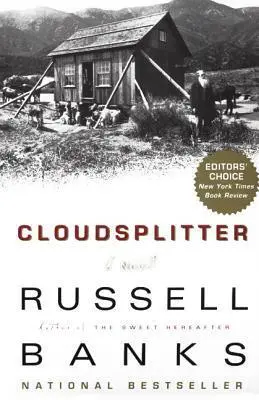
- Название:Cloudsplitter
- Автор:
- Издательство:Harper Perennial
- Жанр:
- Год:2011
- ISBN:нет данных
- Рейтинг книги:3 / 5. Голосов: 1
-
Избранное:Добавить в избранное
- Отзывы:
-
Ваша оценка:
Cloudsplitter: краткое содержание, описание и аннотация
Предлагаем к чтению аннотацию, описание, краткое содержание или предисловие (зависит от того, что написал сам автор книги «Cloudsplitter»). Если вы не нашли необходимую информацию о книге — напишите в комментариях, мы постараемся отыскать её.
is narrated by the enigmatic Owen Brown, last surviving son of America's most famous and still controversial political terrorist and martyr, John Brown. Deeply researched, brilliantly plotted, and peopled with a cast of unforgettable characters both historical and wholly invented,
is dazzling in its re-creation of the political and social landscape of our history during the years before the Civil War, when slavery was tearing the country apart. But within this broader scope, Russell Banks has given us a riveting, suspenseful, heartbreaking narrative filled with intimate scenes of domestic life, of violence and action in battle, of romance and familial life and death that make the reader feel in astonishing ways what it is like to be alive in that time.
Cloudsplitter — читать онлайн бесплатно полную книгу (весь текст) целиком
Ниже представлен текст книги, разбитый по страницам. Система сохранения места последней прочитанной страницы, позволяет с удобством читать онлайн бесплатно книгу «Cloudsplitter», без необходимости каждый раз заново искать на чём Вы остановились. Поставьте закладку, и сможете в любой момент перейти на страницу, на которой закончили чтение.
Интервал:
Закладка:
It was an amusing sight, and certainly he must have looked peculiar to the local farmers who were here and there working in the fields adjacent to the battleground — this lean, middle-aged man in a dark coat with flapping tails and a flat-brimmed hat set straight on his head, striding in geometrically precise lines beneath the hot, mid-morning sun over hill and dale, at meaningless points abruptly stopping and wheeling, pausing briefly with chin in hand, and suddenly putting himself on the march again. And while I myself was no more capable of actually seeing the things he saw out there than were those curious Flemish farmers who leaned on their spades and gazed after him, nonetheless I knew what he saw and heard and even smelled. I knew that he was deliberately, thoughtfully, with impressive, detailed knowledge, situating himself at the hundreds of points where the armies of six nations had met, and that he now walked in the midst of a thunderous battle, heard the angry shouts and pitiful cries of thousands of men falling face-first into the dirt and dying there straightway, saw the fire and smoke of long rows of cannon and the screaming horses going down and heard the crash of huge wagons and machines breaking apart, as wave upon wave of men marched suicidally against high walls of musketry, slashing sabers, blazing pistols, pikes, and daggers, until the lines broke and bloody hands reached out and grasped the throats of terrified, wild-eyed boys and men — farmers, artisans, and simple workmen fleeing for their lives, while all about the field human limbs were heaping up, arms and legs and heads severed brutally from the trunks, leaving howling, bloody mouths at the cut ends and the trunks cast down like so much meat, and the living, those who could still rise, staggering forward, covered with dirt, blood, feces, vomit, as behind them the corpses stiffened in the watery ditches and swelled and started to stink in the heat of the June day, and behind the corpses, up on the ridge, the generals plotted their next assault.
I sat on a hill in the shade of a tree, like one of the generals myself, and watched my father track and translate a series of elaborate, invisible runes in the distant fields. I watched a man controlled by a vision that I, his son, was too roughly finished to share, a vision that he would be obliged, therefore, to come back and report to me, just as he reported back to me his vision of the Lord. I believed in his visions, that they had occurred, and that they were of the truth — the truth of warfare, the truth of religion. This was what I had learned the night that I spoke with Miss Peabody aboard the Cumbria — her last night on earth and, in a sense, my first. I had changed my mind that night, as she had commanded, and forthwith had changed my self. In making my mind up, I had made my self up. And for the first time, the only necessary time, I had decided simply that my father’s visions were worthy of my belief. The rest was like day coming out of night. I would remain, of course, a man made of ordinary stuff, and on my own had nothing else to work with. My great good fortune, however, was that my father was more of a poet than I, was a seer, and was perhaps a prophet. He was a man who saw things that I knew must be there but could not see myself, and because I loved him and trusted him, and because of the power of his language and the consistency of his behavior, my belief had swiftly become as powerful and controlling, as much a determinant of my mind and actions, as Father’s belief was of his. In this refracted way — though I remained until the end his follower and continued to live with no clear plan of my own and no belief in God — I became during those days for the first time a man of action and a man of religion. The difference between us, between me and my father, is that I would inspire no one to follow me, either into battle or towards God, whereas he had me, and soon would have a dozen more, and finally whole legions and then half a nation, following him.
In the evening, after a supper of mutton that the Old Man much admired, we strolled until dark about the town of Brussels, and Father related to me his findings. We walked to the heart of the town and came out upon an ancient, cobblestoned market-square, where the town hall was located. There we admired for a while a large medieval statue of St. Michael trampling the devil under his feet. The statue had been placed on a spire atop the tall building, and to observe it we were obliged to stand at the furthest point in the square, our backs to a stone wall, peering up, as if watching an eclipse. Pronouncing the statue useful, Father declared it the sort of thing we ought to have more of in American towns.
“It’s a Catholic statue, though” I pointed out.
“No, it’s older than that. You don’t have Catholics until you have Protestants. No, it’s a Christian statue.”
“And America is a Christian nation.”
“It is, indeed,” he said. “Or ought to be. It was surely meant to be.” We moved on then, and soon Father returned to the subject of Napoleon. All of Napoleon’s reasons for being defeated at Waterloo, he stated, came down to his having lost the element of surprise. For three straight months, up to and including the time he arrived with his armies at Ligny and drove Blücher’s Prussians from the field, Bonaparte had done the thing that was least expected of him. For that reason alone, all other things being equal or nearly so, he had come away victorious. But when he decamped at Ligny and moved on through the rain, he arrived at dawn at Waterloo, where he discovered that between his army and Wellington’s somewhat exposed and approximately equal force, there lay a half-mile of marshy meadowland. Here, for the first time, he did the expected thing. He pulled up and waited for the sun to dry the field. That gave Wellington time to dig in and, as it turned out, time for Blücher’s regrouped Prussians to arrive from Ligny. There was no way Napoleon could have defeated the Allies after that. For he had not done the unexpected thing. When Blücher arrived, it was nearly noon, and as the battle had just commenced, he was able to re-inforce Wellington’s army. That made all the difference. First, the element of surprise had been lost, and now things were no longer equal. Napoleon had to lose. Mathematics, simple numbers, had taken over. Certain victory was turned into a rout. For Napoleon, it was the end of his campaign, the end of his war, the end of his hundred days. There was nothing left for him now but retreat, eventual surrender, exile, the restoration of the monarchy in France, and a return to the status quo in the rest of Europe.
“What should he have done, then?”
“He should have done whatever Wellington least expected him to do. Which is, first of all, to attack. Attack at once.” And not only should he have attacked at once, Father went on, for the mud would have hampered Wellington’s army as much as his own, but he should have split his force into two equal-seeming parts. “Like Joab against the Syrians and the children of Ammon,” he explained. “One part would be made the superior, however, the way Joab secretly placed the best men of Israel under his command and placed the rest, an inferior lot, under his brother, Abishai.” Then Napoleon should have attacked from the two flanks, not to make a pincers, but to make two separate fronts, so as to force Wellington to divide his army into two parts also. Except that in Wellington’s case, the two would not have merely seemed equal, like Napoleon’s. They would in fact have been equal. Consequently, Napoleon’s secretly superior half would have quickly overrun the British half opposing it. And his inferior portion over on the other flank would have triumphed also, because Wellington’s side would have broken and run when they saw their opposite flank taken by a force apparently equal to the force facing them. “Just as the children of Ammon, when they saw the Syrians broken by Joab’s army of the best men of Israel, fled from the inferior force under his brother, Abishai. Napoleon’s greater false-half, in defeating Wellington’s actual half, would be handing victory like a gift to his lesser half. Thus his army as a whole would have defeated Wellington’s as a whole, and Blücher, arriving six hours later, would have been obliged to beat a hasty retreat back to Prussia. Napoleon would be emperor once again. He might still be emperor today.”
Читать дальшеИнтервал:
Закладка:
Похожие книги на «Cloudsplitter»
Представляем Вашему вниманию похожие книги на «Cloudsplitter» списком для выбора. Мы отобрали схожую по названию и смыслу литературу в надежде предоставить читателям больше вариантов отыскать новые, интересные, ещё непрочитанные произведения.

Обсуждение, отзывы о книге «Cloudsplitter» и просто собственные мнения читателей. Оставьте ваши комментарии, напишите, что Вы думаете о произведении, его смысле или главных героях. Укажите что конкретно понравилось, а что нет, и почему Вы так считаете.