Russell Banks - Cloudsplitter
Здесь есть возможность читать онлайн «Russell Banks - Cloudsplitter» весь текст электронной книги совершенно бесплатно (целиком полную версию без сокращений). В некоторых случаях можно слушать аудио, скачать через торрент в формате fb2 и присутствует краткое содержание. Год выпуска: 2011, Издательство: Harper Perennial, Жанр: Современная проза, на английском языке. Описание произведения, (предисловие) а так же отзывы посетителей доступны на портале библиотеки ЛибКат.
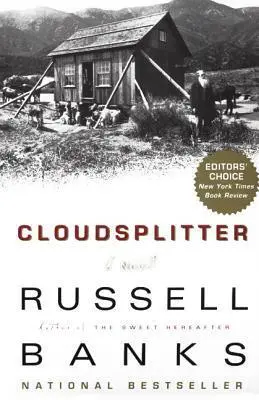
- Название:Cloudsplitter
- Автор:
- Издательство:Harper Perennial
- Жанр:
- Год:2011
- ISBN:нет данных
- Рейтинг книги:3 / 5. Голосов: 1
-
Избранное:Добавить в избранное
- Отзывы:
-
Ваша оценка:
Cloudsplitter: краткое содержание, описание и аннотация
Предлагаем к чтению аннотацию, описание, краткое содержание или предисловие (зависит от того, что написал сам автор книги «Cloudsplitter»). Если вы не нашли необходимую информацию о книге — напишите в комментариях, мы постараемся отыскать её.
is narrated by the enigmatic Owen Brown, last surviving son of America's most famous and still controversial political terrorist and martyr, John Brown. Deeply researched, brilliantly plotted, and peopled with a cast of unforgettable characters both historical and wholly invented,
is dazzling in its re-creation of the political and social landscape of our history during the years before the Civil War, when slavery was tearing the country apart. But within this broader scope, Russell Banks has given us a riveting, suspenseful, heartbreaking narrative filled with intimate scenes of domestic life, of violence and action in battle, of romance and familial life and death that make the reader feel in astonishing ways what it is like to be alive in that time.
Cloudsplitter — читать онлайн бесплатно полную книгу (весь текст) целиком
Ниже представлен текст книги, разбитый по страницам. Система сохранения места последней прочитанной страницы, позволяет с удобством читать онлайн бесплатно книгу «Cloudsplitter», без необходимости каждый раз заново искать на чём Вы остановились. Поставьте закладку, и сможете в любой момент перейти на страницу, на которой закончили чтение.
Интервал:
Закладка:
Never having married, I did not experience this sort of division in my life, which is perhaps why it took me until I was practically middle-aged before I was led to these particular sympathies for Father. And I certainly had no inkling of his conflicted state back then, when I reluctantly agreed to join him in his removal of the family from Springfield to North Elba, the tenth move in nearly as many years. Now, however, I can see that, for the first time in his life, Father expected to live as what he regarded as a whole man. In the Adirondacks, amongst the Negroes, he had at last imagined a life that was capable of containing all his contraries. Or so he believed then.
Father turned fifty that spring; Mary was thirty-seven. I am sure that, despite all, Father’s errand into the wilderness pleased her, especially after the death of the baby Ellen. It was a fresh start, and Father’s reveries and fantasies about the place had convinced her that our life would finally be calm and organized. Mary was a profound and prayerful person, more meditative and inward than the Old Man and most of the rest of us, and the idea of making a sanctuary in the mountains pleased her, especially if it met the Old Man’s standards for his and our participation in the struggle to free the slaves. And as far as she and we knew then, the removal to North Elba would accomplish that.
I remember him reassuring her that in a year or even less he would tie up his tangled affairs with Mr. Perkins in Springfield and Ohio and have all his debts at last paid off. Then he would be free to build his racially harmonious city on the hill, raise his prize-winning cattle and sheep on the slopes of the Adirondacks, and live out his years in the comfort of his family and neighbors. He would be a preacher, a teacher, and a farmer, he said. It was all he had ever wanted in life. He did not want to be a great man.
He told her that, told it to all of us, and we believed it, and I’m sure that, sometimes, he believed it, too. I soon learned, of course, that months before, when he had gone to North Elba alone, he had had other things in mind — the scattered, dimly formed, but powerful beginnings of ideas and plans that would develop and coalesce up there in the mountains and that would eventually prove irresistible to him. And, I confess it, ideas and plans that would prove irresistible to me and to my brothers as well.
To get to Westport, the boys Watson and Salmon, who were but fourteen and thirteen years old that spring, and I had traveled separately from the others, for we had brought Father’s Devon cattle and his five Spanish merino sheep up along the Connecticut River from Litchfield, Connecticut, where Father had been boarding them, crossed overland to Rutland, Vermont, and passed around the bottom of Lake Champlain to the New York side by the Fort Ticonderoga route. The Old Man, Mary, sister Ruth, and the younger children, Oliver, Annie, and little Sarah, at three years old the second to bear that name, had come north from Springfield in the wagon with all our tools and domestic goods, a pig, some fowl, and our dogs. They had crossed the lake on the ferry from Vermont, arrived in Westport, New York, and set up camp a few days before we got there.
By the time we showed up with the cattle and sheep, Father had already purchased the supplies we would need to see us through to our first harvest, but as soon as I saw the size of the load, I knew that Father’s old horse, an animal for whom he had typically developed an intense affection, would prove too feeble to haul it on the flats, let alone over high mountains. The Old Man and I argued a bit over that one, but he relented, for he knew the difficulties of getting up from Lake Champlain to North Elba even better than I.
With regret, then, he decided to sell his precious old horse, Dan, and use his last remaining cash money to buy a team from the shipping agent in Westport, a Mr. Thurston Clarke. As it turned out, Mr. Clarke offered Father a chance to hold on to his money, or most of it, which would have made a useful difference to him later on, but the Old Man gave it over. The red-coated Devon cattle had aroused considerable admiration among the local people there, and Father was briefly tempted by Mr. Clarke to swap a pair straight across for a team of Narragansetts. At the last minute, Father declined the offer.
The reason was the presence of a black man from North Elba — Lyman Epps. Mister Epps, as Father always addressed him, to the frequent consternation of any white people who were present. The man wandered into our camp south of Westport the evening of the day after the boys and I had arrived from Connecticut with the cattle and the sheep, and he swiftly proved to be an intelligent, charming man, although I confess that I did not warm to him as quickly as did the others. A wiry, coal-black fellow of medium height and quick movements, he was one of Gerrit Smith’s settled freedmen, a well-spoken man in his early thirties, I guessed, who had been a blacksmith in Maryland and knew horses. Many men know horses, but only from the outside; Mr. Epps claimed to understand them from the inside, as if they were people.
He told us that he had come down to Westport from North Elba in search of work: he needed cash to buy seed, because his crops from the previous year had failed, and all his reserves were gone, and he had no more credit at the feed stores or suppliers in the area. But he had been turned away by every blacksmith and harrier in the village, due to his race. In the process, however, he had learned of Father’s presence in town — the abolitionist fool from Ohio bent on teaching Gerrit Smith’s niggers to farm in the mountains. Father, as usual, had made no secret of our intentions, and we, like the Negroes, had quickly become something of a local joke.
On the subject of horses, the man was positively brilliant, or I should say he talked brilliantly on the subject. Such talk pleased the Old Man immensely and probably caused him to disregard the man’s occasional gaps in knowledge and experience, for soon he was inviting Mr. Epps to advise him on the purchase of a new team.
While Father’s own knowledge of horses was not nearly as extensive and deep as with cattle and sheep, where he truly was an expert, he nonetheless, unsurprisingly, held strong and frequently voiced opinions as to the relative merits of the more popular breeds. Also, he rarely exhibited any particular reluctance to lecture folks on how to raise, train, work, and ride horses. He took advice badly but gave it without stint. Back in Ohio, when we were still living on the old Haymaker farm and Father was first slipping deeply into land speculation, he had expanded his livestock operation beyond sheep and cattle and had even raised racehorses for a few years and sold off the colts and yearlings at the nearby Warren racetrack.
I remember his lectures to us, for we older boys were obliged to care for the colts and break them to the saddle and so on, before they could be sold off. “Remember, a colt should never be frightened,” he insisted. “Never. Horses are sensitive beings, very intelligent, easily spooked, so they must be treated with gentleness.” Later on, he explained, when you want to bring them under your control, they will trust your intentions completely and will defer to you in all things.
This was not, of course, his philosophy with regard to raising children. Children, the Old Man believed, were innately sinful, and thus they could be broken to the saddle, as it were, only if regularly disciplined and controlled by the rod, and could be saved only by the mysterious dispensation of the Lord’s grace. For whom the Lord loveth he chasteneth, and scourgeth every son whom He receiveth, he said. The blueness of a wound deanseth away evil; so do stripes the inward part of the belly. And, Chasten thy son while there is hope, and let not thy soul spare for his crying. Horses were evidently already saved, or were at least free of sin, and who could argue with that?
Читать дальшеИнтервал:
Закладка:
Похожие книги на «Cloudsplitter»
Представляем Вашему вниманию похожие книги на «Cloudsplitter» списком для выбора. Мы отобрали схожую по названию и смыслу литературу в надежде предоставить читателям больше вариантов отыскать новые, интересные, ещё непрочитанные произведения.

Обсуждение, отзывы о книге «Cloudsplitter» и просто собственные мнения читателей. Оставьте ваши комментарии, напишите, что Вы думаете о произведении, его смысле или главных героях. Укажите что конкретно понравилось, а что нет, и почему Вы так считаете.