Russell Banks - Continental Drift
Здесь есть возможность читать онлайн «Russell Banks - Continental Drift» весь текст электронной книги совершенно бесплатно (целиком полную версию без сокращений). В некоторых случаях можно слушать аудио, скачать через торрент в формате fb2 и присутствует краткое содержание. Год выпуска: 2007, Издательство: Harper Perennial Modern, Жанр: Современная проза, на английском языке. Описание произведения, (предисловие) а так же отзывы посетителей доступны на портале библиотеки ЛибКат.
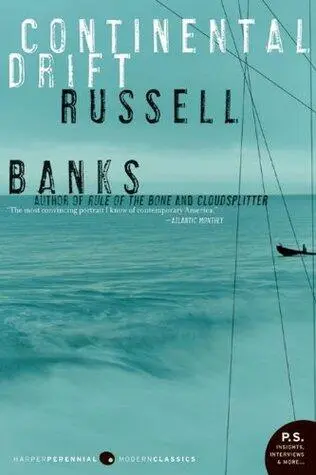
- Название:Continental Drift
- Автор:
- Издательство:Harper Perennial Modern
- Жанр:
- Год:2007
- ISBN:нет данных
- Рейтинг книги:4 / 5. Голосов: 1
-
Избранное:Добавить в избранное
- Отзывы:
-
Ваша оценка:
Continental Drift: краткое содержание, описание и аннотация
Предлагаем к чтению аннотацию, описание, краткое содержание или предисловие (зависит от того, что написал сам автор книги «Continental Drift»). Если вы не нашли необходимую информацию о книге — напишите в комментариях, мы постараемся отыскать её.
is a masterful novel of hope lost and gained, and a gripping, indelible story of fragile lives uprooted and transformed by injustice, disappointment, and the seductions and realities of the American dream.
Continental Drift — читать онлайн бесплатно полную книгу (весь текст) целиком
Ниже представлен текст книги, разбитый по страницам. Система сохранения места последней прочитанной страницы, позволяет с удобством читать онлайн бесплатно книгу «Continental Drift», без необходимости каждый раз заново искать на чём Вы остановились. Поставьте закладку, и сможете в любой момент перейти на страницу, на которой закончили чтение.
Интервал:
Закладка:
“Yeah, I hear you. You can pick up your pay tomorrow after noon at my office downtown. My secretary’ll have it ready for you by three. Don’t even come in to work tomorrow. I’ll get a temporary for a few days. By Wednesday I’ll have a replacement full time out there. That’s the least of my worries right now, replacing you.”
Bob stands up and faces his brother’s lumpy shape in the chair below him. “Okay, then. No hard feelings?”
“No. No hard feelings. I think you’re an asshole, of course. Worse, actually. Since you got a new baby and no job and probably no savings. But no, Bob, no hard feelings.”
“I’ll get another job. I can do lotsa stuff.”
“Yeah. Jobs’re falling outa trees around here.”
“Listen, I’m sorry.”
Eddie doesn’t respond, and Bob takes a step away. “I mean it, Eddie,” he says. “I’m sorry.”
“No, you’re not,” Eddie says, his voice coming from the darkness. “You’re not sorry. You’re glad.”
“Well, I’ll be seeing you.”
“Yeah.”
Bob leaves, walking through the living room to the carpeted front hall, out the huge oaken door and down the long flagstone walkway to the street. As he walks, he listens for the sound of the gun, but it doesn’t come. It’s not until he reaches his car and has got in and slammed the door that he realizes he has been listening for the gun, and then he realizes why, for he knows that if his brother can’t find his way out of this maze he’s built, he will put the barrel of the gun into his mouth and pull the trigger and blow off the top of his head.
Bob turns the ignition key, starts the motor, and drives away.
5
The girls are fine, he tells Elaine, fine, and as soon as he gets off the phone, he’s going home to tuck them into bed. Then he’ll drive out to the hospital to see her and the baby again. Where is he right now? At a pay phone. On the way home from work, he lies. He didn’t call her from work, he explains, because … well, because he didn’t realize how late it was until he got halfway home. So he pulled off the road at the first pay phone he saw and called her to tell her he’d be a little later getting over to the hospital than he’d said this morning. It’s been a real busy day, he explains. Yes, he, too, is grateful to Ellen and Ronnie Skeeter. They couldn’t have done this without them. Yes, he promises that he’ll do something nice for them. Maybe bring home some kind of fancy expensive liqueur from the store, she suggests. Galliano, maybe, or Kahlúa. Okay, sure, why not? He can buy it with his discount, she points out, and that way it won’t cost any more than a regular bottle of whiskey would. Right, right, he says, cringing as he talks, drawing his body into itself, shrinking it away from the rapidly expanding world of lies he’s created. He feels himself being squeezed small and pressed against an invisible wall, until he has begun to imagine his body moving through that wall and becoming invisible itself, leaving behind nothing but lies, leaving behind the life of another man, the one who calls home to check on his kids, while this other Bob, off on his crazy mission to Auburndale with the gun and then to Eddie’s in Oleander Park, forgets all about his kids, forgets that he is the father of three children, two of whom are at home in the care of kindly neighbors; he’s left in the visible world the life of a man who has a job in his brother’s liquor store, when the man who’s just become invisible has no job at all, has in fact quit his job without a second’s hesitation or fear and has no regrets or second thoughts; he’s left out there in the real world an invented, unreal man who’s dutiful, prudent, custodial, faithful and even-tempered, while here in the invisible world, where Bob now lives, he’s feckless, reckless, irresponsible, faithless and irrational — so that the invented man, the one everyone but Bob believes exists, is the father of the real man, who is the man no one but Bob knows exists, the man who is a boy.
He pulls off Route 17, and before he’s halfway down the lane to the trailer, he sees the van that’s parked in front of it, a large, metallic-green Chevy van with mag wheels and one-way mirror glass on the side and rear windows, and his first assumption is that it belongs to a friend of the Skeeters. But when he draws abreast of the van and sees the lettering on the driver’s door, Moray Key Charters , he knows the van belongs to Avery Boone.
This information should astonish Bob, since he hasn’t heard from Avery in almost a year, and then only by means of a Christmas card mailed to him in New Hampshire. Bob never answered the card, not, however, because he was still angry with Avery for what happened between him and Elaine (that, after all, was a long time ago, and both parties felt properly ashamed of themselves immediately afterwards, and who knows, maybe in some unconscious way Bob wanted it to happen, especially that first summer after Ave and Bob finished rebuilding the trawler, and Bob, as if to repay himself for all the work he did on Ave’s boat, treated the boat pretty much as if it were his own and went out on it almost every weekend, frequently alone). But the sight of Avery’s van parked on the grass outside his trailer doesn’t surprise Bob in the least. That is, the sudden appearance of Avery Boone doesn’t surprise the invisible man, Bob Dubois, though it would indeed astonish and unsettle the visible one, the invented man. The invisible version of Bob Dubois, the one who is feckless, reckless, irresponsible, and so forth, that man finds it perfectly natural that Avery should show up at this moment in his life, both natural and desirable, because, with Avery as with no one else, Bob can tell the truth and in that way can make the visible and the invisible man one.
Avery hasn’t come alone, he’s brought a girl with him, the two of them driving south from a month-long visit to New Hampshire, “to see the leaves turn color,” Avery explains, an annual phenomenon that in Avery’s three-year absence from New England has taken on mystical significance, like a total eclipse of the sun or the return of a long-gone comet, a significance reinforced by the reaction of the girl, who, as a native Floridian, has never seen the leaves go from green almost overnight to scarlet, gold, purple and orange and then for weeks hold their color crisply, cleanly, as if at the peak of health instead of the verge of death, and who, as a young woman in her early twenties with a somewhat mystical turn of mind anyhow, believes that in the 1840s in a previous incarnation she lived in Concord, New Hampshire, where she was the mistress of Franklin Pierce, U.S. senator, general in the Mexican War and fourteenth President of the United States. She first learned this from a Ouija board, but many events and signs have confirmed it since. Her belief regarding her previous existence has lent enormous significance to this trip with her “lover,” as she calls Avery, to his home town and state and has caused her to elicit from her lover any information regarding his present existence and actual past that he is willing to give, for she is convinced that an apparently coincidental connection with a man from New Hampshire, from a town not twenty-five miles from where Franklin Pierce was born and first practiced law, is no coincidence at all, but is in fact part of a cosmic plan intended to connect her past and future selves through the agency of this present self, if only she allows herself to read the signs properly. Avery Boone, she now realizes, is the most important sign, as well as the vehicle for her actual, physical return to New Hampshire, where there was, she reports to Bob, a “rush of signs,” including Bob Dubois himself, whose name came up often in this visit as she and Avery drove along in the van late at night, and Avery rambled on about his childhood and adolescence and young manhood, all shared with a person named Bob Dubois. When, after much prodding, Avery confessed to having had a falling out with Bob, the girl, whose name is Honduras (not her real name, of course, which is Joan Greenberg — the name Honduras, she says, was given to her when she was sixteen by her first lover, who happened to be a full-blooded Arawak Indian from the hills of Jamaica), convinced Avery that he should take this occasion to visit his old friend Bob Dubois in Catamount, to reestablish their bond, which would be good for their karma, she pointed out, and when they learned that Bob and his family had moved to Florida , well, she just knew, oh, yes, man, she knew .
Читать дальшеИнтервал:
Закладка:
Похожие книги на «Continental Drift»
Представляем Вашему вниманию похожие книги на «Continental Drift» списком для выбора. Мы отобрали схожую по названию и смыслу литературу в надежде предоставить читателям больше вариантов отыскать новые, интересные, ещё непрочитанные произведения.








Обсуждение, отзывы о книге «Continental Drift» и просто собственные мнения читателей. Оставьте ваши комментарии, напишите, что Вы думаете о произведении, его смысле или главных героях. Укажите что конкретно понравилось, а что нет, и почему Вы так считаете.