David Wallace - Infinite jest
Здесь есть возможность читать онлайн «David Wallace - Infinite jest» весь текст электронной книги совершенно бесплатно (целиком полную версию без сокращений). В некоторых случаях можно слушать аудио, скачать через торрент в формате fb2 и присутствует краткое содержание. Год выпуска: 2006, Издательство: Back Bay Books, Жанр: Современная проза, на русском языке. Описание произведения, (предисловие) а так же отзывы посетителей доступны на портале библиотеки ЛибКат.
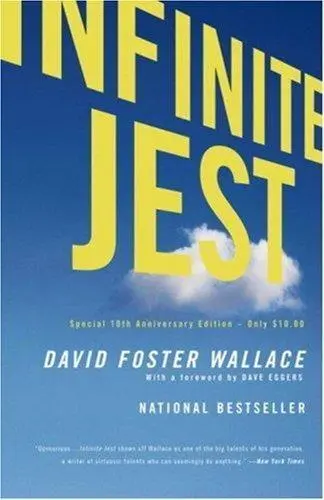
- Название:Infinite jest
- Автор:
- Издательство:Back Bay Books
- Жанр:
- Год:2006
- ISBN:нет данных
- Рейтинг книги:3 / 5. Голосов: 1
-
Избранное:Добавить в избранное
- Отзывы:
-
Ваша оценка:
Infinite jest: краткое содержание, описание и аннотация
Предлагаем к чтению аннотацию, описание, краткое содержание или предисловие (зависит от того, что написал сам автор книги «Infinite jest»). Если вы не нашли необходимую информацию о книге — напишите в комментариях, мы постараемся отыскать её.
Infinite Jest
On this outrageous frame hangs an exploration of essential questions about what entertainment is, and why it has come to so dominate our lives; about how our desire for entertainment interacts with our need to connect with other humans; and about what the pleasures we choose say about who we are. Equal parts philosophical quest and screwball comedy, Infinite Jest bends every rule of fiction without sacrificing for a moment its own entertainment value. The huge cast and multilevel narrative serve a story that accelerates to a breathtaking, heartbreaking, unfogettable conclusion. It is an exuberant, uniquely American exploration of the passions that make us human and one of those rare books that renew the very idea of what a novel can do.
Infinite jest — читать онлайн бесплатно полную книгу (весь текст) целиком
Ниже представлен текст книги, разбитый по страницам. Система сохранения места последней прочитанной страницы, позволяет с удобством читать онлайн бесплатно книгу «Infinite jest», без необходимости каждый раз заново искать на чём Вы остановились. Поставьте закладку, и сможете в любой момент перейти на страницу, на которой закончили чтение.
Интервал:
Закладка:
But you can’t play U.S. football with a draped sportcoat. And Orin’s only real speed was in tiny three-meter lateral bursts. And then it turned out that the idea of actually making direct physical contact with an opponent was so deeply ingrained as alien and horrific that Orin’s tryouts, even at reserve positions, were too pathetic to describe. He was called a dragass and then a mollygag and then a bona fried pussy. He was finally told that he seemed to have some kind of empty swinging sack where his balls ought to be and that if he wanted to keep his scholarship he might ought to stick to minor-type sports where what you hit didn’t up and hit you back. The Coach finally actually grabbed Orin’s facemask and pointed to the mouth of the field’s southern tunnel. Orin walked south off the field solo and disconsolate, helmet under his little right arm, with not even a wistful glance back at the Pep Squad’s P.G.O.A.T. practicing baton-aloft splits in a heart-rendingly distant way beneath the Visitors’ northern goalposts.
What metro Boston AAs are trite but correct about is that both destiny’s kisses and its dope-slaps illustrate an individual person’s basic personal powerlessness over the really meaningful events in his life: [100]i.e. almost nothing important that ever happens to you happens because you engineer it. Destiny has no beeper; destiny always leans trenchcoated out of an alley with some sort of Psst that you usually can’t even hear because you’re in such a rush to or from something important you’ve tried to engineer. The destiny-grade event that happened to Orin Incandenza at this point was that just as he was passing glumly under the Home goalposts and entering the shadow of the south exit-tunnel’s adit a loud and ominously orthopedic cracking sound, plus then shrieking, issued from somewhere on the field behind him. What had happened was that B.U.’s best defensive tackle — a 180-kilo future pro who had no teeth and liked to color — practicing Special Teams punt-rushes, not only blocked B.U.’s varsity punter’s kick but committed a serious mental error and kept coming and crashed into the little padless guy while the punter’s cleated foot was still up over his head, falling on him in a beefy heap and snapping everything from femur to tarsus in the punter’s leg with a dreadful high-caliber snap. Two Pep majorettes and a waterboy fainted from the sound of the punter’s screams alone. The blocked punt’s ball caromed hard off the defensive tackle’s helmet and bounced crazily and rolled untended all the way back to the shadow of the south tunnel, where Orin had turned to watch the punter writhe and the lineman rise with a finger in his mouth and a guilty expression. The Defensive Line Coach disconnected his headset and dashed out and began blowing his whistle at the lineman at extremely close range, over and over, as the huge tackle started to cry and hit himself in the forehead with the heel of his hand. Since nobody else was close, Orin picked up the blocked punt’s ball, which the Head Coach was gesturing impatiently for from his position at the midfield bench. Orin held the football (which he’d not been very good at it during tryouts, holding onto it), feeling its weird oval weight, and looked way upfield at the stretcher-bearers and punter and assistants and Coach. It was too far to try to throw, and there was just no way Orin was making another solo walk up the sideline and then back off the field again under the distant green gaze of the twirler who owned his CNS.
Orin, before that seminal moment, had never tried to kick any sort of ball before in his whole life, was the unengineered and kind of vulnerable revelation that ended up moving Joelle van Dyne way more than status or hang-time.
And but as of that moment, as whistles fell from lips and people pointed, and under that same green and sprinkler-hazed gaze Orin found for himself, within competitive U.S. football, a new niche and carrot. A Show-type career he could never have dreamed of trying to engineer. Within days he was punting 60 yards without a rush, practicing solo on an outside field with the Special Teams Assistant, a dreamy Gauloise-smoking man who invoked ideas of sky and flight and called Orin ‘ephebe,’ which a discreet phone call to his youngest brother revealed not to be the insult Orin had feared it sounded like. By the second week O. was up around 65 yards, still without a snap or rush, his rhythm clean and faultless, his concentration on the transaction between one foot and one leather egg almost frighteningly total. Nor, by the third week, was he much distracted by the ten crazed pituitary giants bearing down as he took the snap and stepped forward, the gasps and crunching and meaty splats of interpersonal contact around him, the cooly-type shuffle of the stretcher-bearers who came and went after the whistles blew. He’d been taken aside and the empty-scrotum crack apologized for, and it had been explained — complete with blow-ups of Rulebook pages — that regulations against direct physical contact with the punter were draconian, enforced by the threat of massive yardage and loss of possession. The rifle-shot sounds of the ex-punter’s now useless leg were one-in-a-million sounds, he was assured. The Head Coach let Orin overhear him telling the defense that any man misfortunate enough to impact the team’s new stellar punt-man might could just keep on walking after the play was over, all the way to the south tunnel and the stadium exit and the nearest transportation to some other institution of learning and ball.
It was, pretty obviously, the start of football season. Crisp air, everything half dead, burning leaves, hot chocolate, raccoon coats and halftime-twirling and something called the Wave. Crowds exponentially larger and more demonstrative than tennis-tournament crowds. HOME v. SUNY-Buffalo, HOME v. Syracuse, AT Boston College, AT Rhode Island, HOME v. the despised Minutemen of UMass-Amherst. Orin’s average reached 69 yards per kick and was still improving, his eyes fixed on the twin inducements of a gleaming baton and a massive developmental carrot he hadn’t felt since age fourteen. He punted the football better and better as his motion — a dancerly combination of moves and weight-transfers every bit as complex and precise as a kick serve — got more instinctive and he found his hamstrings and adductors loosening through constant and high-impact competitive punting, his left cleat finishing at 90° to the turf, knee to his nose, Rockette-kicking in the midst of crowd-noise so rabid and entire it seemed to remove stadiums’ air, the one huge wordless orgasmic voice rising and creating a vacuum that sucked the ball after it into the sky, the leather egg receding as it climbed in a perfect spiral, seeming to chase the very crowd-roar it had produced.
By Halloween his control was even better than his distance. It wasn’t by accident that the Special Teams Assistant described it as ‘touch.’ Consider that a football field is basically just a grass tennis court tugged unnaturally long, and that white lines at complex right angles still define tactics and movement, the very possibility of play. And that Orin Incandenza, who tennis-historically had had mediocre passing shots, had been indicted by Schtitt for depending way too often on the lob he’d developed as compensation. Like the equally weak-passing Eschaton-prodigy Michael Pemulis after him, Orin’s whole limited game had been built around a preternatural lob, which of course a lob is just a higher-than-opponent parabola that ideally lands just shy of the area of play’s rear boundary and is hard to retrieve and return. Gerhardt Schtitt and deLínt and their depressed prorectors had had to sit eating butterless popcorn through only one cartridge of one B.U. game to understand how Orin had found his major-sport niche. Orin was still just only lobbing, Schtitt observed, illustrating with the pointer and a multiple-replayed fourth down, but now with the leg instead, the only punting, and now with ten armored and testosterone-flushed factota to deal with what ever return an opponent could muster; Schtitt posited that Orin had stumbled by accident on a way, in this grotesquely physical and territorial U.S. game, to legitimate the same dependency on the one shot of lob that had kept him from developing the courage to develop his weaker areas, which this unwillingness to risk the temporary failure and weakness for long-term gaining had been the real herbicide on the carrot of Orin Incandenza’s tennis. Puberty Schmüberty, as the real reason for burning down the inside fire for tennis, Schtitt knew. Schtitt’s remarks were nodded vigorously at and largely ignored, in the Viewing Room. Schtitt later told deLint he had several very bad feelings about Orin’s future, inside.
Читать дальшеИнтервал:
Закладка:
Похожие книги на «Infinite jest»
Представляем Вашему вниманию похожие книги на «Infinite jest» списком для выбора. Мы отобрали схожую по названию и смыслу литературу в надежде предоставить читателям больше вариантов отыскать новые, интересные, ещё непрочитанные произведения.



Обсуждение, отзывы о книге «Infinite jest» и просто собственные мнения читателей. Оставьте ваши комментарии, напишите, что Вы думаете о произведении, его смысле или главных героях. Укажите что конкретно понравилось, а что нет, и почему Вы так считаете.