David Wallace - Infinite jest
Здесь есть возможность читать онлайн «David Wallace - Infinite jest» весь текст электронной книги совершенно бесплатно (целиком полную версию без сокращений). В некоторых случаях можно слушать аудио, скачать через торрент в формате fb2 и присутствует краткое содержание. Год выпуска: 2006, Издательство: Back Bay Books, Жанр: Современная проза, на русском языке. Описание произведения, (предисловие) а так же отзывы посетителей доступны на портале библиотеки ЛибКат.
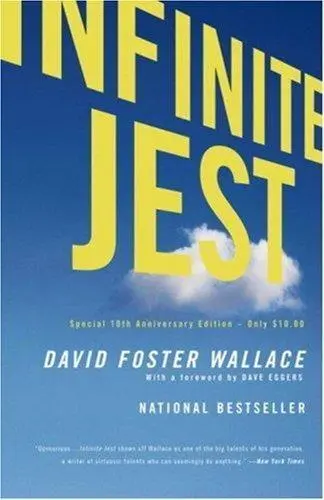
- Название:Infinite jest
- Автор:
- Издательство:Back Bay Books
- Жанр:
- Год:2006
- ISBN:нет данных
- Рейтинг книги:3 / 5. Голосов: 1
-
Избранное:Добавить в избранное
- Отзывы:
-
Ваша оценка:
Infinite jest: краткое содержание, описание и аннотация
Предлагаем к чтению аннотацию, описание, краткое содержание или предисловие (зависит от того, что написал сам автор книги «Infinite jest»). Если вы не нашли необходимую информацию о книге — напишите в комментариях, мы постараемся отыскать её.
Infinite Jest
On this outrageous frame hangs an exploration of essential questions about what entertainment is, and why it has come to so dominate our lives; about how our desire for entertainment interacts with our need to connect with other humans; and about what the pleasures we choose say about who we are. Equal parts philosophical quest and screwball comedy, Infinite Jest bends every rule of fiction without sacrificing for a moment its own entertainment value. The huge cast and multilevel narrative serve a story that accelerates to a breathtaking, heartbreaking, unfogettable conclusion. It is an exuberant, uniquely American exploration of the passions that make us human and one of those rare books that renew the very idea of what a novel can do.
Infinite jest — читать онлайн бесплатно полную книгу (весь текст) целиком
Ниже представлен текст книги, разбитый по страницам. Система сохранения места последней прочитанной страницы, позволяет с удобством читать онлайн бесплатно книгу «Infinite jest», без необходимости каждый раз заново искать на чём Вы остановились. Поставьте закладку, и сможете в любой момент перейти на страницу, на которой закончили чтение.
Интервал:
Закладка:
‘Easy does it,’ Charlotte Treat half-sings, not looking up from her needle and frame.
Day looks around at her. ‘I don’t believe I was speaking to you in any way shape or form.’
Lenz stares at him. ‘If you’re trying to fuck with me, brother.’ He shakes his fine shiny head. ‘Big mistake.’
‘Oo I’m all atremble. I can barely hold my arm steady to read my watch.’
‘Big big big real big mistake.’
‘Peace on earth good will toward men,’ says Gately, back on his back, smiling at the dun cracked ceiling. He’s the one who’d farted.
They returned from Long Island bearing their shields rather than upon them, as they say. John Wayne and Hal Incandenza lost only five total games between them in singles. The A doubles had resembled a spatterpainting. And the B teams, especially the distaffs, had surpassed themselves. The whole P.W.T.A. staff and squad had had to sing a really silly song. Coyle and Troeltsch didn’t win, and Teddy Schacht had, incredibly, lost to his squat spin-doctory opponent in three sets, despite the kid’s debilitating nerves at crucial junctures. The fact that Schacht wasn’t all that upset got remarked on by staff. Schacht and a conspicuously energized Jim Troeltsch rallied for the big win in 18-A #2 dubs, though. Troeltsch’s disconnected microphone mysteriously disappeared from his gear bag during post-doubles showers, to the rejoicing of all. Pemulis’s storky intense two-hands-off-both-sides opponent had gotten weirdly lethargic and then disoriented in the second set after Pemulis had lost the first in a tie-break. After the kid had delayed play for several minutes claiming the tennis balls were too pretty to hit, P.W.T.A. trainers had conducted him gently from the court, and the Peemster got ‘V.D.,’ which is jr.-circuit argot for a Victory by Default. The fact that Pemulis hadn’t walked around with his chest out recounting the win for any E.T.A. females got remarked on only by Hal and T. Axford. Schacht was in too much knee-pain to remark on much of anything, and Schtitt had E.T.A.’s Barry Loach inject the big purple knee with something that made Schacht’s eyes roll up in his head.
Then during the post-meet mixer and dance Pemulis’s defaulted opponent ate from the hors d’ oeuvres table without using utensils or at one point even hands, did a disco number when there wasn’t any music going, and was finally heard telling the Port Washington Headmaster’s wife that he’d always wanted to do her from behind. Pemulis spent a lot of time whistling and staring innocently up at the pre-fab ceiling.
The bus for all the 18’s squads was warm and there were little nozzles of light over your seat that you could either have on to do homework or shut off and sleep. Troeltsch, left eye ominously nystagmic, pretended to recap the day’s match highlights for a subscription audience, speaking earnestly into his fist. The C team’s Stockhausen was pretending to sing opera. Hal and Tall Paul Shaw were each reading an SAT prep-guide. A good quarter of the bus was yellow-highlighting copies of E. A. Abbott’s inescapable-at-E.T.A. book Flatland for either Flottman or Chawaf or Thorp. An elongated darkness with assorted shapes melted by, plus long gauntlets, near exits, of tall Interstatish lamps laying down cones of dirty-looking sodium light. The ghastly sodium lamplight made Mario Incandenza happy to be in his little cone of white inside light. Mario sat next to K. D. Coyle — who was kind of mentally slow, especially after a hard loss — and they played rock-paper-scissors for two hundred clicks or more, not saying anything, engrossed in trying to locate patterns in each other’s rhythms of choices of shapes, which they both decided there weren’t any. Two or three upper-classmen in Levy-Richardson-O’Byrne-Chawaf’s Disciplinary Lit. were slumped over Goncharov’s Oblomov, looking very unhappy indeed. Charles Tavis sat way in the back with John Wayne and beamed and spoke nonstop in hushed tones to Wayne as the Canadian stared out the window. DeLint was with the 16’s one bus back; he’d been ragging Slice’s and Korn-span’s asses since their doubles, which it looked like they practically gave away. The bus was Schtittless: Schtitt always found a private mysterious way back, then appeared at dawn drills with deLint and elaborate work-ups of everything that had gone wrong the day before. He was particularly shrill and insistent and negative after they’d won something. Schacht sat listing to port and didn’t respond when hands were waved in front of his face, and Axford and Struck started kibitzing Barry Loach about their knees were feeling punk as well. The luggage rack over everyone’s heads bristled with grips and coverless strings, and liniment and tincture of benzoin had been handed out and liberally applied, so the warm air became complexly spiced. Everybody was tired in a good way.
The homeward ride’s camaraderie was marred only by the fact that someone near the back of the bus started the passing around of a Gothic-fonted leaflet offering the kingdom of prehistoric England to the man who could pull Keith Freer out of Bernadette Longley. Freer had been discovered by prorector Mary Esther Thode more or less Xing poor Bernadette Longley under an Adidas blanket in the very back seat on the bus trip to the East Coast Clays in Providence in September, and it had been a nasty scene, because there were some basic Academy-license rules that it was just unacceptable to flout under the nose of staff. Keith Freer was deeply asleep when the leaflet was getting passed around, but Bernadette Longley wasn’t, and when the leaflet hit the front half where all the females now had to sit since September she’d buried her face in her hands and flushed even on the back of her pretty neck, and her doubles partner [92]came all the way back to where Jim Struck and Michael Pemulis were sitting and told them in no uncertain terms that somebody on this bus was so immature it was really sad.
Charles Tavis was irrepressible. He did a Pierre Trudeau impersonation no one except the driver was old enough to laugh at. And the whole mammoth travelling squad, three buses’ worth, got to stop and have the Mega-breakfast at Denny’s, over next to Empire Waste, at like 0030, when they got in.
Hal’s eldest brother Orin Incandenza got out of competitive tennis when Hal was nine and Mario nearly eleven. This was during the period of great pre-Experialist upheaval and the emergence of the fringe C.U.S.P. of Johnny Gentle, Famous Crooner, and the tumescence of O.N.A.N.ism. At late seventeen, Orin was ranked in the low 70s nationally; he was a senior; he was at that awful age for a low-70s player where age eighteen and the terminus of a junior career are looming and either: (1) you’re going to surrender your dreams of the Show and go to college and play college tennis; or (2) you’re going to get your full spectrum of gram-negative and cholera and amoebic-dysentery shots and try to eke outsome kind of sad diasporic existence on a Eurasian satellite pro tour and try to hop those last few competitive plateaux up to Show-caliber as an adult; or (3) or you don’t know what you’re going to do; and it’s often an awful time.[93]
E.T.A. tries to dilute the awfulness a little by letting eight or nine postgraduates stay on for two years and serve in deLint’s platoon of prorec-tors [94]in exchange for room and board and travel expenses to small sad satellite tourneys, and Orin’s being directly related to E.T.A. Administration obviously gave him kind of a lock on a prorector appointment if he wanted it, but a prorector’s job was only for maybe at most a few years, and was regarded as sad and purgatorial … and then of course what then, what are you going to do after that, etc.
Orin’s decision to attend college pleased his parents a great deal, though Mrs. Avril Incandenza, especially, had gone out of her way to make it clear that whatever Orin decided to do would please them because they stood squarely behind and in full support of him, Orin, and any decision his very best thinking yielded. But they were still in favor of college, privately, you could tell. Orin was clearly not ever going to be a professional-caliber adult tennis player. His competitive peak had come at thirteen, when he’d gotten to the 14-and-Under quarterfinals of the National Clays in Indianapolis IN and in the Quarters had taken a set off the second seed; but starting soon after that he’d suffered athletically from the same delayed puberty that had compromised his father when Himself had been a junior player, and having boys he’d cleaned the clocks of at twelve and thirteen become now seemingly overnight mannish and deep-chested and hairy-legged and starting now to clean Orin’s own clock at fourteen and fifteen — this had sucked some kind of competitive afflatus out of him, broken his tennis spirit, Orin, and his U.S.T.A. ranking had nosedived through three years until it levelled off somewhere in the low 70s, which meant that by age fifteen he wasn’t even qualifying for the major events’ main 64-man draw. When E.T.A. opened, his ranking among the Boys’ 18s hovered around 10 and he was relegated to a middle spot on the Academy’s B-squad, a mediocrity that sort of becalmed his verve even further. His style was essentially that of a baseliner, a coun-terpuncher, but without the return of serve or passing shots you need to stand much of a chance against a quality net-man. The E.T.A. rap on Orin was that he lobbed well but too often. He did have a phenomenal lob: he could hug the curve of the dome of the Lung and three times out of four nail a large-sized coin placed on the opposite baseline; he and Marlon Bain and two or three other marginal counterpunching boys at E.T.A. all had phenomenal lobs, honed through spare P.M. devoted more and more to Es-chaton, which by the most plausible account a Croatian-refugee transfer had brought up from the Palmer Academy in Tampa. Orin was Eschaton’s first game-master at E.T.A., where in the first Eschaton generations it was mostly marginal and deafflatusized upperclassmen who played.
Читать дальшеИнтервал:
Закладка:
Похожие книги на «Infinite jest»
Представляем Вашему вниманию похожие книги на «Infinite jest» списком для выбора. Мы отобрали схожую по названию и смыслу литературу в надежде предоставить читателям больше вариантов отыскать новые, интересные, ещё непрочитанные произведения.






Обсуждение, отзывы о книге «Infinite jest» и просто собственные мнения читателей. Оставьте ваши комментарии, напишите, что Вы думаете о произведении, его смысле или главных героях. Укажите что конкретно понравилось, а что нет, и почему Вы так считаете.