David Wallace - Infinite jest
Здесь есть возможность читать онлайн «David Wallace - Infinite jest» весь текст электронной книги совершенно бесплатно (целиком полную версию без сокращений). В некоторых случаях можно слушать аудио, скачать через торрент в формате fb2 и присутствует краткое содержание. Год выпуска: 2006, Издательство: Back Bay Books, Жанр: Современная проза, на русском языке. Описание произведения, (предисловие) а так же отзывы посетителей доступны на портале библиотеки ЛибКат.
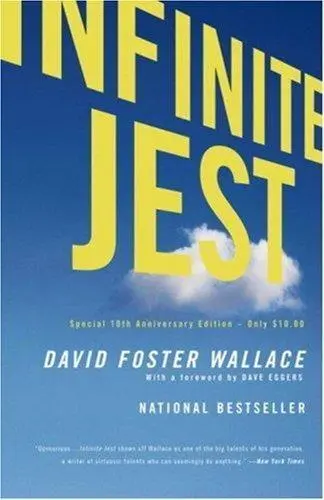
- Название:Infinite jest
- Автор:
- Издательство:Back Bay Books
- Жанр:
- Год:2006
- ISBN:нет данных
- Рейтинг книги:3 / 5. Голосов: 1
-
Избранное:Добавить в избранное
- Отзывы:
-
Ваша оценка:
Infinite jest: краткое содержание, описание и аннотация
Предлагаем к чтению аннотацию, описание, краткое содержание или предисловие (зависит от того, что написал сам автор книги «Infinite jest»). Если вы не нашли необходимую информацию о книге — напишите в комментариях, мы постараемся отыскать её.
Infinite Jest
On this outrageous frame hangs an exploration of essential questions about what entertainment is, and why it has come to so dominate our lives; about how our desire for entertainment interacts with our need to connect with other humans; and about what the pleasures we choose say about who we are. Equal parts philosophical quest and screwball comedy, Infinite Jest bends every rule of fiction without sacrificing for a moment its own entertainment value. The huge cast and multilevel narrative serve a story that accelerates to a breathtaking, heartbreaking, unfogettable conclusion. It is an exuberant, uniquely American exploration of the passions that make us human and one of those rare books that renew the very idea of what a novel can do.
Infinite jest — читать онлайн бесплатно полную книгу (весь текст) целиком
Ниже представлен текст книги, разбитый по страницам. Система сохранения места последней прочитанной страницы, позволяет с удобством читать онлайн бесплатно книгу «Infinite jest», без необходимости каждый раз заново искать на чём Вы остановились. Поставьте закладку, и сможете в любой момент перейти на страницу, на которой закончили чтение.
Интервал:
Закладка:
Joelle scrubbed at the discolored square of fingerprints around the light-switch until the wet Kleenex disintegrated into greebles.
Never trust a man on the subject of his own parents. As tall and basso as a man might be on the outside, he nevertheless sees his parents from the perspective of a tiny child, still, and will always. And the unhappier his childhood was, the more arrested will be his perspective on it. She’s learned this through sheer experience.
Greebles had been her own mother’s word for the little bits of sleepy goo you got in your eyes’ corners. Her own personal Daddy called them ‘eye-boogers’ and used to get them out for her with the twisted corner of his hankie.
Though it’s not as if you could trust parents on the subject of their memory of their children either.
The cheap glass shade over the ceiling’s light was black with interior grime and dead bugs. Some of the bugs looked like they might have been from long-extinct species. The loose grime alone filled half an empty Carefree box. The more stubborn crud would take a scouring pad and ammonia. Joelle put the shade aside for until she’d shot down to the kitchen to toss out different boxes of crud and wet Kleenex and grab some serious Chore-type supplies from under the sink.
Orin had said she was the third-neatnikest person he knew after his Moms and a former player he’d played with with Obsessive Compulsive Disorder, a dual diagnosis with which the U.H.I.D. membership was rife. But at the time the import had missed her. At that time it had never occurred to her that Orin’s pull toward her could have had anything either pro or con to do with his mother. Her biggest worry was that Orin was pulled only by what she looked like, which her personal Daddy’d warned her the sweetest syrup draws the nastiest flies, so to watch out.
Orin hadn’t been anything like her own personal Daddy. When Orin was out of the room it had never seemed like a relief. When she was home, her own Daddy never seemed to be out of the room for more than a few seconds. Her mother said she hardly even tried to talk to him when his Pokie was home. He kind of trailed her around from room to room, kind of pathetically, talking batons and low-pH chemistry. It was like when she exhaled he inhaled and vice versa. He was all through the house. He was real present at all times. His presence penetrated a room and outlasted him there. Orin’s absence, whether for class or practice, emptied the co-op out. The place seemed vacuumed and buffed sterile before the cleaning even started, when he went. She didn’t feel lonely in the place without him, but she did feel alone, what alone was going to feel like, and she, no one’s fool, [305]was erecting fortifications real early into it.
It was Orin, of course, who’d introduced them. He’d had this stubborn idea that Himself would want to use her. In the Work. She was too pretty for somebody not to want to arrange, capture. Better Himself than some weak-chinned academic. Joelle’d protested the whole idea. She had a brainy girl’s discomfort about her own beauty and its effect on folks, a caution intensified by the repeated warnings of her personal Daddy. Even more to the immediate point, her filmic interests lay behind the lens. She’d do the capturing thank you very much. She wanted to make things, not appear in them. She had a student filmmaker’s vague disdain for actors. Worst, Orin’s idea’s real project was developmentally obvious: he thought he could somehow get to his father through her. That he pictured himself having weighty, steeple-fingered conversations with the man, Joelle’s appearance and performance the subjects. A three-way bond. It made her real uneasy. She theorized that Orin unconsciously wished her to mediate between himself and ‘Himself,’ just as it sounded like his mother had. She was uneasy about the excited way Orin predicted that his father wouldn’t be able to ‘‘resist using’ her. She was extra uneasy about how Orin referred to his father as ‘Himself.’ It seemed painfully blatant, developmental-arrest-wise. Plus she felt — only a little less than she made it sound, on the futon at night, protesting — she’d felt uneasy at the prospect of any sort of connection with the man who had hurt Orin so, a man so monstrously tall and cold and remotely hidden. Joelle heard a howl and a crash from the kitchen, followed by McDade’s tubercular laugh. Twice Charlotte Treat sat up in sleep, glistening with fever, and said in a flat dead voice something that sounded for all the world like ‘Trances in which she did not breathe,’ and then fell back, out. Joelle was trying to pin down a queer rancid-cinnamon smell that came from the back of a closet stuffed with luggage. It was especially hard to clean when you weren’t supposed to be allowed to touch any other resident’s stuff.
She might have known from the Work. The man’s Work was amateurish, she’d seen, when Orin had had his brother — the unretarded one — lend them some of The Mad Stork’s Read-Only copies. Was amateurish the right word? More like the work of a brilliant optician and technician who was an amateur at any kind of real communication. Technically gorgeous, the Work, with lighting and angles planned out to the frame. But oddly hollow, empty, no sense of dramatic towardness — no narrative movement toward a real story; no emotional movement toward an audience. Like conversing with a prisoner through that plastic screen using phones, the upperclassman Molly Notkin had said of Incandenza’s early oeuvre. Joelle thought them more like a very smart person conversing with himself. She thought of the significance of the moniker ‘Himself.’ Cold. Pre-Nuptial Agreement of Heaven and Hell — mordant, sophisticated, campy, hip, cynical, technically mind-bending; but cold, amateurish, hidden: no risk of empathy with the Job-like protagonist, whom she felt like the audience was induced to regard like somebody sitting atop a dunk-tank. The lampoons of ‘inverted’ genres: archly funny and sometimes insightful but with something provisional about them, like the finger-exercises of someone promising who refused to really sit down and play something to test that promise. Even as an under-grad Joelle’d been convinced that parodists were no better than camp-followers in ironic masks, satires usually the work of people with nothing new themselves to say. [306] ‘The Medusa v. the Odalisque’ — cold, allusive, inbent, hostile: the only feeling for the audience one of contempt, the meta-audience in the film’s theater presented as objects long before they turn to blind stone.
But there had been flashes of something else. Even in the early oeuvre, before Himself made the leap to narratively anticonfluential but unironic melodrama she helped prolong the arc of, where he dropped the technical fireworks and tried to make characters move, however inconclusively, and showed courage, abandoned everything he did well and willingly took the risk of appearing amateurish (which he had). But even in the early Work — flashes of something. Very hidden and quick. Almost furtive. She noticed them only when alone, watching, without Orin and his rheostat’s dimmer, the living room’s lights up high like she liked them, liked to see herself and everything else in the room with the viewer — Orin liked to sit in the dark and enter what he watched, his jaw slackening, a child raised on multichannel cable TV. But Joelle began — on repeated viewing whose original purpose was to study how the man had blocked out scenes, for an Advanced Storyboard course she went the extra click in — she began to see little flashes of something. The M v. O.’s three quick cuts to the sides of the gorgeous combatants’ faces, twisted past recognition with some kind of torment. Each cut to a flash of pained face had followed the crash of a petrified spectator toppling over in her chair. Three split-seconds, no more, of glimpses of facial pain. And not pain at wounds — they never touched each other, whirling with mirrors and blades; the defenses of both were impenetrable. More like as if what their beauty was doing to those drawn to watch it ate them alive, up there on stage, the flashes seemed to suggest. But just three flashes, each almost subliminally quick. Accidents? But not one shot or cut in the whole queer cold film was accidental — the thing was clearly s-boarded frame by frame. Must have taken hundreds of hours. Astounding technical anality. Joelle kept trying to Pause the cartridge on the flashes of facial torment, but these were the early days of InterLace cartridges, and the Pause still distorted the screen just enough to keep her from seeing what she wanted to study. Plus she got the creepy feeling the man had upped the film-speed in these few-frame human flashes, to thwart just such study. It was like he couldn’t help putting human flashes in, but he wanted to get them in as quickly and unstudyably as possible, as if they compromised him somehow.
Читать дальшеИнтервал:
Закладка:
Похожие книги на «Infinite jest»
Представляем Вашему вниманию похожие книги на «Infinite jest» списком для выбора. Мы отобрали схожую по названию и смыслу литературу в надежде предоставить читателям больше вариантов отыскать новые, интересные, ещё непрочитанные произведения.



Обсуждение, отзывы о книге «Infinite jest» и просто собственные мнения читателей. Оставьте ваши комментарии, напишите, что Вы думаете о произведении, его смысле или главных героях. Укажите что конкретно понравилось, а что нет, и почему Вы так считаете.