David Wallace - Infinite jest
Здесь есть возможность читать онлайн «David Wallace - Infinite jest» весь текст электронной книги совершенно бесплатно (целиком полную версию без сокращений). В некоторых случаях можно слушать аудио, скачать через торрент в формате fb2 и присутствует краткое содержание. Год выпуска: 2006, Издательство: Back Bay Books, Жанр: Современная проза, на русском языке. Описание произведения, (предисловие) а так же отзывы посетителей доступны на портале библиотеки ЛибКат.
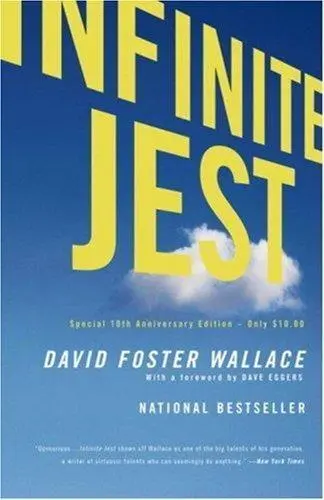
- Название:Infinite jest
- Автор:
- Издательство:Back Bay Books
- Жанр:
- Год:2006
- ISBN:нет данных
- Рейтинг книги:3 / 5. Голосов: 1
-
Избранное:Добавить в избранное
- Отзывы:
-
Ваша оценка:
Infinite jest: краткое содержание, описание и аннотация
Предлагаем к чтению аннотацию, описание, краткое содержание или предисловие (зависит от того, что написал сам автор книги «Infinite jest»). Если вы не нашли необходимую информацию о книге — напишите в комментариях, мы постараемся отыскать её.
Infinite Jest
On this outrageous frame hangs an exploration of essential questions about what entertainment is, and why it has come to so dominate our lives; about how our desire for entertainment interacts with our need to connect with other humans; and about what the pleasures we choose say about who we are. Equal parts philosophical quest and screwball comedy, Infinite Jest bends every rule of fiction without sacrificing for a moment its own entertainment value. The huge cast and multilevel narrative serve a story that accelerates to a breathtaking, heartbreaking, unfogettable conclusion. It is an exuberant, uniquely American exploration of the passions that make us human and one of those rare books that renew the very idea of what a novel can do.
Infinite jest — читать онлайн бесплатно полную книгу (весь текст) целиком
Ниже представлен текст книги, разбитый по страницам. Система сохранения места последней прочитанной страницы, позволяет с удобством читать онлайн бесплатно книгу «Infinite jest», без необходимости каждый раз заново искать на чём Вы остановились. Поставьте закладку, и сможете в любой момент перейти на страницу, на которой закончили чтение.
Интервал:
Закладка:
And then naturally also a wider range of field-test Subjects would then be required, to verify that this Subject’s responses were not merely subjective and typical only of a certain sensibility of entertainment-consumer. The bus window yielded a faint and ghostly reflection of Fortier, and, through that faint view, the lights of urban life outside the bus. Somerville Massachusetts U.S.A.’s Phoenix House administrative person had listened to Fortier’s delivery with shows of great compassion, then explained with patience that they were unable to admit addicted persons for whom English was the secondary language. D ‘accord, though he was pretending disappointment. Fortier had been able to see the admitted addicts of Phoenix House holding a gathering in the room of living outside the office door: no person among them wore a veil of facial concealment, and so c’est ça. Four small teams were at this moment rolling through the streets and small streets and alleys of the unpleasant district of the Antitoi establishment, for the purpose of acquiring additional Subjects for M. Broullîme for the time when the Subject’s digits were expended. The Subjects for suitability had to be passively undefended enough to be acquired publicly with quiet, yet not damaged in the brains or under the influence of the many of the district’s intoxicant compounds. The A.F.R. were highly trained in patience and to be disciplined.
The southbound bus, empty and (which he detested) fluorescently lit, climbs a thin hill off Winter Park, north Cambridge, heading for the Squares Inman and Central. Fortier looks out at the lights passing. He can smell snow coming; it soon will snow. He sees in his imagination two-thirds of NNE’s largest urban city inert, sybaritically entranced, staring, without bodily movement, home-bounded, fouling their divans and the chairs which may recline. He sees the district of business’s towers of buildings and luxury apartments striated as two of every three floors is darkened to lightless black. With here and there the vaguely blue flicker of expensive digital entertainment equipment flickering through darkened windows. He imagines M. Tine holding the hand holding the pen of President J. Gentle as the O.N.A.N.ite President signs declaring War. He imagines teacups clinking thinly beneath trembling hands in the interior sanctums of Ottawa’s sanctum of power. He adjusts his sportcoat’s lapel over his sweater and smooths the wiry hair that tends to bulge unsmoothly around the bare spot. He watches the back of the bus driver’s neck as the driver stares straight ahead.
Sure enough the Chinkette women had been strengthless and lightweight, flew aside like dolls, and their bags were indeed treasure-heavy, hard to heft; but as Lenz cut left down the north-south alley he could hold the bags by their twine handles out slightly before him, so their weight’s momentum kind of pulled him along. The cruciform alleys through the blocks between Central and Inman in Little Lisbon were a kind of second city. Lenz ran. His breath came easy and he could feel himself from scalp to sole. Green and green-with-red dumpsters lined both walls and made the going narrow. He vaulted two sitting figures in khaki sharing a can of Sterno on the alley floor. He glided through the foul air above them, untouched by it. The sounds behind him were his footfalls’ echo off dumpsters and fire-escapes’ iron. His left hand ached nicely from holding both a bag’s handle and his large-print volume. A dumpster up ahead had been hitched to an E.W.D. truck and just left to sit: probably quitting time. The Empire guys had an incredible union. In the recess of the hitch’s bar a small blue light flickered and died. This was a dozen dumpsters up ahead. Lenz slowed to a brisk walk. His topcoat had slipped slightly off one of his shoulders but he had no free hand to fix it and wasn’t going to take time to put a bag down. His left hand felt cramped. It was somewhere vague between 2224 and 2226h. The alley was dark as a pocket. A tiny crash off somewhere south down the network of alleys was actually Poor Tony Krause rolling the steel waste-barrel that tripped up Ruth van Cleve. The tiny blue flame came on, hung still, flickered, moved, hung there, went back out. Its glow was dark blue against the back of the huge E.W.D. truck. Empire trucks were unstoppable, hitches were valuable but locked down with a Kryptonite device thing you needed welding stuff to cut through. From the recess of the hitch there were small sounds. When the lighter lit again Lenz was almost on them, two boys on the hitch and two squatting down by the hitch facing them, four of them, a fire-escape’s pull-ladder distended like a tongue and hanging just above them. None of the boys was over like twelve. They used a M. Fizzy bottle instead of a pipe, and the smell of burnt plastic hung mixed with the sicksweet smell of overcarbonated rock. The boys were all small and slight and either black or spic, greedily hunching over the flame; they looked ratty. Lenz kept them in peripheral view as he strode briskly by, carrying his bags, spine straight and extruding dignified purpose. The lighter went out. The boys on the hitch eyed Lenz’s bags. The squatting boys turned their heads to look. Lenz kept them in peripheral view. None of them wore watches. One of them wore a knit cap and watched steadily. He locked eyes with Lenz’s left eye, made a gun of his thin hand, pretended to draw a slow bead. Like performing for the others. Lenz walked by with urban dignity, like he both saw them and didn’t. The smell was intense but real local, of the rock and bottle. He had to veer out to miss the Empire truck’s side mirror on its steel strut. He heard them say things as the truck’s grille fell behind, and unkind laughter, and then something called out in a minority agnate he didn’t know. He heard the lighter’s flint. He thought to himself Assholes. He was looking for someplace empty and a bit more lit, to go through the bags. And cleaner than this one north-south alley here, which smelled of ripe waste and rotting skin. He would separate the bags’ valuables from the nonvaluables and transfer the valuables to a single bag. He would fence the nonnegotiable valuables in Little Lisbon and refill the receptacle in his medical dictionary, and buy some attractiver shoes. The alley was devroid of cats and rodents both; he did not stop to reflect why. A rock or bit of brick courtesy of the junior crack-jockeys back there landed behind him and skittered past and rang out against something, and someone cried out aloud, a sexless figure lying back against a maybe duffel bag or pack against a dump-ster, its hand moving furiously in its groin and its feet pointed out into the alley and turned out like a dead body’s, its shoes two different shoes, its hair a clotted mass around its face, looking up over at Lenz going past in the faint start of light from a broader alley’s intersection ahead, chanting softly what Lenz could hear as he stepped gingerly over the rot-smelling legs as ‘Pretty, pretty, pretty.’ Lenz whispered to himself ‘Jesus what a lot of fucked-up ass-eating fucking losers.’
‘Our cult burned money for fuel.’
‘As in like currency.’
‘We used Ones. The Semi Divine One advocated thrift. We’d bring them to Him at the stove. There was one stove. We had to bring them to Him on our knees with no part of our feet could touch the floor. He sat by the stove in our blankets and fed it Ones. We got an extra slap if the currency was new.’
‘As in like crisp and new.’
‘It was a cleansing. Somebody always played a drum.’
‘Our cult’s Divinely Chosen Leader drove a Rolls. In neutral. We pushed him wherever he was Called to like be at. He never turned it on. The Rolls. I got all muscled up.’
‘In summer then they made us slither on our bellies. We had to embrace our snake-nature. It was a cleansing.’
Читать дальшеИнтервал:
Закладка:
Похожие книги на «Infinite jest»
Представляем Вашему вниманию похожие книги на «Infinite jest» списком для выбора. Мы отобрали схожую по названию и смыслу литературу в надежде предоставить читателям больше вариантов отыскать новые, интересные, ещё непрочитанные произведения.





Обсуждение, отзывы о книге «Infinite jest» и просто собственные мнения читателей. Оставьте ваши комментарии, напишите, что Вы думаете о произведении, его смысле или главных героях. Укажите что конкретно понравилось, а что нет, и почему Вы так считаете.