David Wallace - Infinite jest
Здесь есть возможность читать онлайн «David Wallace - Infinite jest» весь текст электронной книги совершенно бесплатно (целиком полную версию без сокращений). В некоторых случаях можно слушать аудио, скачать через торрент в формате fb2 и присутствует краткое содержание. Год выпуска: 2006, Издательство: Back Bay Books, Жанр: Современная проза, на русском языке. Описание произведения, (предисловие) а так же отзывы посетителей доступны на портале библиотеки ЛибКат.
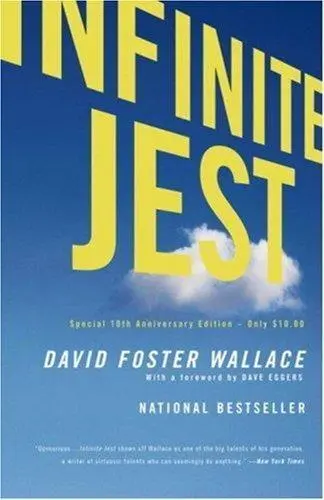
- Название:Infinite jest
- Автор:
- Издательство:Back Bay Books
- Жанр:
- Год:2006
- ISBN:нет данных
- Рейтинг книги:3 / 5. Голосов: 1
-
Избранное:Добавить в избранное
- Отзывы:
-
Ваша оценка:
Infinite jest: краткое содержание, описание и аннотация
Предлагаем к чтению аннотацию, описание, краткое содержание или предисловие (зависит от того, что написал сам автор книги «Infinite jest»). Если вы не нашли необходимую информацию о книге — напишите в комментариях, мы постараемся отыскать её.
Infinite Jest
On this outrageous frame hangs an exploration of essential questions about what entertainment is, and why it has come to so dominate our lives; about how our desire for entertainment interacts with our need to connect with other humans; and about what the pleasures we choose say about who we are. Equal parts philosophical quest and screwball comedy, Infinite Jest bends every rule of fiction without sacrificing for a moment its own entertainment value. The huge cast and multilevel narrative serve a story that accelerates to a breathtaking, heartbreaking, unfogettable conclusion. It is an exuberant, uniquely American exploration of the passions that make us human and one of those rare books that renew the very idea of what a novel can do.
Infinite jest — читать онлайн бесплатно полную книгу (весь текст) целиком
Ниже представлен текст книги, разбитый по страницам. Система сохранения места последней прочитанной страницы, позволяет с удобством читать онлайн бесплатно книгу «Infinite jest», без необходимости каждый раз заново искать на чём Вы остановились. Поставьте закладку, и сможете в любой момент перейти на страницу, на которой закончили чтение.
Интервал:
Закладка:
Geoffrey Day’s noted the way most of the male residents of Ennet House have special little cognomens for their genitals. E.g. ‘Bruno,’ ‘Jake,’ ‘Fang’ (Minty), ‘The One-Eyed Monk,’ ‘Fritzie,’ ‘Russell the Love Muscle.’ He speculates this could be a class thing: neither he nor Ewell nor Ken Erdedy have named their Units. Like Ewell, Day enters a certain amount of comparative-class data in his journal. Doony Glynn called his penis ‘Poor Richard’; Chandler Foss confessed to the moniker ‘Barn-Bam.’ Lenz had referred to his own Unit as ‘the Frightful Hog.’ Day would die before admitting he missed either Lenz or his soliloquies about the Hog, which had been frequent. The penis in question had been that curious two or three shades darker than the rest of Lenz that people’s penises sometimes are. Lenz had brandished it at his roommates whenever he wished to emphasize a point. It had been short and thick and blunt, and Lenz described the Hog as a prímo example of what he called the Polish Curse, viz. undistinguished length but sobering circumference: ‘Easy on the bottom but tears hell out of the sides, brother.’ This had been his description of the Polish Curse. A surprising amount of Day’s Recovery Journal is filled with quotations from R. Lenz. Lenz’s discharge had moved the tax-attorney Tiny Ewell up into the 3-Man room with Day. Ewell was the one man here with whom a conversation of anything remotely approaching depth could be held, so Day was nonplussed when he found himself, after a couple long nights, almost missing Lenz, his obsession with time, his patter, his way of leaning up against the wall upside-down in his briefs, or brandishing the Hog.
And re Ennet House resident Kate Gompert and this depression issue: Some psychiatric patients — plus a certain percentage of people who’ve gotten so dependent on chemicals for feelings of well-being that when the chemicals have to be abandoned they undergo a loss-trauma that reaches way down deep into the soul’s core systems — these persons know firsthand that there’s more than one kind of so-called ‘depression.’ One kind is low-grade and sometimes gets called anhedonia [280] or simple melancholy. It’s a kind of spiritual torpor in which one loses the ability to feel pleasure or attachment to things formerly important. The avid bowler drops out of his league and stays home at night staring dully at kick-boxing cartridges. The gourmand is off his feed. The sensualist finds his beloved Unit all of a sudden to be so much feelingless gristle, just hanging there. The devoted wife and mother finds the thought of her family about as moving, all of a sudden, as a theorem of Euclid. It’s a kind of emotional novocaine, this form of depression, and while it’s not overtly painful its deadness is disconcerting and … well, depressing. Kate Gompert’s always thought of this anhedonic state as a kind of radical abstracting of everything, a hollowing out of stuff that used to have affective content. Terms the undepressed toss around and take for granted as full and fleshy — happiness, joie de vivre, preference, love — are stripped to their skeletons and reduced to abstract ideas. They have, as it were, denotation but not connotation. The anhedonic can still speak about happiness and meaning et ah, but she has become incapable of feeling anything in them, of understanding anything about them, of hoping anything about them, or of believing them to exist as anything more than concepts. Everything becomes an outline of the thing. Objects become schemata. The world becomes a map of the world. An anhedonic can navigate, but has no location. I.e. the anhedonic becomes, in the lingo of Boston AA, Unable To Identify.
It’s worth noting that, among younger E.T.A.s, the standard take on Dr. J. O. Incandenza’s suicide attributes his putting his head in the microwave to this kind of anhedonia. This is maybe because anhedonia’s often associated with the crises that afflict extremely goal-oriented people who reach a certain age having achieved all or more than all than they’d hoped for. The what-does-it-all-mean-type crisis of middle-aged Americans. In fact this is in fact not what killed Incandenza at all. In fact the presumption that he’d achieved all his goals and found that the achievement didn’t confer meaning or joy on his existence says more about the students at E.T.A. than it says about Orin’s and Hal’s father: still under the influence of the deLint-like carrot-and-stick philosophies of their hometown coaches rather than the more paradoxical Schtitt/Incandenza/Lyle school, younger athletes who can’t help gauging their whole worth by their place in an ordinal ranking use the idea that achieving their goals and finding the gnawing sense of worthlessness still there in their own gut as a kind of psychic bogey, something that they can use to justify stopping on their way down to dawn drills to smell flowers along the E.T.A. paths. The idea that achievement doesn’t automatically confer interior worth is, to them, still, at this age, an abstraction, rather like the prospect of their own death — ‘Caius Is Mortal’ and so on. Deep down, they all still view the competitive carrot as the grail. They’re mostly going through the motions when they invoke anhedonia. They’re mostly small children, keep in mind. Listen to any sort of sub-16 exchange you hear in the bathroom or food line: ‘Hey there, how are you?’ ‘Number eight this week, is how I am.’ They all still worship the carrot. With the possible exception of the tormented LaMont Chu, they all still subscribe to the delusive idea that the continent’s second-ranked fourteen-year-old feels exactly twice as worthwhile as the continent’s #4.
Deluded or not, it’s still a lucky way to live. Even though it’s temporary. It may well be that the lower-ranked little kids at E.T.A. are proportionally happier than the higher-ranked kids, since we (who are mostly not small children) know it’s more invigorating to want than to have, it seems. Though maybe this is just the inverse of the same delusion.
Hal Incandenza, though he has no idea yet of why his father really put his head in a specially-dickied microwave in the Year of the Trial-Size Dove Bar, is pretty sure that it wasn’t because of standard U.S. anhedonia. Hal himself hasn’t had a bona fide intensity-of-interior-life-type emotion since he was tiny; he finds terms like joie and value to be like so many variables in rarified equations, and he can manipulate them well enough to satisfy everyone but himself that he’s in there, inside his own hull, as a human being — but in fact he’s far more robotic than John Wayne. One of his troubles with his Moms is the fact that Avril Incandenza believes she knows him inside and out as a human being, and an internally worthy one at that, when in fact inside Hal there’s pretty much nothing at all, he knows. His Moms Avril hears her own echoes inside him and thinks what she hears is him, and this makes Hal feel the one thing he feels to the limit, lately: he is lonely.
It’s of some interest that the lively arts of the millennial U.S.A. treat anhedonia and internal emptiness as hip and cool. It’s maybe the vestiges of the Romantic glorification of Weltschmerz, which means world-weariness or hip ennui. Maybe it’s the fact that most of the arts here are produced by world-weary and sophisticated older people and then consumed by younger people who not only consume art but study it for clues on how to be cool, hip — and keep in mind that, for kids and younger people, to be hip and cool is the same as to be admired and accepted and included and so Unalone. Forget so-called peer-pressure. It’s more like peer-hunger. No? We enter a spiritual puberty where we snap to the fact that the great transcendent horror is loneliness, excluded encagement in the self. Once we’ve hit this age, we will now give or take anything, wear any mask, to fit, be part-of, not be Alone, we young. The U.S. arts are our guide to inclusion. A how-to. We are shown how to fashion masks of ennui and jaded irony at a young age where the face is fictile enough to assume the shape of whatever it wears. And then it’s stuck there, the weary cynicism that saves us from gooey sentiment and unsophisticated naïveté. Sentiment equals na-ïveté on this continent (at least since the Reconfiguration). One of the things sophisticated viewers have always liked about J. O. Incandenza’s The American Century as Seen Through a Brick is its unsubtle thesis that naïveté is the last true terrible sin in the theology of millennial America. And since sin is the sort of thing that can be talked about only figuratively, it’s natural that Himself’s dark little cartridge was mostly about a myth, viz. that queerly persistent U.S. myth that cynicism and naïveté are mutually exclusive. Hal, who’s empty but not dumb, theorizes privately that what passes for hip cynical transcendence of sentiment is really some kind of fear of being really human, since to be really human fat least as he conceptualizes it) is probably to be unavoidably sentimental and naive and goo-prone and generally pathetic, is to be in some basic interior way forever infantile, some sort of not-quite-right-looking infant dragging itself anaclitically around the map, with big wet eyes and froggy-soft skin, huge skull, gooey drool. One of the really American things about Hal, probably, is the way he despises what it is he’s really lonely for: this hideous internal self, incontinent of sentiment and need, that pules and writhes just under the hip empty mask, anhedonia.[281]
Читать дальшеИнтервал:
Закладка:
Похожие книги на «Infinite jest»
Представляем Вашему вниманию похожие книги на «Infinite jest» списком для выбора. Мы отобрали схожую по названию и смыслу литературу в надежде предоставить читателям больше вариантов отыскать новые, интересные, ещё непрочитанные произведения.







Обсуждение, отзывы о книге «Infinite jest» и просто собственные мнения читателей. Оставьте ваши комментарии, напишите, что Вы думаете о произведении, его смысле или главных героях. Укажите что конкретно понравилось, а что нет, и почему Вы так считаете.