David Wallace - Infinite jest
Здесь есть возможность читать онлайн «David Wallace - Infinite jest» весь текст электронной книги совершенно бесплатно (целиком полную версию без сокращений). В некоторых случаях можно слушать аудио, скачать через торрент в формате fb2 и присутствует краткое содержание. Год выпуска: 2006, Издательство: Back Bay Books, Жанр: Современная проза, на русском языке. Описание произведения, (предисловие) а так же отзывы посетителей доступны на портале библиотеки ЛибКат.
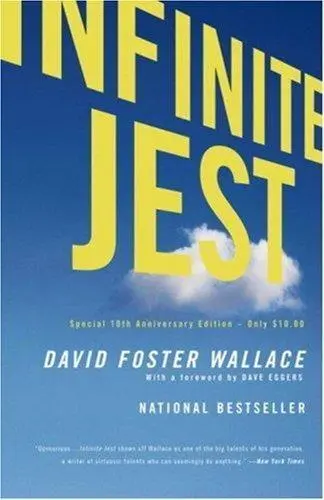
- Название:Infinite jest
- Автор:
- Издательство:Back Bay Books
- Жанр:
- Год:2006
- ISBN:нет данных
- Рейтинг книги:3 / 5. Голосов: 1
-
Избранное:Добавить в избранное
- Отзывы:
-
Ваша оценка:
Infinite jest: краткое содержание, описание и аннотация
Предлагаем к чтению аннотацию, описание, краткое содержание или предисловие (зависит от того, что написал сам автор книги «Infinite jest»). Если вы не нашли необходимую информацию о книге — напишите в комментариях, мы постараемся отыскать её.
Infinite Jest
On this outrageous frame hangs an exploration of essential questions about what entertainment is, and why it has come to so dominate our lives; about how our desire for entertainment interacts with our need to connect with other humans; and about what the pleasures we choose say about who we are. Equal parts philosophical quest and screwball comedy, Infinite Jest bends every rule of fiction without sacrificing for a moment its own entertainment value. The huge cast and multilevel narrative serve a story that accelerates to a breathtaking, heartbreaking, unfogettable conclusion. It is an exuberant, uniquely American exploration of the passions that make us human and one of those rare books that renew the very idea of what a novel can do.
Infinite jest — читать онлайн бесплатно полную книгу (весь текст) целиком
Ниже представлен текст книги, разбитый по страницам. Система сохранения места последней прочитанной страницы, позволяет с удобством читать онлайн бесплатно книгу «Infinite jest», без необходимости каждый раз заново искать на чём Вы остановились. Поставьте закладку, и сможете в любой момент перейти на страницу, на которой закончили чтение.
Интервал:
Закладка:
‘You just never quite occurred out there, kid,’ deLint apprises him. He has regressed certain figures to back this up, this nonoccurrence. His choice of words chills Hal to the root.
After which, during what’s supposed to be mandatory P.M. Study Period, and despite the three chapters of Boards-prep his Boards-prep schedule calls for, Hal sits alone up in Viewing Room 6, the bad leg out along the couch in front of him, flexing the bad ankle idly, holding the other leg’s knee to his chest, squeezing a ball but with the hand he doesn’t play with, chewing Kodiak and spitting directly into an unlined wastebasket, his expression neutral, watching some cartridges of his late father’s entertainments. Anyone else looking at him in there tonight would call Hal depressed. He watches several cartridges all in a row. He watches The American Century as Seen Through a Brick and Pre-Nuptial Agreement of Heaven and Hell and then part of Valuable Coupon Has Been Removed, which is maddening because it’s all a monologue from some bespectacled little contemporary of Miles Penn and Heath Pearson who was almost as ubiquitous as Reat and Bain in Himself’s work but whose name right now Hal can’t for the life of him recall. He watches parts of Death in Scarsdale and Union of Publicly Hidden in Lynn and Various Small Flames and Kinds of Pain. The Viewing Room has insulated panelling behind the wallpaper and is essentially soundproof. Hal watches half of the ‘Medusa v. Odalisque’ thing but takes it out abruptly when people in the audience start getting turned to stone.
Hal tortures himself by imagining swarthy leering types threatening to torture various loved ones if Hal can’t come up with the name of the kid in Valuable Coupon and Low-Temperature Civics and Wave Bye-Bye to the Bureaucrat.
There are two cartridges on V.R. 6’s glass shelves of Himself getting interviewed in various arty Community-Access-cable-type forums, which Hal declines to watch.
The lights’ slight flicker and subtle change in the pressure of the room is from the E.T.A. furnaces kicking on way down in the tunnels below Comm.-Ad. Hal shifts uneasily on the couch, spitting into the wastecan. The very faint smell of burnt dust is also from the furnace.
A minor short didactic one Hal likes and runs twice in a row is Wave Bye-Bye to the Bureaucrat. A bureaucrat in some kind of sterile fluorescent-lit office complex is a fantastically efficient worker when awake, but he has this terrible problem waking up in the A.M., and is consistently late to work, which in a bureaucracy is idiosyncratic and disorderly and wholly unacceptable, and we see this bureaucrat getting called in to his supervisor’s pebbled-glass cubicle, and the supervisor, who wears a severely dated leisure suit with his shirt-collar flaring out on either side of its rust-colored lapels, tells the bureaucrat that’s he’s a good worker and a fine man, but that this chronic tardiness in the A.M. is simply not going to fly, and if it happens one more time the bureaucrat is going to have to find another fluorescent-lit office complex to work in. It’s no accident that in a bureaucracy getting fired is called ‘termination,’ as in ontological erasure, and the bureaucrat leaves his supervisor’s cubicle duly shaken. That night he and his wife go through their Bauhaus condominium collecting every alarm clock they own, each one of which is electric and digital and extremely precise, and they festoon their bedroom with them, so there are like a dozen timepieces with their digital alarms all set for 0615h. But that night there’s a power failure, and all the clocks lose an hour or just sit there blinking 0000h. over and over, and the bureaucrat still oversleeps the next A.M. He wakes late, lies there for a moment staring at a blinking 0000. He shrieks, clutches his head, throws on wrinkled clothes, ties his shoes in the elevator, shaves in the car, blasting through red lights on the way to the commuter rail. The 0816 train to the City pulls in to the station’s lower level just as the crazed bureaucrat’s car screeches into the station’s parking lot, and the bureaucrat can see the top of the train sitting there idling from across the open lot. This is the very last temporally feasible train: if the bureaucrat misses this train he’ll be late again, and terminated. He hauls into a Handicapped spot and leaves the car there at a crazy angle, vaults the turnstile, and takes the stairs down to the platform seven at a time, sweaty and bug-eyed. People scream and dive out of his way. As he careers down the long stairway he keeps his crazed eyes on the open doors of the 0816 train, willing them to stay open just a little longer. Finally, filmed in a glacial slo-mo, the bureaucrat leaps from the seventh-to-the-bottom step and lunges toward the train’s open doors, and right in mid-lunge smashes headlong into an earnest-faced little kid with thick glasses and a bow-tie and those nerdy little schoolboy-shorts who’s tottering along the platform under a tall armful of carefully wrapped packages. Kerwham, they collide. Bureaucrat and kid both stagger back from the impact. The kid’s packages go flying all over the place. The kid recovers his balance and stands there stunned, glasses and bow-tie askew. [279]The bureaucrat looks frantically from the kid to the litter of packages to the kid to the train’s doors, which are still open. The train thrums. Its interior is fluorescent-lit and filled with employed, ontologically secure bureaucrats. You can hear the station’s PA announcer saying something tinny and garbled about departure. The stream of platform foot-traffic opens around the bureaucrat and the stunned boy and the litter of packages. Ogilvie’d once lectured for a whole period on this kid’s character as an instance of the difference between an antagonist and a deuteragonist in moral drama; he’d mentioned the child-actor’s name over and over. Hal tries whacking himself just over the right eye several times, to dislodge the name. The film’s bureaucrat’s buggy eyes keep going back and forth between the train’s open doors and the little kid, who’s looking steadily up at him, almost studious, his eyes big and liquid behind the lenses. Hal doesn’t remember who played the bureaucrat, either, but it’s the kid’s name that’s driving him bats. The bureaucrat’s leaning away, inclined way over toward the train doors, as if his very cells were being pulled that way. But he keeps looking at the kid, the gifts, struggling with himself. It’s a clear internal-conflict moment, one of Himself’s films’ very few. The bureaucrat’s eyes suddenly recede back into their normal places in his sockets. He turns from the fluorescent doors and bends to the kid and asks if he’s OK and says it’ll all be OK. He cleans the kid’s spectacles with his pocket handkerchief, picks the kid’s packages up. About halfway through the packages the PA issues something final and the train’s doors close with a pressurized hiss. The bureaucrat gently loads the kid back up with packages, neatens them. The train pulls out. The bureaucrat watches the train pull out, expressionless. It’s anybody’s guess what he’s thinking. He straightens the kid’s bow-tie, kneeling down the way adults do when they’re ministering to a child, and tells him he’s sorry about the impact and that it’s OK. He turns to go. The platform’s mostly empty now. Now the strange moment. The kid cranes his neck around the packages and looks up at the guy as he starts to walk away:
‘Mister?’ the kid says. ‘Are you Jesus?’
‘Don’t I wish,’ the ex-bureaucrat says over his shoulder, walking away, as the kid shifts the packages and frees one little hand to wave Bye at the guy’s topcoat’s back as the camera, revealed now as mounted on the 0816’s rear, recedes from the platform and picks up speed.
Читать дальшеИнтервал:
Закладка:
Похожие книги на «Infinite jest»
Представляем Вашему вниманию похожие книги на «Infinite jest» списком для выбора. Мы отобрали схожую по названию и смыслу литературу в надежде предоставить читателям больше вариантов отыскать новые, интересные, ещё непрочитанные произведения.

Обсуждение, отзывы о книге «Infinite jest» и просто собственные мнения читателей. Оставьте ваши комментарии, напишите, что Вы думаете о произведении, его смысле или главных героях. Укажите что конкретно понравилось, а что нет, и почему Вы так считаете.