David Wallace - Infinite jest
Здесь есть возможность читать онлайн «David Wallace - Infinite jest» весь текст электронной книги совершенно бесплатно (целиком полную версию без сокращений). В некоторых случаях можно слушать аудио, скачать через торрент в формате fb2 и присутствует краткое содержание. Год выпуска: 2006, Издательство: Back Bay Books, Жанр: Современная проза, на русском языке. Описание произведения, (предисловие) а так же отзывы посетителей доступны на портале библиотеки ЛибКат.
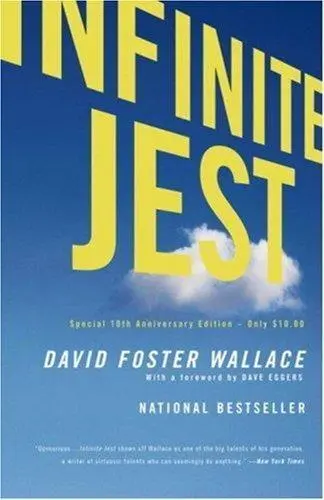
- Название:Infinite jest
- Автор:
- Издательство:Back Bay Books
- Жанр:
- Год:2006
- ISBN:нет данных
- Рейтинг книги:3 / 5. Голосов: 1
-
Избранное:Добавить в избранное
- Отзывы:
-
Ваша оценка:
Infinite jest: краткое содержание, описание и аннотация
Предлагаем к чтению аннотацию, описание, краткое содержание или предисловие (зависит от того, что написал сам автор книги «Infinite jest»). Если вы не нашли необходимую информацию о книге — напишите в комментариях, мы постараемся отыскать её.
Infinite Jest
On this outrageous frame hangs an exploration of essential questions about what entertainment is, and why it has come to so dominate our lives; about how our desire for entertainment interacts with our need to connect with other humans; and about what the pleasures we choose say about who we are. Equal parts philosophical quest and screwball comedy, Infinite Jest bends every rule of fiction without sacrificing for a moment its own entertainment value. The huge cast and multilevel narrative serve a story that accelerates to a breathtaking, heartbreaking, unfogettable conclusion. It is an exuberant, uniquely American exploration of the passions that make us human and one of those rare books that renew the very idea of what a novel can do.
Infinite jest — читать онлайн бесплатно полную книгу (весь текст) целиком
Ниже представлен текст книги, разбитый по страницам. Система сохранения места последней прочитанной страницы, позволяет с удобством читать онлайн бесплатно книгу «Infinite jest», без необходимости каждый раз заново искать на чём Вы остановились. Поставьте закладку, и сможете в любой момент перейти на страницу, на которой закончили чтение.
Интервал:
Закладка:
The rest, for Hal, is recent history.
By the time not only second-run Hollywood releases but a good many first-run films, plus new sitcoms and crime-dramas and near-live sports, plus now also big-name-anchor nightly newscasts, weather, art, health, and financial-analysis cartridges were available and pulsing nicely onto cartridges everywhere, the ranks of A.C.D.C.’s own solvent program-pumpers had been winnowed back to the old-movie-and-afternoon-baseball major-metro regional systems of more like the B.S. ‘80s. Passive pickings were slim
now. American mass-entertainment became inherently pro-active, consumer-driven. And because advertisements were now out of the televisual question — any halfway-sensitive Power-PC’s CPU could edit out anything shrill or ungratifying in the post-receipt Review Function of an entertainment-diskette — cartridge production (meaning by now both the satellitic ‘spontaneous dissemination’ of viewer-selected menu-programming and the factory-recording of programming on packaged 9.6 mb diskettes available cheap and playable on any CD-ROM-equipped system) yes cartridge production — though tentacularly controlled by an InterLace that had patented the digital-transmission process for moving images and held more stock than any one of the five Baby Bells involved in the InterNet fiber-optic transmission-grid bought for. 17 on the dollar from GTE after Sprint went belly-up trying to launch a primitively naked early mask- and Tableauxless form of videophony — became almost Hobbes-ianly free-market. No more Network reluctance to make a program too entertaining for fear its commercials would pale in comparison. The more pleasing a given cartridge was, the more orders there were for it from viewers; and the more orders for a given cartridge, the more InterLace kicked back to whatever production facility they’d acquired it from. Simple. Personal pleasure and gross revenue looked at last to lie along the same demand curve, at least as far as home entertainment went.
And as InterLace’s eventual outright purchase of the Networks’ production talent and facilities, of two major home-computer conglomerates, of the cutting-edge Froxx 210 °CD-ROM licenses of Aapps Inc., of RCA’s D.S.S. orbiters and hardware-patents, and of the digital-compatible patents to the still-needing-to-come-down-in-price-a-little technology of HDTV’s visually enhanced color monitor with microprocessed circuitry and  more lines of optical resolution — as these acquisitions allowed Noreen Lace-Forché’s cartridge-dissemination network to achieve vertical integration and economies of scale, viewers’ pulse-reception- and cartridge-fees went down markedly; [165]and then the further increased revenues from consequent increases in order- and rental-volume were plowed presciently back into more fiber-optic-InterGrid-cable-laying, into outright purchase of three of the five Baby Bells InterNet’d started with, into extremely attractive rebate-offers on special new InterLace-designed R.I.S.C. [166]-grade High-Def-screen PCs with mimetic-resolution cartridge-view motherboards (recognizably renamed by Veals’s boys in Recognition ‘Teleputers’ or ‘TPs’), into fiber-only modems, and, of course, into extremely high-quality entertainments that viewers would freely desire to choose even more.[167]
But there were — could be — no ads of any kind in the InterLace pulses or ROM cartridges, was the point Hal’s presentation kept struggling to return to. And so then besides e.g. a Turner who kept litigating bitterly via shortwave radio from his equatorial yacht, the true loser in the shift from A.C.D.C. cable to InterLace Grid was an American advertising industry already reeling from the death of broadcast’s Big Four. No significant markets seemed in any hurry to open up and compensate for the capping of TV’s old gusher. Agencies, reduced to skeletal cells of their best and most rapacious creative minds, cast wildly about for new pulses to finger and niches to fill. Billboards sprouted with near-mycological fury alongside even rural two-laners. No bus, train, trolley, or hack went unfestooned with high-gloss ads. Commercial airliners began for a while to trail those terse translucent ad-banners usually reserved for like Piper Cubs over football games and July beaches. Magazines (already endangered by HD-video equivalents) got so full of those infuriating little fall-out ad cards that Fourth-Class postal rates ballooned, making the e-mail of their video-equivalents that much more attractive, in another vicious spiral. Chicago’s once-vaunted Sickengen, Smith and Lundine went so far as to get Ford to start painting little domestic-product come-ons on their new lines’ side-panels, an idea that fizzled as U.S. customers in Nike T-shirts and Marlboro caps perversely refused to invest in ‘cars that sold out.’ In contrast to just about the whole rest of the industry, a certain partnerless metro-Boston ad agency was doing so well that it was more out of ennui and a sense of unlikely challenge that P. Tom Veals consented to manage PR for the fringe candidacy of a former crooner and schmaltz-mogul who went around swinging a mike and ranting about literally clean streets and creatively refocused blame and rocketing people’s waste into the forgiving chill of infinite space.[168]
30 APRIL / 1 MAY YEAR OF THE DEPEND ADULT UNDERGARMENT
Marathe did not quite sleep. They had remained on the shelf for some hours. He thought it a bit of much that Steeply refused even for a brief time to sit down upon the ground. If his persona’s skirt rode up above his weapon, what was the difference? Were grotesque and humiliating undergarments also involved? Marathe’s wife had been in an irreversible coma for fourteen months. Marathe was able to refresh himself without quite sleeping. It was not a state of fugue or neural relaxation, but a type of detachment. He had learned this in the months after losing his legs to a U.S.A. train. Part of Marathe floated off and hovered somewhere just above him, crossing its legs, nibbling at his consciousness as does a spectator at popcorn.
At some times on the outcropping Steeply went farther than crossing his arms, almost embracing himself, chilled but unwilling to comment on the chill. Marathe noted that the gesture of self-embrace appeared convincingly feminine and unconscious. Steeply’s preparations for his returning field-assignment had been disciplined and effective. The feature of complete un-swallowability about M. Steeply as a U.S.A. female journalist — even a massive and unfortunate-looking U.S.A. female journalist — was his feet. These were broad and yellow-nailed, hairy and trollesque, the ugliest feet Marathe had observed anywhere south of 60° N, and the ugliest supposedly female feet of his experience.
Both men were strangely reluctant, somehow, to broach the subject of plans for getting down off the shelf in the utter dark. Steeply didn’t even waste time wondering how Marathe could have gotten up (or down) there in the first place, short of some sort of helicopter drop, which capricious winds and the proximity of the mountainside made unlikely. The dogma around Unspecified Services was that if Les Assassins des Fauteuils Rollents had one Achilles’ heel it was their penchant for showing off, making a spectacle of denying any kind of physical limitation, etc. Steeply had field-interfaced with Rémy Marathe once on a rickety-feeling Louisiana oil platform 50-plus clicks out of Caillou Bay, covered the whole time by armed Cajun sympathizers. Marathe always disguised the boggling size of his arms under a long-sleeved windbreaker. His eyelids were half-closed whenever Steeply turned to look. If he (Marathe) were a cat he would be purring. One hand stayed below the blanket at all times, Steeply noted. Steeply himself had a small and unregistered Taurus PT9 taped to his shaved inner thigh, which was the main reason he was reluctant to sit down on the outcrop-ping’s stone; the weapon was unsafetied.
Читать дальшеИнтервал:
Закладка:
Похожие книги на «Infinite jest»
Представляем Вашему вниманию похожие книги на «Infinite jest» списком для выбора. Мы отобрали схожую по названию и смыслу литературу в надежде предоставить читателям больше вариантов отыскать новые, интересные, ещё непрочитанные произведения.











Обсуждение, отзывы о книге «Infinite jest» и просто собственные мнения читателей. Оставьте ваши комментарии, напишите, что Вы думаете о произведении, его смысле или главных героях. Укажите что конкретно понравилось, а что нет, и почему Вы так считаете.