David Wallace - Infinite jest
Здесь есть возможность читать онлайн «David Wallace - Infinite jest» весь текст электронной книги совершенно бесплатно (целиком полную версию без сокращений). В некоторых случаях можно слушать аудио, скачать через торрент в формате fb2 и присутствует краткое содержание. Год выпуска: 2006, Издательство: Back Bay Books, Жанр: Современная проза, на русском языке. Описание произведения, (предисловие) а так же отзывы посетителей доступны на портале библиотеки ЛибКат.
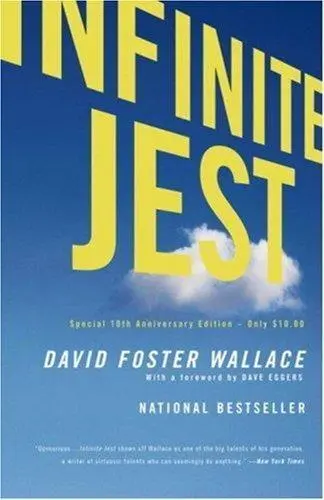
- Название:Infinite jest
- Автор:
- Издательство:Back Bay Books
- Жанр:
- Год:2006
- ISBN:нет данных
- Рейтинг книги:3 / 5. Голосов: 1
-
Избранное:Добавить в избранное
- Отзывы:
-
Ваша оценка:
Infinite jest: краткое содержание, описание и аннотация
Предлагаем к чтению аннотацию, описание, краткое содержание или предисловие (зависит от того, что написал сам автор книги «Infinite jest»). Если вы не нашли необходимую информацию о книге — напишите в комментариях, мы постараемся отыскать её.
Infinite Jest
On this outrageous frame hangs an exploration of essential questions about what entertainment is, and why it has come to so dominate our lives; about how our desire for entertainment interacts with our need to connect with other humans; and about what the pleasures we choose say about who we are. Equal parts philosophical quest and screwball comedy, Infinite Jest bends every rule of fiction without sacrificing for a moment its own entertainment value. The huge cast and multilevel narrative serve a story that accelerates to a breathtaking, heartbreaking, unfogettable conclusion. It is an exuberant, uniquely American exploration of the passions that make us human and one of those rare books that renew the very idea of what a novel can do.
Infinite jest — читать онлайн бесплатно полную книгу (весь текст) целиком
Ниже представлен текст книги, разбитый по страницам. Система сохранения места последней прочитанной страницы, позволяет с удобством читать онлайн бесплатно книгу «Infinite jest», без необходимости каждый раз заново искать на чём Вы остановились. Поставьте закладку, и сможете в любой момент перейти на страницу, на которой закончили чтение.
Интервал:
Закладка:
Hal, having smoked cannabis on four separate occasions — twice w/ others — on this continental day of rest, plus still in a kind of guiltily sickening stomach-pit shock from the afternoon’s Eschaton debacle and his failure to intervene or even get up out of his patio-chair, Hal has lost a bit of his grip and has just gotten on the outside of his fourth chocolate cannoli in half an hour, and is feeling the icy electric keening of some sort of incipient carie in the left-molar range, and also now as usual, after swinishness with sugar, finds himself sinking, emotionally, into a kind of distracted funk. The puppet-film is reminiscent enough of the late Himself that just about the only more depressing thing to pay attention to or think about would be advertising and the repercussions of O.N.A.N.ite Reconfiguration for the U.S. advertising industry. Mario’s film executes some rather over-arty flash-cuts between the erections of Lucite fortifications and ATHSCME and E.W.D. displacement installations along the new U.S. border, on the one hand, and the shadowily implied Rodney-Tine-disastrous-love-interest element with the voluptuous puppet representing the infamous and enigmatic Québecois fatale known publicly only as ‘Luria P-----,’ on the other.
Tine’s puppet’s tiny brown felt hand is on Luria’s voluptuously padded little Popsicle-stick knee in the famous Vienna, Virginia Szechuan steakhouse where, according to dark legend, Subsidized Time was conceived on the back of a chintzy Chinese-zodiac paper placemat, by R. Tine. Hal happens to know the fall and rise of millennial U.S. advertising exceptionally well, because one of the only two academic things he’s ever written about anything even remotely filmic [161]was a mammoth research paper on the tangled fates of broadcast television and the American ad industry. This was the final and grade-determining project in Mr. U. Ogilvie’s year-long Intro to Entertainment Studies in May of Y.P.W.; and Hal, a seventh-grader and only up to R in the Condensed O.E.D., wrote about TV-advertising’s demise with a reverent tone that sounded like the events had taken place at the misty remove of glaciers and guys in pelts instead of just four years prior, more or less overlapping with the waxing of the Gentle Era and Experialist Reconfiguration Mario’s puppet-show makes fun of.
There’s no question that the Network television industry — meaning, since PBS is a whole different kettle, the Big Three plus the fast-starting but low-endurance Fox — had already been in serious trouble. Between the exponential proliferation of cable channels, the rise of the total-viewer-control hand-held remotes known historically as zappers, and VCR-recording advances that used subtle volume- and hysterical-pitch-sensors to edit most commercials out of any program taped (here a rather chatty digression on legal battles between Networks and VCR-manufacturers over the Edit-function that Mr. O. drew a big red yawning skull next to, in the margin, out of impatience), the Networks were having problems drawing the kind of audiences they needed to justify the ad-rates their huge overhead’s slavering maw demanded. The Big Four’s arch-foe was America’s 100-plus regional and national cable networks, which, in the pre-millennial Limbaugh Era of extraordinarily generous Justice Dept. interpretation of the Sherman statutes, had coalesced into a fractious but potent Trade Association under the stewardship of TCI’s Malone, TBS’s Turner, and a shadowy Albertan figure who owned the View-Out-the-Simulated-Window-of-Various-Lavish-Homes-in-Exotic-Locales Channel, the Yuletide-Fireplace Channel, CBC–Cable’s Educational Programming Matrix, and four of Le Groupe Video-iron’s five big Canadian Shop-at-Home networks. Mounting an aggressive hearts-and-minds campaign that derided the ‘passivity’ of hundreds of millions of viewers forced to choose nightly between only four statistically pussified Network broadcasters, then extolled the ‘empoweringly American choice’ of 500-plus esoteric cable options, the American Council of Disseminators of Cable was attacking the Four right at the ideological root, the psychic matrix where viewers had been conditioned (conditioned, rather deliciously, by the Big Four Networks and their advertisers themselves, Hal notes) to associate the Freedom to Choose and the Right to Be Entertained with all that was U.S. and true.
The A.C.D.C. campaign, brilliantly orchestrated by Boston MA’s Viney and Veals Advertising, was pummelling the Big Four in the fiscal thorax with its ubiquitous anti-passivity slogan ‘Don’t Sit Still for Anything Less’ when a wholly unintended coup de grace to Network viability was delivered in the form of an unrelated Viney and Veals side-venture. V&V, like most U.S. ad agencies, greedily buttered its bread on every conceivable side when it could, and started taking advantage of the plummeting Big Four advertising rates to launch effective Network-ad campaigns for products and services that wouldn’t previously have been able to afford national image-proliferation. For the obscure local Nunhagen Aspirin Co. of Framingham MA, Viney and Veals got the Enfield-based National Cranio-Facial Pain Foundation to sponsor a huge touring exhibition of paintings by artists with crippling cranio-facial pain about crippling cranio-facial pain. The resultant Network Nunhagen ads were simply silent 30-second shots of some of the exhibits, with NUNHAGEN ASPIRIN in soothing pale pastels at lower left. The paintings themselves were excruciating, the more so because consumer HDTV had arrived, at least in the very upscale Incandenza home. The ads with the more dental-pain-type paintings Hal doesn’t even want to think back on, what with a fragment of cannoli wedged someplace upper-left he keeps looking around for Schacht to ask him to have an angle-mirrored look at. One he can recall was of an ordinary middle-class American guy’s regular face, but with a tornado coming out of the right eyesocket and a mouth at the vortex of that tornado, screaming. And that was a mild one. [162]The ads cost next to nothing to produce. Nunhagen Aspirin sales went nationally roofward even as ratings-figures for the Nunhagen ads themselves went from low to abysmal. People found the paintings so excruciating that they were buying the product but recoiling from the ads. Now you’d think this wouldn’t matter so long as the product itself was selling so well, this fact that millions of national viewers were zapping or surfing to a different channel with their remotes the moment a silent painted twisted face with a hatchet in its forehead came on. But what made the Nunhagen ads sort of fatally powerful was that they also compromised the ratings-figures for the ads that followed them and for the programs that enclosed the ads, and, worse, were disastrous because they were so violently unpleasing to look at that they awakened from their spectatorial slumbers literally millions of Network-devotees who’d hitherto been so numbed and pacified they usually hadn’t bothered to expend the thumb-muscle-energy required to zap or surf away from anything on the screen, awakened legions of these suddenly violently repelled and disturbed viewers to the power and agency their thumbs actually afforded them.
Viney and Veals’s next broadcast cash-cow, a lurid series of spots for a national string of walk-in liposuction clinics, reinforced the VôíV trend of high product-sales but dreadful ad-ratings; and here the Big Four were really put on the spot, because — even though the critics and P.T.A.s and eating-disorder-oriented distaff PACs were denouncing the LipoVac spots’ shots of rippling cellulite and explicit clips of procedures that resembled crosses between hyperbolic Hoover Upright demonstrations and filmed autopsies and cholesterol-conscious cooking shows that involved a great deal of chicken-fat drainage, and even though audiences’ flights from the LipoVac spots themselves were absolutely gutting ratings for the other ads and the shows around them — Network execs’ sweaty sleep infected with vivid REM-visions of flaccid atrophied thumbs coming twitchily to life over remote zap and surf controls — even though the spots were again fatally potent, the LipoVac string’s revenues were so obscenely enhanced by the ads that LipoVac Unltd. could soon afford to pay obscene sums for 30-second Network spots, truly obscene, sums the besieged Four now needed in the very worst way. And so the LipoVac ads ran and ran, and much currency changed hands, and overall Network ratings began to slump as if punctured with something blunt. From a historical perspective it’s easy to accuse the Network corporations of being greedy and short-sighted w/r/t explicit liposuction; but Hal argued, with a compassion Mr. Ogilvie found surprising in a seventh-grader, that it’s probably hard to be restrained and far-sighted when you’re fighting against a malignant invasive V&V-backed cable kabal for your very fiscal life, day to day.
Читать дальшеИнтервал:
Закладка:
Похожие книги на «Infinite jest»
Представляем Вашему вниманию похожие книги на «Infinite jest» списком для выбора. Мы отобрали схожую по названию и смыслу литературу в надежде предоставить читателям больше вариантов отыскать новые, интересные, ещё непрочитанные произведения.





Обсуждение, отзывы о книге «Infinite jest» и просто собственные мнения читателей. Оставьте ваши комментарии, напишите, что Вы думаете о произведении, его смысле или главных героях. Укажите что конкретно понравилось, а что нет, и почему Вы так считаете.