Marisha Pessl - Night Film
Здесь есть возможность читать онлайн «Marisha Pessl - Night Film» весь текст электронной книги совершенно бесплатно (целиком полную версию без сокращений). В некоторых случаях можно слушать аудио, скачать через торрент в формате fb2 и присутствует краткое содержание. Год выпуска: 2014, Издательство: Random House Trade Paperbacks, Жанр: Современная проза, на английском языке. Описание произведения, (предисловие) а так же отзывы посетителей доступны на портале библиотеки ЛибКат.
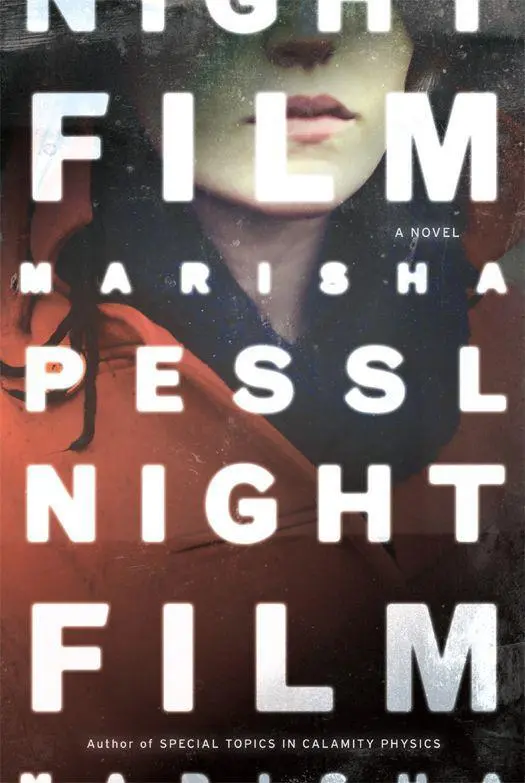
- Название:Night Film
- Автор:
- Издательство:Random House Trade Paperbacks
- Жанр:
- Год:2014
- ISBN:нет данных
- Рейтинг книги:5 / 5. Голосов: 1
-
Избранное:Добавить в избранное
- Отзывы:
-
Ваша оценка:
Night Film: краткое содержание, описание и аннотация
Предлагаем к чтению аннотацию, описание, краткое содержание или предисловие (зависит от того, что написал сам автор книги «Night Film»). Если вы не нашли необходимую информацию о книге — напишите в комментариях, мы постараемся отыскать её.
tells the haunting story of a journalist who becomes obsessed with the mysterious death of a troubled prodigy — the daughter of an iconic, reclusive filmmaker. On a damp October night, beautiful young Ashley Cordova is found dead in an abandoned warehouse in lower Manhattan. Though her death is ruled a suicide, veteran investigative journalist Scott McGrath suspects otherwise. As he probes the strange circumstances surrounding Ashley’s life and death, McGrath comes face-to-face with the legacy of her father: the legendary, reclusive cult-horror-film director Stanislas Cordova — a man who hasn’t been seen in public for more than thirty years.
For McGrath, another death connected to this seemingly cursed family dynasty seems more than just a coincidence. Though much has been written about Cordova’s dark and unsettling films, very little is known about the man himself.
Driven by revenge, curiosity, and a need for the truth, McGrath, with the aid of two strangers, is drawn deeper and deeper into Cordova’s eerie, hypnotic world.
The last time he got close to exposing the director, McGrath lost his marriage and his career. This time he might lose even more.
Night Film
Night Film — читать онлайн бесплатно полную книгу (весь текст) целиком
Ниже представлен текст книги, разбитый по страницам. Система сохранения места последней прочитанной страницы, позволяет с удобством читать онлайн бесплатно книгу «Night Film», без необходимости каждый раз заново искать на чём Вы остановились. Поставьте закладку, и сможете в любой момент перейти на страницу, на которой закончили чтение.
Интервал:
Закладка:
“What happened this time?” I asked.
“She began playing. The opening parallel fifths of La cathédrale engloutie —”
“The opening parallel what ?” interjected Nora, frowning.
“ La cathédrale engloutie. The Sunken Cathedral.”
Peter, noting our obvious ignorance, beamed, unable to restrain his delight.
“Claude Debussy. The French impressionist. It’s one of my very favorite preludes. It tells the story of a cathedral submerged at the bottom of the sea. On a clear day, it rises up out of the churning waves and fog, bells chiming ecstatically, to rest for mere seconds in the air, shimmering in the sun, before sinking down again in the fathomless depths, out of sight. Debussy instructs the musician to play the final chords pianissimo, at half-pedal, so it truly sounds as if there are church bells deep underwater, notes colliding, before fading and ending as all things do — as we all do —with a few reverberating chords and then silence.”
He paused, his face darkening.
“She couldn’t do it. Her playing — so revelatory before, such melting lyricism, such romance — was disturbing now. She tore into the music, but the notes eluded her. It was erratic. Despairing. And when she looked up at me, I …” He swallowed loudly. “Her eyes were bloodshot. They actually looked to be bleeding. I was filled with such horror by her face, how it had transformed so from the time I’d seen her before, I instantly left to phone the police. I left her playing here in front. But just as I entered the back room, she stopped. There was only silence. I peeked my head out. She was sitting very still, watching me with those eyes, as if she knew what I was doing. Suddenly she grabbed her bag and left. Like that. ” He snapped his fingers. “It was what truly frightened me.”
“Why?” I asked.
He wrung his hands, uneasy. “She moved like an animal.”
“An animal ?” Hopper repeated.
Peter nodded. “It was too fast. It certainly wasn’t normal.”
“Which direction did she go?” I asked.
“I don’t know. I returned to the front, but there was no sign of her. I even stepped outside to take a look. She wasn’t anywhere. I locked up the shop immediately. I didn’t want to be in the store alone.”
He lapsed into melancholic silence, staring at the floor. “She never came back. I thought about her. But I hadn’t told anyone until you came in.” He looked at Hopper. “I was relieved when you asked about her, so happy to know I hadn’t dreamt her out of thin air. I’ve … I’ve been under some pressure of late.” He flushed. “To say the least, it was nice to know I wasn’t going crazy.” His gaze returned to the piano. “She was a bit like that cathedral. Rising up, stunning me, decaying, and then vanishing, leaving only her echo. And me, so uncertain of what I’d seen.”
“Do you have video surveillance in the store?” I asked.
“We have an alarm system. But no cameras.”
“Did she mention anything else? Where she was staying?”
“Oh, no. We didn’t speak beyond what I told you.”
“And she left nothing behind? No personal items?”
“I’m afraid not.”
Nora had moved over to the small table along the wall with the open guestbook, turning back the pages.
“That’s really all — oh, do be careful with that.” Peter scurried after her. “The pages are quite fragile, and it’s our only copy.”
“I’m just wondering if she signed it,” said Nora, Peter looking on nervously over her shoulder.
Hopper had stepped up to the Fazioli that Ashley had played, solemnly running his hand along the gleaming keys, playing a few sharp notes.
I strode over to Nora. Having found the page marked October 4, she was running her finger down the list of scribbled names and addresses.
“Daniel Hwang,” she read. “Yuja Li. Jessica Song. Kirill Luminovich. Boris Anthony.” She turned the page rather roughly, and Peter touched his forehead as if he might faint. “Kay Glass. Viktor Koslov. Ling Bl—”
“What did you say?” I asked.
“Viktor Koslov.”
“Before that.”
“Kay Glass.”
I stepped closer, incredulous, staring down at the page.
It was scribbled in black pen, that familiar handwriting, identical, I was certain, to the note that Morgan Devold had shown us — and maybe even the envelope mailed to Hopper.
“That’s her,” I said.
33
The streets were narrow, shriveled bodegas and faded walk-ups packed shoulder to shoulder. Upstairs windows, filled with plants and shampoo bottles, were lit up like dirty fish tanks in electric greens and blues. Every now and then we passed someone walking alone, usually Chinese, carrying orange plastic shopping bags or hurrying along in a down jacket. Almost everyone turned to stare in at us as if they knew — probably because we were riding in a taxi — we were trespassing.
Our driver turned onto Pike Street, a wide, four-lane boulevard. To our left was a low brick building — MANHATTAN REPAIR COMPANY, read the sign — and on our right, what looked to be a public school.
“That’s Henry Street,” Hopper said suddenly, craning his neck to make out the street sign. The cabdriver made the left turn.
HONG KONG SUPERMARKET. JASMINE BEAUTY SALON. It was after seven o’clock, and every shop was closed, metal grates pulled down, padlocked.
“There’s ninety-one,” said Nora, leaning forward to survey the deserted street. “Eighty-three is coming up on the right.”
Ashley had written in the Klavierhaus guestbook — and Peter Schmid was at a loss to explain when exactly she had done so:
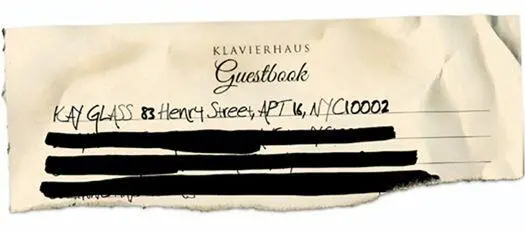
Kay Glass was the name of the missing friend in A Small Evil —the unseen woman who invites her new coworker, Alexandra, and Alex’s fiancé, Mitchell, to her parents’ beach house for the weekend. In the opening minutes of the film, Alex and Mitch, having argued during most of the drive from the city, arrive at the house a little after midnight. They find it entirely in the dark and deserted, the friend — Kay Glass — nowhere to be found. An initial search of the home — a modernist glass structure standing at the edge of the ocean like a monument to nihilism — reveals that a horrific crime has taken place moments before their arrival, and the perpetrators — masked, dressed head-to-toe in black — are still there.
I’d recognized the name because not only were the Blackboards rife with theories and the occasional shrine to the elusive Kay Glass, I’d also heard Beckman give a detailed lecture on the name and its meaning. He contended Kay Glass meant chaos. Beckman further argued that the missing woman — the question of what had happened to her — was, in fact, a metaphor for the inescapable darkness in life. The figure was a Cordova trademark, and Beckman had named one of his cats after it: Shadow.
“Kay Glass is the Shadow that hounds us relentlessly,” Beckman said. “It’s what we chase but never find. It is the mystery of our lives, the understanding that even when we have everything we want it is one day to leave us. It’s the something unseen, the lurking devastation, the darkness that gives our lives dimension.”
The fact that out of all the potential pseudonyms, Ashley had chosen that one —a missing woman from her father’s film — led to all sorts of psychological conclusions, the most obvious being that her father’s stories were a part of her day-to-day reality, maybe even overshadowed her sense of self. What was her response when Peter Schmid had asked her who she was?
Читать дальшеИнтервал:
Закладка:
Похожие книги на «Night Film»
Представляем Вашему вниманию похожие книги на «Night Film» списком для выбора. Мы отобрали схожую по названию и смыслу литературу в надежде предоставить читателям больше вариантов отыскать новые, интересные, ещё непрочитанные произведения.









Обсуждение, отзывы о книге «Night Film» и просто собственные мнения читателей. Оставьте ваши комментарии, напишите, что Вы думаете о произведении, его смысле или главных героях. Укажите что конкретно понравилось, а что нет, и почему Вы так считаете.