Marisha Pessl - Night Film
Здесь есть возможность читать онлайн «Marisha Pessl - Night Film» весь текст электронной книги совершенно бесплатно (целиком полную версию без сокращений). В некоторых случаях можно слушать аудио, скачать через торрент в формате fb2 и присутствует краткое содержание. Год выпуска: 2014, Издательство: Random House Trade Paperbacks, Жанр: Современная проза, на английском языке. Описание произведения, (предисловие) а так же отзывы посетителей доступны на портале библиотеки ЛибКат.
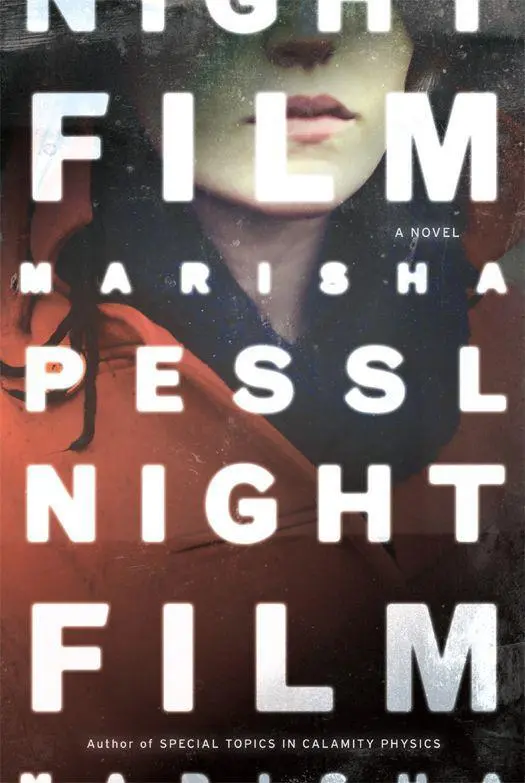
- Название:Night Film
- Автор:
- Издательство:Random House Trade Paperbacks
- Жанр:
- Год:2014
- ISBN:нет данных
- Рейтинг книги:5 / 5. Голосов: 1
-
Избранное:Добавить в избранное
- Отзывы:
-
Ваша оценка:
Night Film: краткое содержание, описание и аннотация
Предлагаем к чтению аннотацию, описание, краткое содержание или предисловие (зависит от того, что написал сам автор книги «Night Film»). Если вы не нашли необходимую информацию о книге — напишите в комментариях, мы постараемся отыскать её.
tells the haunting story of a journalist who becomes obsessed with the mysterious death of a troubled prodigy — the daughter of an iconic, reclusive filmmaker. On a damp October night, beautiful young Ashley Cordova is found dead in an abandoned warehouse in lower Manhattan. Though her death is ruled a suicide, veteran investigative journalist Scott McGrath suspects otherwise. As he probes the strange circumstances surrounding Ashley’s life and death, McGrath comes face-to-face with the legacy of her father: the legendary, reclusive cult-horror-film director Stanislas Cordova — a man who hasn’t been seen in public for more than thirty years.
For McGrath, another death connected to this seemingly cursed family dynasty seems more than just a coincidence. Though much has been written about Cordova’s dark and unsettling films, very little is known about the man himself.
Driven by revenge, curiosity, and a need for the truth, McGrath, with the aid of two strangers, is drawn deeper and deeper into Cordova’s eerie, hypnotic world.
The last time he got close to exposing the director, McGrath lost his marriage and his career. This time he might lose even more.
Night Film
Night Film — читать онлайн бесплатно полную книгу (весь текст) целиком
Ниже представлен текст книги, разбитый по страницам. Система сохранения места последней прочитанной страницы, позволяет с удобством читать онлайн бесплатно книгу «Night Film», без необходимости каждый раз заново искать на чём Вы остановились. Поставьте закладку, и сможете в любой момент перейти на страницу, на которой закончили чтение.
Интервал:
Закладка:
29
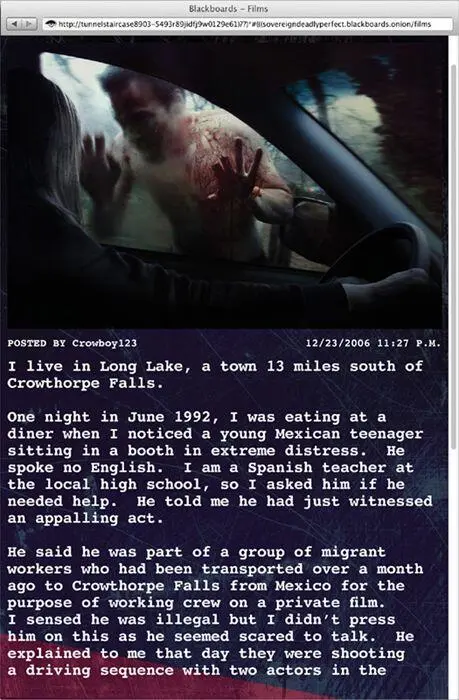
Nora and I stayed up most of the night on the Blackboards.
It was like fumbling through a pitch-black funhouse with trapdoors and tunnels, voices calling out from rooms with no doors, stumbling down rickety staircases that twisted deep into the ground with no end.
Every time I was about to suggest we head to bed, continue sifting through this endless Cordova archive with rested eyes in the morning, there was one more anecdote to click onto, another uncanny incident, rumor, or strange photo.
Freak the ferocious out —there were quite a few pages on the site devoted to Cordova’s supposed life philosophy, which meant, in a nutshell, that to be terrified, to be scared out of your skin, was the beginning of freedom, of opening your eyes to what was graphic and dark and gorgeous about life, thereby conquering the monsters of your mind. This was, in Cordovite speak, to slaughter the lamb, get rid of your meek, fearful self, thereby freeing yourself from the restrictions imposed on you by friends, family, and society at large.
Once you slaughter the lamb, you are capable of everything and anything, and the world is yours, proclaimed the site.
Sovereign. Deadly. Perfect.
These three words, which Cordova had mentioned in his infamous Rolling Stone interview while describing his favorite shot in his films — a close-up of his own eye — was a slogan on the Blackboards and for life itself. Sovereign: the sanctity of the individual, regarding yourself as princely, powerful, self-contained, wrestling authority for yourself away from society. Deadly: constant awareness that your own death is inevitable, which means there is no reason not to be ferocious, now, about your life. Perfect: the understanding that life and wherever you find yourself at the present are absolutely ideal. No regret, no guilt, because even if you were stuck it was only a cocoon to break out of —setting your life loose.
I’d known Cordova’s fans believed him to be an amoral enchanter, a dark acolyte who led them away from what was stale and tedious about their daily lives deep into the world’s moist, tunneled underbelly, where every hour was unexpected. Combing through the Blackboards’ whispers and suspicions, the sheer density of anonymous comments — which veered from reverential to frightened to supremely twisted and depraved — only underscored what I’d long suspected, that Cordova was not just an oddball eccentric along the lines of Lewis Carroll or Howard Hughes, but a man who also inspired devotion and awe in a vast number of people, not unlike a leader of a religious cult.
By 3:45 A.M. Nora and I — blank-eyed and delirious — were in the living room, digging out my pirated copy of Wait for Me Here —purchased for seventy-five bucks from Beckman — watching the terrifying opening scene, which featured Jenny Decanter, played by twenty-two-year-old Tamsin Polk, driving alone down the dirt forest road in the dead of night.
Abruptly, Theo Cordova — cast as John Doe #1—came crashing out of the trees, causing Jenny to scream, slamming on the brakes, sending her car spinning into a ditch, the engine stalling.
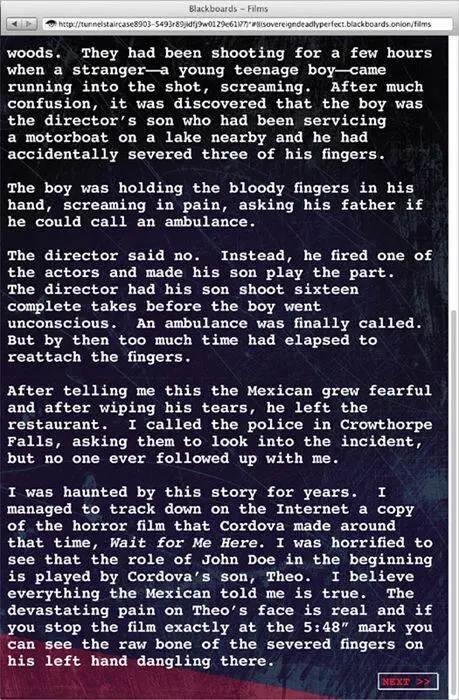
I’d always thought Theo Cordova looked like a deranged Puck: strung-out, half naked, eyes glassy, blood and what looked to be human bite marks covering his bare chest. He looked even more horrendous now, given Crowboy123’s anecdote on the Blackboards. As he knocked on the car window, trying the door, and said his only line—“ Help me, please, ” words barely audible over Jenny’s screams — his voice oozed out like some strange sap.
Nora, standing beside the flat-screen, paused it.
Frame by frame, she inched toward 5:48, where it was possible to see that Theo was missing three fingers.
“There.”
“It’s a movie. It could be special effects, makeup, prosthetics—”
“But the look on his face is real pain. I know it.”
She pressed play, and Theo’s hand dropped out of sight.
Jenny managed to get the car started, and, nearly running over this strung-out, wounded boy, she barreled back into the road, tree branches cracking the windshield, tires squealing. As she blindly took off, petrified, blinking away tears, she watched him in the rearview mirror.
The boy’s half-naked figure glowed red in her taillights, quickly faded to a thin black silhouette, and then —fast as an insect —he darted out of the road, vanishing from view.
Nora scrambled back to the couch, pulling the wool blanket over her legs and reaching down to pick up Septimus from the coffee table, as if that ancient bird would protect her from the horror about to unfold on-screen.
“Want me to make some popcorn?” I asked her.
“Definitely.”
We ended up watching all of Wait for Me Here.
Cordova’s films were addictive opiates; it was impossible to watch just one minute. One craved more and more. Around 5:30 A.M., when my head was soaked with gory imagery and that hellish story — not to mention echoing with whispers of those anonymous voices calling out from the Blackboards — Nora and I called it a day.
30
The next morning I woke up to learn Vanity Fair was reporting that they had “the inside scoop” on Ashley Cordova and the article was due to be published on their website within days. This meant not only that other reporters were hot on the trail, but it was probably just a matter of time before they ended up at Briarwood Hall — and on the doorstep of Morgan Devold. Whatever advantage I’d had, thanks to Sharon Falcone and getting my hands on Ashley’s police file, would be gone.
And unfortunately, my own investigation had stalled.
We’d learned about Ashley’s escape from Briarwood and her diagnosed affliction, nyctophobia, “a severe fear of the dark or night, triggered by the brain’s distorted perception of what would or could happen to the body when it’s exposed to a dark environment,” according to The New England Journal of Medicine. We’d had a small coup by logging successfully on to the Blackboards, able now to ransack through the rumors of his staunchest fans.
Yet there was no new lead to follow.
Ashley had come to the city by train after leaving Morgan Devold, but why, or where she’d gone during the ten days before her death — besides the thirtieth floor of the Waldorf Towers — was still a mystery.
I could bribe an employee at the hotel for a list of every guest staying on that floor within the time frame — September 30 to October 10—but from personal experience I knew I needed something more, a filter for the names. The list would be substantial, many of the guests doubtlessly wealthy tourists who wouldn’t appreciate — or feel any obligation to honestly answer —questions about what they were doing at the hotel. By the time I tracked everyone down, showing them Ashley’s picture, I’d probably have little to go on and, even worse, the exercise would take up a hell of a lot of time.
“Maybe we could take Ashley’s picture to businesses around the Waldorf,” Nora said, after I explained some of this to her. “Ask if someone noticed her. She’d stand out with that red coat.”
Читать дальшеИнтервал:
Закладка:
Похожие книги на «Night Film»
Представляем Вашему вниманию похожие книги на «Night Film» списком для выбора. Мы отобрали схожую по названию и смыслу литературу в надежде предоставить читателям больше вариантов отыскать новые, интересные, ещё непрочитанные произведения.



Обсуждение, отзывы о книге «Night Film» и просто собственные мнения читателей. Оставьте ваши комментарии, напишите, что Вы думаете о произведении, его смысле или главных героях. Укажите что конкретно понравилось, а что нет, и почему Вы так считаете.