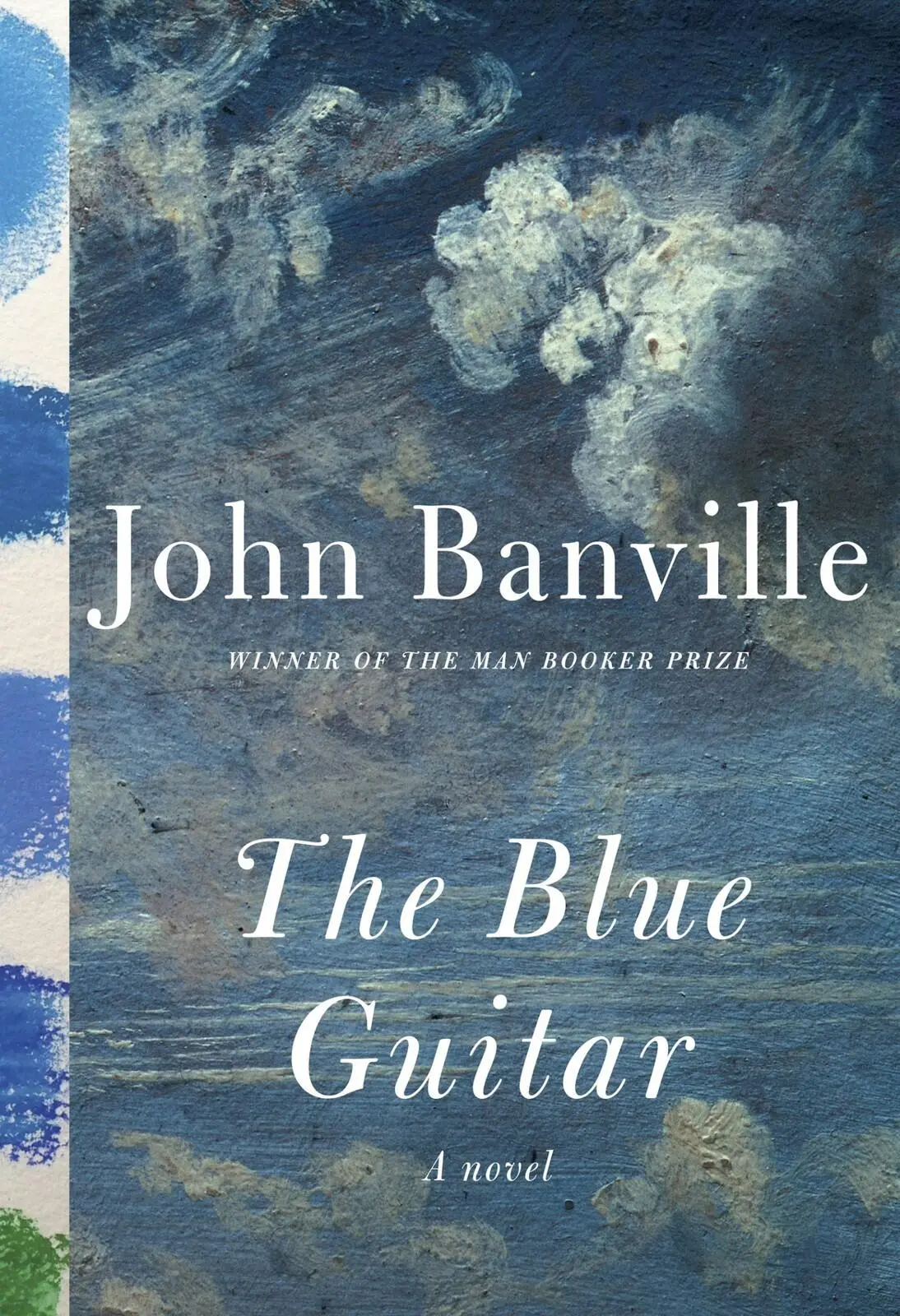
John Banville - The Blue Guitar
Здесь есть возможность читать онлайн «John Banville - The Blue Guitar» весь текст электронной книги совершенно бесплатно (целиком полную версию без сокращений). В некоторых случаях можно слушать аудио, скачать через торрент в формате fb2 и присутствует краткое содержание. Год выпуска: 2015, Издательство: Knopf, Жанр: Современная проза, на английском языке. Описание произведения, (предисловие) а так же отзывы посетителей доступны на портале библиотеки ЛибКат.
- Название:The Blue Guitar
- Автор:
- Издательство:Knopf
- Жанр:
- Год:2015
- ISBN:нет данных
- Рейтинг книги:4 / 5. Голосов: 1
-
Избранное:Добавить в избранное
- Отзывы:
-
Ваша оценка:
The Blue Guitar: краткое содержание, описание и аннотация
Предлагаем к чтению аннотацию, описание, краткое содержание или предисловие (зависит от того, что написал сам автор книги «The Blue Guitar»). Если вы не нашли необходимую информацию о книге — напишите в комментариях, мы постараемся отыскать её.
and
a new novel-at once trenchant, witty, and shattering-about the intricacies of artistic creation and theft, and about the ways in which we learn to possess one another, and to hold on to ourselves. Equally self-aggrandizing and self-deprecating, our narrator, Oliver Otway Orme, is a painter of some renown, and a petty thief who does not steal for profit and has never before been caught. But he's pushing fifty, feels like a hundred, and things have not been going so well lately. Having recognized the "man-killing crevasse" that exists between what he sees and any representation he might make of it-any attempt to make what he sees his own-he's stopped painting. And his last purloined possession-aquired the last time he felt the "secret shiver of bliss" in thievery-has been discovered. The fact that it was the wife of the man who was, perhaps, his best friend, has compelled him to run away: from his mistress, his home, his wife, from whatever remains of his impulse to paint and from the tragedy that haunts him, and to sequester himself in the house where he was born, trying to uncover in himself the answer to how and why things have turned out as they did. Excavating memories of family, of places he's called home, and of the way he has apprehended the world around him ("no matter what else is going on, one of my eyes is always swivelling towards the world beyond"), Ollie reveals the very essence of a man who, in some way, has always been waiting to be rescued from himself.
The Blue Guitar — читать онлайн бесплатно полную книгу (весь текст) целиком
Ниже представлен текст книги, разбитый по страницам. Система сохранения места последней прочитанной страницы, позволяет с удобством читать онлайн бесплатно книгу «The Blue Guitar», без необходимости каждый раз заново искать на чём Вы остановились. Поставьте закладку, и сможете в любой момент перейти на страницу, на которой закончили чтение.
Интервал:
Закладка:
First of all there was high tea. Pots of a peat-brown brew were prepared, slices of bread were laid out like fallen dominoes, cold meats were displayed in sweaty, glistening slabs. There were biscuits and buns, and homemade jam in a sticky dish, and, the pinnacle of all, a mighty plum cake, quite stale, with a glacé cherry on top, which was produced with a conjuror’s flourish from a big japanned tin with shiny dents in it. Janey the cook-cum-housekeeper-cum-maid, ageless and feral, with a tangle of wiry, grizzled hair reminiscent of Mrs. Plomer’s fright-wig, through which her scalp showed pinkly, ferried it all up from the kitchen on a vast tray, in three or four staggering relays, her elbows stuck out at either side and the tip of a moist grey tongue showing. Mrs. Plomer, still in her gumboots, drifted in and out through doorways, smiling on everyone and everything with remote benevolence, while her husband hovered, chafing his hands and humming to himself in happy nervousness. The day was waning, yet a great glare of yellow-gold light was filling the westward-facing windows and casting all indoors into greyish-brown shadow. The china was mismatched, the milk jug was cracked. Janey snatched up Polly’s teaspoon and used it to take a slurp of milk from the jug, testing it for freshness, then dropped the spoon into Polly’s tea with a clatter and a splash. She eyed the child darkly. “Are you feeding that babby at all?” she demanded. “She looks starved to me.”
Seated at the centre of this parody of rustic domesticity, I felt like a lately hatched cuckoo, huge and absurd, around which the nest’s rightful chicks were doing their best to fit themselves, flapping stubby wings and chirping weakly. Polly had introduced me in the vaguest terms, saying I was a friend of Marcus’s who had come along to help her with the child and the bags; of Marcus himself, of his whereabouts or his state, she said not a word. Janey in her apron pointedly ignored me, looking through me as if I were perfectly transparent; I’m sure she had the measure of me. So did Polly’s father, I should say, though he was too polite to show it. “Orme, Orme,” he said, putting a finger to his paper-pale brow and frowning at the ceiling. “Aren’t you the painter who’s living in town in Dr. Barragry’s old house?” I said yes, that I did indeed live at Fairmount, but that I did not paint any more. “Ah,” he said, nodding, and gazing at me with blank brightness. He was a small, neat man with a fine, hollow-cheeked profile and pale grey eyes — Polly’s eyes. He had overall a worn, dry aspect, as if he had been left out for a long time to weather under the elements. His sparse hair must once have been, improbably, red, and still had a sandy cast, and his nose, prominent and strong, might have been carved from a piece of bleached driftwood. He wore a three-piece suit of greenish tweed, and a venerable pair of highly polished brown brogues. Though his complexion was in general colourless, there was a ragged pink patch, finely veined, in the hollow of each cheek. He was a little deaf, and when addressed would draw himself quickly forwards, his head tilted to one side and his eyes fixed on the speaker’s lips with bird-like alertness. He had struck me at first as much too old to be Polly’s father. Her mother, as I was to learn, had been peculiar in the head even as a girl, and the family, casting about for someone to marry her off to, had fixed on her cousin Herbert, the last, it had been expected, of the Plomers of Grange Hall. Herbert, the Mr. Plomer seated before me now, was then a bachelor in his middle years, vague, kindly, easily coerced, and in possession of a fine old house and a few hundred acres of decent land. It all sounded much too plausible, in a novelettish, nineteenth-century sort of way, and for a mad minute I thought perhaps the entire thing — the old stone mansion, the aged father and loony mother, the crusty retainer with her groaning trays of grub, even the grass under the gate and the wheeling rooks — had been got up to lull me into thinking I was Ichabod Crane come to seek the hand of fair Katrina and win the riches of Sleepy Hollow. And would there be, I asked myself, a Headless Horseman, too?
Janey, fuming and muttering, was handing round plates of bread-and-butter and ham and pickles, with indifferent haste, as if it were a pack of greasy playing cards she was dealing out. It was a long time since I had eaten a pickled onion. It had a strongly familiar, metallic taste. Remarkable, how much our mouths remember, with such sharpness, and over aeons.
Pip, who in my mind will always be Little Pip, sat in a high-chair, itself a relic from Polly’s own infancy. Polly’s mother regarded the child with snatched, sidelong glances, blinking suspiciously. At the outset of the meal her husband had assured her, speaking loudly and slowly, that the young woman seated at the foot of the table was indeed her daughter, Polly, grown up now and a mother herself, as evidenced by the child perched there in the high-chair, but I could see the poor woman wondering how this could be, since here was Polly, still little, banging her spoon on the table and dribbling into her bib. It must all have been very puzzling, to such a scattered mind as hers. Polly, I knew, had been the couple’s only child, her arrival a surprise, if not indeed a shock, to everyone, not least to her mother, who I am sure had hardly known how the thing had come about. The condition that Mrs. Plomer suffered from, as it was explained to me, was an early, mild and for the most part placid form of dementia, although on occasion, when something startled or vexed her, she could become severely agitated, and stay that way for days. Mr. Plomer chose to present his wife’s malaise as if it were merely a form of chronic and endearing eccentricity, and greeted all manifestations of it with elaborate displays of amazement and rueful mirth. “But look, my dear,” he would exclaim, “you’ve put my trousers in the larder! What were you thinking of?” Then he would turn to whoever was present, smiling indulgently and shaking his head, as if this were a unique occurrence, as if boot polish had never appeared in the butter dish before, or a lavatory brush on the dining-room table.
The child in her chair gave a squeak, surprising herself, and looked about the table quickly to see what the rest of us had made of her sudden intervention. Yes yes, children are uncanny, no doubt of it. Is it because the things that are familiar to us are to them a novelty? That can’t be right. As Adler tells us, in his great essay on the subject, the uncanny arises when a known object presents itself to us in an alien mode. So if children see everything as new, then blah blah blah, etc., etc., etc. — you get my drift. Yet is there a them and an us, and can we make such distinctions? The young and the old, we say, the past and the present, the quick and the dead, as if we ourselves were somehow outside the temporal process, applying an Archimedean lever to it. The living being, so one of the philosophers has it, is only a species of the dead, and a rare species at that; likewise, and obviously, the young are only an early version of the old, and should not be treated as a separate species, and wouldn’t be, if they didn’t seem so strange to us. I looked at Little Pip and wondered what could be going on in her head. She had no words yet, only pictures, presumably, with which to make whatever sense it was she made of things. There seemed to be figured for me here a lesson of some sort, for me the former painter; it rose up out of my vaguely groping thoughts, shimmered a moment tantalisingly, then dispersed. I can’t think in this fashion any more, rubbing concepts against each other to make illuminating sparks. I’ve lost the knack, or the will, or something. Yes, my muse has flown the coop, old hen that she was.
Читать дальшеИнтервал:
Закладка:
Похожие книги на «The Blue Guitar»
Представляем Вашему вниманию похожие книги на «The Blue Guitar» списком для выбора. Мы отобрали схожую по названию и смыслу литературу в надежде предоставить читателям больше вариантов отыскать новые, интересные, ещё непрочитанные произведения.



Обсуждение, отзывы о книге «The Blue Guitar» и просто собственные мнения читателей. Оставьте ваши комментарии, напишите, что Вы думаете о произведении, его смысле или главных героях. Укажите что конкретно понравилось, а что нет, и почему Вы так считаете.