Leo Tolstoy - The Kingdom of God is Within You; What is Art?
Здесь есть возможность читать онлайн «Leo Tolstoy - The Kingdom of God is Within You; What is Art?» — ознакомительный отрывок электронной книги совершенно бесплатно, а после прочтения отрывка купить полную версию. В некоторых случаях можно слушать аудио, скачать через торрент в формате fb2 и присутствует краткое содержание. Жанр: Русская классическая проза, foreign_language, на английском языке. Описание произведения, (предисловие) а так же отзывы посетителей доступны на портале библиотеки ЛибКат.
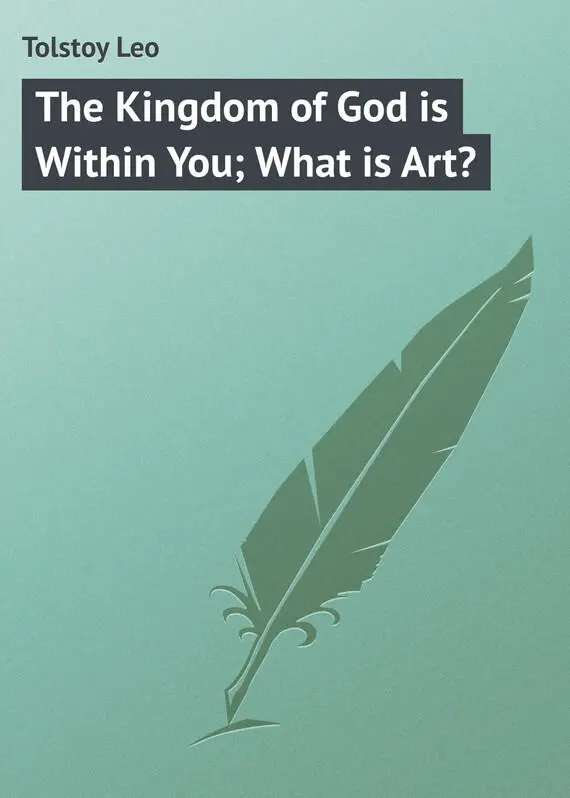
- Название:The Kingdom of God is Within You; What is Art?
- Автор:
- Жанр:
- Год:неизвестен
- ISBN:нет данных
- Рейтинг книги:5 / 5. Голосов: 1
-
Избранное:Добавить в избранное
- Отзывы:
-
Ваша оценка:
The Kingdom of God is Within You; What is Art?: краткое содержание, описание и аннотация
Предлагаем к чтению аннотацию, описание, краткое содержание или предисловие (зависит от того, что написал сам автор книги «The Kingdom of God is Within You; What is Art?»). Если вы не нашли необходимую информацию о книге — напишите в комментариях, мы постараемся отыскать её.
The Kingdom of God is Within You; What is Art? — читать онлайн ознакомительный отрывок
Ниже представлен текст книги, разбитый по страницам. Система сохранения места последней прочитанной страницы, позволяет с удобством читать онлайн бесплатно книгу «The Kingdom of God is Within You; What is Art?», без необходимости каждый раз заново искать на чём Вы остановились. Поставьте закладку, и сможете в любой момент перейти на страницу, на которой закончили чтение.
Интервал:
Закладка:
All these commandments are reminders of that which we, in our striving for perfection, must and can avoid; reminders, too, that we must labor now to acquire by degrees habits of self-restraint, until such habits become second nature. But these commandments, far from exhausting the doctrine, do not by any means cover it. They are but stepping-stones on the way to perfection, and must necessarily be followed by higher and still higher ones, as men pursue the course toward perfection.
That is why a Christian doctrine would make higher demands than those embodied in the commandments, and not in the least decrease its demands, as they who judge the Christian doctrine from a social life-conception seem to think.
This is one of the mistakes of the scientists in regard to the significance of Christ's doctrine. And the substitution of the love of humanity for the love and service of God is another, and it springs from the same source.
In the Christian doctrine of loving and of serving God, and (as the natural consequence of such love and service) of loving and serving one's neighbor, there seems to the scientific mind a certain mysticism, something at once confused and arbitrary; and, believing that the doctrine of love for humanity rests on a firmer basis and is altogether more intelligible, they utterly reject the requirement of love and service of God.
The theory of a scientist is that a virtuous life, a life with a purpose, must be useful to the world at large; and in a life of this kind they discover the solution of the Christian doctrine, to which they reduce Christianity itself. Assuming their own doctrine to be identical with that of Christianity, they seek and believe that they find in the latter an affirmation of their own views.
This is a fallacy. The Christian doctrine, and the doctrine of the Positivists, and of all advocates of the universal brotherhood of man, founded on the utility of such a brotherhood, have nothing in common, and especially do they differ in that the doctrine of Christianity has a solid and a clearly defined foundation in the human soul, whereas love of humanity is but a theoretical conclusion reached through analogy.
The doctrine of the love of humanity has for its basis the social life-conception.
The essence of the social life-conception consists in replacing the sense of individual life by that of the life of the group. In its first steps, this is a simple and natural progression, as from the family to the tribe; from the family to the race is more difficult, and requires special education, – which has arrived at its utmost limits when the State has been reached.
It is natural for every man to love himself, and he needs no incentive thereto; to love his tribe, which lends both support and protection; to love his wife, the delight and comfort of his daily life; the children, who are his consolation and his future hope; his parents, who gave him life and cherished him, – all this, although not so intense as love of self, is natural and common to mankind.
To love one's race, one's people, for their own sake, although not so instinctive, is also common. To love one's ancestors, one's kinsfolk, through pride, is also natural and frequent; and a man may feel love for his fellow-countrymen, who speak the same language and profess the same faith as himself, although the emotion is less strong than love of self or love of family. But love for a nation, Turkey, for instance, or Germany, England, Austria, Russia, is almost impossible, and notwithstanding the training given in that direction, it is only a fictitious semblance; it has no real existence. At this aggregate ceases man's power of transfusing his innermost consciousness; for such a fiction he can feel no direct sentiment. And yet the Positivists and all the preachers of the scientific fraternity, not taking into consideration the fact that this feeling is weakened in proportion to the expansion of its object, continue to theorize on the same lines. They say: "If it were to the advantage of an individual to transfuse his consciousness into the family, and thence into the nation and the State, it follows that it will be to his further advantage to transfuse his consciousness into the universal entity, mankind, that all men may live for humanity, as they have lived for the family and for the State."
And theoretically they are right.
After having transferred the consciousness and love for the individual to the family, and from the family to the race, the nation, and the State, it would be perfectly logical for men, in order to escape the strife and disasters that result from the division of mankind into nations and states, to transfer their love to humanity at large. This would appear to be the logical outcome, and it has been offered as a theory by those who forget that love is an innate sentiment, which can never be inspired by preaching; that it must have a real object, and that the entity which men call humanity is not a real object, but a fiction.
A family, a race, even a State, are no inventions of men; these things have formed themselves like a hive of bees, or a colony of ants, and possess an actual existence. The man who loves his family, after a human fashion, knows whom he is loving – Ann, Maria, John, or Peter. The man who loves his ancestors, and is proud of them, knows that he loves the Guelphs, for instance, or the Ghibellines; the man who loves his country knows that he loves France from the Rhine to the Pyrenees, that he loves its capital, Paris, and all its history. But the man who loves humanity, what is it that he loves? There is a State, there is a people, there is the abstract conception of man. But humanity as a concrete conception is impossible.
Humanity? Where is its limit? Where does it end and where does it begin? Does it exclude the savage, the idiot, the inebriate, the insane? If one were to draw a line of demarcation so as to exclude the lower representatives of the human race, where ought it to be drawn? Ought it to exclude the Negro, as they do in the United States, or the Hindoos, as some Englishmen do, or the Jews, as does another nation? But if we include all humanity without exception, why should we restrict ourselves to men? Why should we exclude the higher animals, some of whom are superior to the lowest representatives of the human race?
We do not know humanity in the concrete, nor can we fix its limits. Humanity is a fiction, and therefore it cannot be loved. Indeed, it would be advantageous if men could love humanity as they love the family. It would be very useful, as the communists say, to substitute a community of interests for individual competition, or the universal for the personal; in a word, to make the whole world a mutual benefit society, – only that there are no motives to bring about such a result. The Positivists, communists, and all the exponents of the scientific fraternity exhort us to extend the love which men feel for themselves, their families, their fellow-countrymen, over humanity at large, forgetting that the love of which they speak is a personal love, which may be kindled for the family, and even extend to include one's native country, but which expires altogether when it is appealed to in behalf of an artificial state, such as Austria, England, or Turkey; and when claimed for that mystical object, humanity in general, one cannot even grasp the idea.
"A man loves himself, his physical personality, he loves his family, he even loves his country. Why should he not also love mankind? It would seem such a happy consummation! And it so happens that Christianity inculcates the same precept." These are the opinions of the Positivist, the communist, and the socialist fraternities.
It would indeed be fortunate, but it is impossible, because love founded on a personal and social life-conception can go no further than the love of country.
Читать дальшеИнтервал:
Закладка:
Похожие книги на «The Kingdom of God is Within You; What is Art?»
Представляем Вашему вниманию похожие книги на «The Kingdom of God is Within You; What is Art?» списком для выбора. Мы отобрали схожую по названию и смыслу литературу в надежде предоставить читателям больше вариантов отыскать новые, интересные, ещё непрочитанные произведения.





Обсуждение, отзывы о книге «The Kingdom of God is Within You; What is Art?» и просто собственные мнения читателей. Оставьте ваши комментарии, напишите, что Вы думаете о произведении, его смысле или главных героях. Укажите что конкретно понравилось, а что нет, и почему Вы так считаете.