James Tarr - Dogsoldiers
Здесь есть возможность читать онлайн «James Tarr - Dogsoldiers» весь текст электронной книги совершенно бесплатно (целиком полную версию без сокращений). В некоторых случаях можно слушать аудио, скачать через торрент в формате fb2 и присутствует краткое содержание. Год выпуска: 2020, ISBN: 2020, Жанр: prose_military, sf_postapocalyptic, на английском языке. Описание произведения, (предисловие) а так же отзывы посетителей доступны на портале библиотеки ЛибКат.
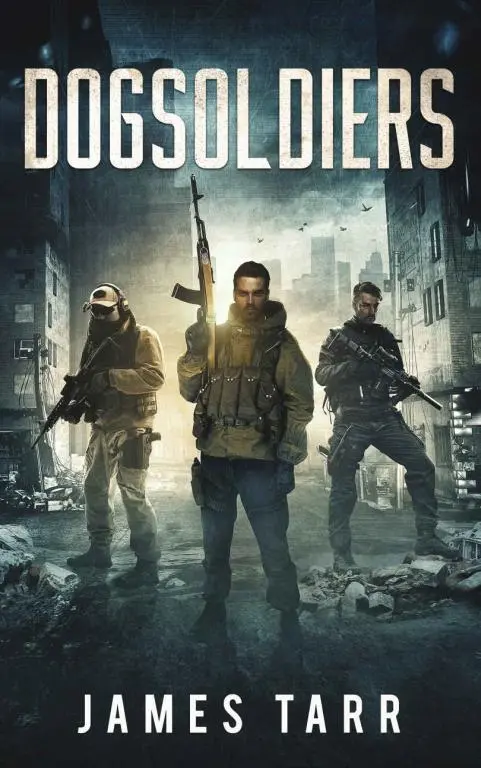
- Название:Dogsoldiers
- Автор:
- Жанр:
- Год:2020
- ISBN:979-8-61657-086-4
- Рейтинг книги:3 / 5. Голосов: 1
-
Избранное:Добавить в избранное
- Отзывы:
-
Ваша оценка:
Dogsoldiers: краткое содержание, описание и аннотация
Предлагаем к чтению аннотацию, описание, краткое содержание или предисловие (зависит от того, что написал сам автор книги «Dogsoldiers»). Если вы не нашли необходимую информацию о книге — напишите в комментариях, мы постараемся отыскать её.
Nobody can agree on how or even when the war started. But, hopefully, this is where it ends.
Dogsoldiers — читать онлайн бесплатно полную книгу (весь текст) целиком
Ниже представлен текст книги, разбитый по страницам. Система сохранения места последней прочитанной страницы, позволяет с удобством читать онлайн бесплатно книгу «Dogsoldiers», без необходимости каждый раз заново искать на чём Вы остановились. Поставьте закладку, и сможете в любой момент перейти на страницу, на которой закончили чтение.
Интервал:
Закладка:
The Major shook his head, not hiding his disapproval well. A thought came to mind. “That firefight in sector eleven might be related to what intelligence is telling us, if what they’re telling us is accurate,” he said. “That sector’s been pretty quiet the past few weeks.”
“Was the lieutenant able to provide any numbers on the guerillas? Direction of travel? That might help. You mentioned it was just small arms.”
“Small arms fire, that’s all he knew, coming from the houses lining the road. Couple of grenades thrown their way. The patrol the next morning checked the houses before towing the Growler, but didn’t find so much as a blood trail. The tangos even policed their brass cases.”
The Colonel crumpled up the sugar packets and threw them into a corner. “I’d like to bulldoze this whole fucking city,” he spat.
“They’d just go into the sewers. They did exactly that at the start of the war. General Block had many of them flooded and demo’d, just like the Nazis did in Warsaw during World War II,” Major Cooper observed flatly. Against standing orders, if he remembered correctly, at the time the government was still worried about preserving the city’s infrastructure. Now, outside of the Blue Zone, no one cared about the state of the city, but Parker had neither the bulldozers nor the diesel to make his dream a reality.
“Yeah? Did it work?”
Cooper wanted to shake his head, but instead kept his expression blank. The guerrillas already compared them to the Nazis, but this young Colonel seemed oblivious to any and all of the political nuances. He just followed orders, and believed in the cause, and these days being politically reliable was more important to the brass than experience, skill, or intelligence. “Yes.”
“Well there you go.”
Cooper declined to point out that the Jews of the Warsaw ghetto started out unarmed and had held off the entire might of the Nazi war machine for over two weeks, longer than the entire country of Poland had resisted. The enemies they were fighting were many things, but unarmed wasn’t one of them.
CHAPTER SEVEN
Colonel Parker was supposed to be reading the reports stacked on the desk before him, the daily log, the AARs and OARs (After- and Overnight Action Reports), the incident and status reports, the requests and reminders, but he kept drifting off. He’d find himself staring out the window, eyes fixed on some point, some visual reference, the corner of a building, the burned-out hulk of a car inside the perimeter, two of his men standing beside their tank, smoking. On the side of the tank away from the perimeter, he observed, because of the persistent threat of snipers.
There was a constant haze of smoke over the city, from cooking fires and fire fires; even after all these years people still seemed to find entertainment in arson, setting fire to buildings. It was surprising, actually, that there was anything left in the city to burn.
The former Federal Building, across the avenue to the southeast, looked especially decrepit in the morning light. Most of its windows below the twentieth floor or so were empty black sockets, scorched from the fires and explosions. Molotov cocktails, grenades, mortars, tank rounds, artillery, small arms fire; at one time or another during the initial eight day battle it had been pounded by everything. It was a wonder it was still standing.
To the west, across the avenue, was the casino. Between the high-tech parking garages, hotel towers, and the casino building itself the site covered two large blocks. The city had been drab and grey before the war, and the casino’s creamy yellow and burgundy paint job had been quite striking. The partnership that owned it had done everything they could to keep it operating and turning a profit even with a war cranking up. When the power became undependable they brought in huge generators. When the water supply became unreliable they brought in their own filtering systems. It was a gallant effort, and worked for a while, but eventually, when they could no longer find enough diesel for the generators, or food for the kitchen, or employees willing to pass through the checkpoints, or customers willing to brave all that to gamble, and hyperinflation making the cash its customers wagered increasingly less valuable, the casino closed its doors. Hope had finally succumbed to reality. Ironically, the shuttering of their doors made a small number of locals mad. They’d been consistently willing to brave roadblocks and snipers to gamble, and couldn’t believe a little thing like a war should be reason enough for the casino to close its doors.
There was a knock on the open door and he turned his head.
“Sir, General Barnson’s on the line.” Major Cooper glanced past his commanding officer out the window, wondering what he’d been staring at so intently. The windows were all mirrored on the outside, and the tint gave everything a smoky cast.
“Thank you.” He nodded and his S2 left. Parker stared at the phone on the desk, sitting atop what looked like a small stereo receiver. He had a direct land line to IV Corps headquarters that was almost always up, which he much preferred to the satellite uplink radios the troops had to depend on. The satellites weren’t nearly as dependable as they used to be. Or numerous. Fifth column activity, he suspected, but nobody had been able to prove anything. Or maybe they had and he was being kept out of the loop to keep his morale up. Which was a sobering thought.
Parker hit two buttons on the scrambler unit, then picked up the receiver. “Good morning Sir.” There was always about a half-second delay as his voice was scrambled, sent out, and unscrambled at his commander’s end.
“Morning Mr. Parker.” The digital scrambling process made everyone sound as if they were talking with a mouthful of water. Barnson’s voice was slightly blurred and bubbly. “I trust you’re still well?” Major General Barnson was his commanding officer, the man he directly reported to. The two men liked each other, but their friendship had become strained over the last few months.
“As well as can be expected, Sir.”
“Well, Colonel, I hate to be the one to ruin your day, but I have bad news. The resupply ship you’ve been waiting for, the one carrying the armor you’ve been hoping for, has been ordered to turn around.”
“What?”
“Now I know this news doesn’t come at a good time, but rest assured I’m doing all I can to get you properly resupplied.”
Parker was incredulous. “General, Sir, I know I don’t have to remind you just how thin I’m stretched here. You’ve tasked me with controlling an area half the size of Connecticut. I have less than one quarter of the men and equipment that would be necessary to even attempt such a thing. I’m not sure I’d even have enough men to control Manhattan, and that’s an island . I mean no disrespect, Sir, but I’m being set up to fail through no fault of my own.”
“Mr. Parker, we have had this conversation before.”
“Yes sir, that’s why this decision has me so confused. Never mind the equipment, or that we’re having to pull old rifles out of storage because we can’t get basic spare parts for our M5 carbines, which as you know chew through bolts and barrels like they’re candy. You pulled all my fixed-wing air assets last year. I’ve had to pull all of our Kestrels inside our base here, as I don’t have enough men to secure them at the airport, and eight Kestrels, eight, comprise my entire air wing, apart from two unarmed cargo copters which I think are older than you and I put together. I’m barely getting enough fuel to keep birds in the air or patrols outside the wire. I’m losing ten men a month to the guerillas, and another five to desertion… for which I’m getting five replacements. And those five replacements, draftees all, I swear half of them have never touched a rifle before, and if their sergeants give them orders they don’t like they want to file hate crime charges. If the guerrillas had a clue about how thinly stretched we are I’m sure they’d be a lot more aggressive. My men are running double and triple patrols, per your orders, just to give the impression we’ve got bodies to spare, and it’s wearing them down.” It had also depleted his fuel reserves to near zero. He was thinking about reducing the number of men he had providing security at the food distribution centers or on foot patrol in the Blue Zone to give the few productive people still in the city peace of mind. The guerrillas had never attacked the Blue Zone or any of the food distribution points, and he knew why, “hearts and minds”. Except… there’d been a small, quickly put down riot at the northeast food site several days before when they’d unexpectedly run out of water. Without soldiers providing security for the government aid workers, that riot could quickly have gotten out of hand.
Читать дальшеИнтервал:
Закладка:
Похожие книги на «Dogsoldiers»
Представляем Вашему вниманию похожие книги на «Dogsoldiers» списком для выбора. Мы отобрали схожую по названию и смыслу литературу в надежде предоставить читателям больше вариантов отыскать новые, интересные, ещё непрочитанные произведения.






Обсуждение, отзывы о книге «Dogsoldiers» и просто собственные мнения читателей. Оставьте ваши комментарии, напишите, что Вы думаете о произведении, его смысле или главных героях. Укажите что конкретно понравилось, а что нет, и почему Вы так считаете.