James Tarr - Dogsoldiers
Здесь есть возможность читать онлайн «James Tarr - Dogsoldiers» весь текст электронной книги совершенно бесплатно (целиком полную версию без сокращений). В некоторых случаях можно слушать аудио, скачать через торрент в формате fb2 и присутствует краткое содержание. Год выпуска: 2020, ISBN: 2020, Жанр: prose_military, sf_postapocalyptic, на английском языке. Описание произведения, (предисловие) а так же отзывы посетителей доступны на портале библиотеки ЛибКат.
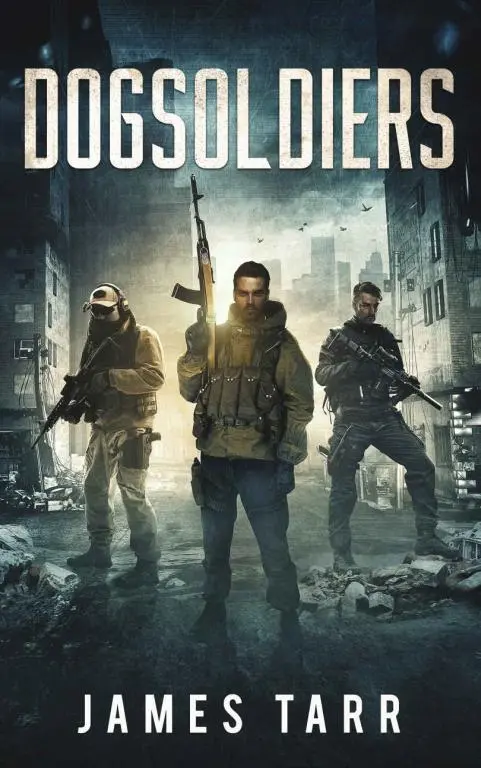
- Название:Dogsoldiers
- Автор:
- Жанр:
- Год:2020
- ISBN:979-8-61657-086-4
- Рейтинг книги:3 / 5. Голосов: 1
-
Избранное:Добавить в избранное
- Отзывы:
-
Ваша оценка:
Dogsoldiers: краткое содержание, описание и аннотация
Предлагаем к чтению аннотацию, описание, краткое содержание или предисловие (зависит от того, что написал сам автор книги «Dogsoldiers»). Если вы не нашли необходимую информацию о книге — напишите в комментариях, мы постараемся отыскать её.
Nobody can agree on how or even when the war started. But, hopefully, this is where it ends.
Dogsoldiers — читать онлайн бесплатно полную книгу (весь текст) целиком
Ниже представлен текст книги, разбитый по страницам. Система сохранения места последней прочитанной страницы, позволяет с удобством читать онлайн бесплатно книгу «Dogsoldiers», без необходимости каждый раз заново искать на чём Вы остановились. Поставьте закладку, и сможете в любой момент перейти на страницу, на которой закончили чтение.
Интервал:
Закладка:
After a few minutes Ed began to grow worried they were running out of time, but he just didn’t have the energy to do more than a fast hobble-hop-step that had him gasping. Mark wasn’t doing much better.
“There, is that it?” Jason said.
Ed paused and it took him a few seconds to push through the pain and focus on the building. At first he didn’t recognize it, because the last time he’d seen it the sun hadn’t been up. But then he nodded. He recognized the splintered door frame opening onto the alley.
Early and Seattle jogged ahead and checked the building. Early reappeared in the empty door frame as Ed limped up. “It’s clear.”
“Use a flashlight, check the tunnel opening for any tripwires.” The Tabs should have been too busy in the Blue Zone to bother with anything out near Six Mile, but Ed didn’t want to take any chances. Early nodded and disappeared into the gloom again.
They’d take the tunnel west to the end of the section cleared by Morris’ men. By the time they crawled back up to the surface it would be dark. They’d have a long painful walk north to get out of the city, but they had Morris’ schedule to avoid the satellites, and Ed was pretty sure the Tabs no longer had the manpower to support random patrols of the city. They knew a doctor who worked with the ARF Underground Railroad who would patch up Mark’s wounds, and maybe could do a walking cast for Ed’s foot.
Jason stood next to Ed, his face streaked with sweat and blood, eyes moving constantly, scanning back the way they’d come for threats, carbine held casually in his hands. He looked old beyond his years. He looked like a veteran dogsoldier which, after the week they’d all had, he was.
“I hate running away,” Jason said, staring down the alley.
“We’re not running away,” Ed assured him with a smile and a squeeze of his shoulder. “We’re not retreating. We’re just regrouping to get patched up and grab some more ammo.” Ed took one last look around. “Don’t worry,” he said confidently, to Jason, to himself, and to the city, “we’ll be back to finish the job.”
AUTHOR’S NOTE
The idea and reality of civil war.
It is, in the final equation, just the matter of a little math and a basic grasp of history.
The History part of the equation is this: every country, every empire, every nation-state or other government entity in the history of the world has, sooner or later, come to an end. It is both wishful thinking and a rejection of reality to think that, at some point, the same fate won’t befall the United States. We’ve had a great run, but it won’t last forever.
The three most common causes of a nation/country/empire coming to an end are 1. Invasion/conquest 2. Civil war and/or sociocultural collapse, and 3. Pandemic.
A civil war, in our modern era, could very well be that thing which ends our country. It would be catastrophic.
As for the chances of us experiencing a civil war, many people like to say “That could never happen here,” conveniently forgetting the fact that it has. Twice. The Revolutionary War (1775–1783) could be argued to be our nation’s first civil war as we were fighting our own government and many of our fellow citizens (the Tories). The American Civil War (1861–1865) was very much a conflict between two very different cultures, and slavery was just one of those differences. In many ways our country is just as divided—culturally, socially, religiously, politically—now as we were when the southern states tried to break off and form the Confederate States of America. The Civil War resulted in an estimated 750,000 Americans dead, more than all our other wars combined.
As for the chances of us experiencing another civil war? That’s just math, and somebody’s already done those calculations for you. That somebody is B. J. Campbell, who in 2018 worked out the figures in an article entitled The Surprisingly Solid Mathematical Case of the Tin Foil Hat Prepper at Medium.com. According to Mr. Campbell:
The average year for American colony establishment is 1678. If you factor in the two qualifying revolutionary events (Revolutionary War, Civil War) and the average life expectancy of the modern American, he found that there is a 37% chance that any American of average life expectancy will experience a nationwide violent revolution.
Thirty-seven percent.
Those are better odds than you get in half the casino games in Las Vegas. And yet everybody acts like it could never happen.
Hoping and wishing something won’t happen has no bearing on the chances that it might, or could. Considering how Orwellian our government has become in its power and desire to control every aspect of our lives, and how fractured modern American society is, I think the chance of some sort of civil war is higher now than it has been in quite some time.
If it does happen, I suspect the horrors it will visit upon this nation will make the events of this book pale in comparison.
Now, as for Detroit…
At one point the population of the city of Detroit was near two million, but it was dropping even before the famous 1967 riots. After decades of first “white flight” and then everyone else bailing from the city into the surrounding suburbs and states, the population dropped to below 700,000, a loss of two-thirds of its residents over a period of time when the population of every other large city in the country was growing, some hugely.
Many of these departing residents were renters, and the property owners could not find new tenants, and just left the houses/apartments vacant because of the plummeting property values in the city. The number of empty homes in the city was staggering, and they became home to all sorts of criminal activity.
Because of the Devil’s Night Fires in the 1980s where hundreds of vacant homes were set fire the night before Halloween (On Devil’s Night 1984 there were 810 fires in Detroit), the city made a huge push to tear down any and all abandoned and vacant structures in the city. As a result, by 2019 over half the land inside the city limits of Detroit was vacant, and the city could not afford to mow much of it. This was far from the only problem Detroit was having. Estimates put the number of wild dogs roaming the streets of the city at 10,000.
As I write this there are many areas of Detroit that look like it has endured a zombie apocalypse, and this is peace time, with a functioning economy. Imagine what Detroit would look like after a decade of civil war, and you’ll see I didn’t exaggerate anything.
I adhered exactly to actual Detroit geography, history, and the downtown buildings, except in the few places where I didn’t. I changed a few things to better suit the story. That’s called artistic license. As for the Detroit sewers… they are, for the most part, as I have described them. I know retired Detroit cops who went into the sewers during the ’67 riots, chasing after people.
I had a few technical advisors who helped me immeasurably with this book.
I write for a number of national magazines, and Harper Collins published my second book which did so well I found myself in the position to accidentally piss off John Stossel in the green room of The O’Reilly Factor (long story), but I have never had a better editor of my work than my son Barrett who, as I write this, is still a teenager. Whether it was spotting a missing period or a missing motivation for a character, Barrett, as usual, was on top of things. You may not be shocked to learn that he is also a bit of a smart-ass, as evidenced by his comment on something I wrote in my rough draft: “This sentence hurts to read. It may be broken.”
Yehuda Remer (The Pew Pew Jew) helped to school me on all things Jewish, and his contributions made this a better, more interesting novel. David Fortier made me think about the motivations for some of my characters, and gave me a quick primer on High Power shooting, as well as his colorful opinion of the M1A.
Читать дальшеИнтервал:
Закладка:
Похожие книги на «Dogsoldiers»
Представляем Вашему вниманию похожие книги на «Dogsoldiers» списком для выбора. Мы отобрали схожую по названию и смыслу литературу в надежде предоставить читателям больше вариантов отыскать новые, интересные, ещё непрочитанные произведения.






Обсуждение, отзывы о книге «Dogsoldiers» и просто собственные мнения читателей. Оставьте ваши комментарии, напишите, что Вы думаете о произведении, его смысле или главных героях. Укажите что конкретно понравилось, а что нет, и почему Вы так считаете.