David Robbins - War of the Rats - A Novel of Stalingrad
Здесь есть возможность читать онлайн «David Robbins - War of the Rats - A Novel of Stalingrad» весь текст электронной книги совершенно бесплатно (целиком полную версию без сокращений). В некоторых случаях можно слушать аудио, скачать через торрент в формате fb2 и присутствует краткое содержание. Город: London, Год выпуска: 1999, ISBN: 1999, Издательство: Orion, Жанр: prose_military, Историческая проза, на английском языке. Описание произведения, (предисловие) а так же отзывы посетителей доступны на портале библиотеки ЛибКат.
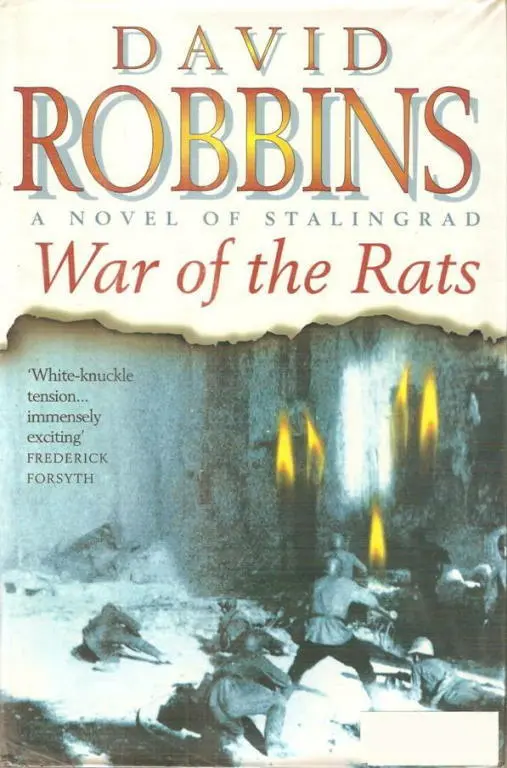
- Название:War of the Rats: A Novel of Stalingrad
- Автор:
- Издательство:Orion
- Жанр:
- Год:1999
- Город:London
- ISBN:978-0-752-82524-3
- Рейтинг книги:4 / 5. Голосов: 1
-
Избранное:Добавить в избранное
- Отзывы:
-
Ваша оценка:
War of the Rats: A Novel of Stalingrad: краткое содержание, описание и аннотация
Предлагаем к чтению аннотацию, описание, краткое содержание или предисловие (зависит от того, что написал сам автор книги «War of the Rats: A Novel of Stalingrad»). Если вы не нашли необходимую информацию о книге — напишите в комментариях, мы постараемся отыскать её.
Stalingrad in 1942 is a city in ruins, its Russian defenders fighting to the last man to repel the invading German army. One of their most potent weapons is the crack sniper school developed by Vasily Zaitsev. Its members can pick off the enemy at long range, and their daring tactics—hiding for hours in no man’s land until a brief opportunity presents itself—mean that no German, and particularly no German officer, can ever feel safe. This part of the battle is as much psychological as anything, and to counter the continuing threat to German morale, the Nazi command bring to the city their own top marksman, Heinz Thorvald. His mission is simple: to identify, and kill, Zaitsev.
Based on a true story, THE WAR OF THE RATS is a brilliantly compelling thriller which brings vividly to life probably the most harrowing battlefront of the Second World War.
War of the Rats: A Novel of Stalingrad — читать онлайн бесплатно полную книгу (весь текст) целиком
Ниже представлен текст книги, разбитый по страницам. Система сохранения места последней прочитанной страницы, позволяет с удобством читать онлайн бесплатно книгу «War of the Rats: A Novel of Stalingrad», без необходимости каждый раз заново искать на чём Вы остановились. Поставьте закладку, и сможете в любой момент перейти на страницу, на которой закончили чтение.
Интервал:
Закладка:
Sectors two and three, Zaitsev thought. That’s where the attack is. Kulikov is in two, Morozov in three.
Nikolay Kulikov. He wasn’t at the celebration last night. He and Baugderis probably stayed in their trench overnight to work their tin can lines again at dawn. They’re already in the thick of it. I’ve got to get to them.
Chuikov pulled me off all assignments to hunt down the sniper from Berlin. But it can’t be helped at the moment. I’ll get back to Thorvald later. He’ll keep.
Besides, he might even be in sector two, waiting for me.
The Hare and the Bear ran through trenches and empty alleys to reach the Volga. There, behind the safety of its cliffs along the littered beach, lay the main route from the Lazur to the troops defending the factory district.
The Nazi general Paulus had made reaching the river a priority, to isolate the Russian positions into small beachheads, especially now during the supply crisis. But running, Zaitsev felt in his shaking bones that this last offensive spasm by the Germans was doomed. He knew Chuikov’s Sixty-second Army was well dug in. To a man, the Ivans were fired up on vodka and stoked to a red glow by the bellows of the commissars’ ceaseless bunker speeches, their foxhole whispers, their iron nudges.
Nearing the Red October, Zaitsev heard the boom of artillery and tank fire. Viktor slowed. Great puffs of steam heaved from his mouth. His wide shoulders slumped under the weights strapped to him.
Zaitsev patted Viktor’s shoulder. “Bear, we need to hurry.”
“Let’s rest a moment,” Viktor huffed. “No sense getting there and being too tired to kill any Germans.” He trotted to a halt on the sand and bent over, hands on knees, breathing like a draft horse just in from the plow.
Zaitsev felt drops of sweat on his brow under his fur hat. He looked across the green river to the wooded islands two kilometers offshore. Behind those islands are food, ammunition, vodka, medicine, warmer boots, he thought. The Volga, the most beloved river of Russian lore, is even now shifting, deciding whether to help or destroy its countrymen.
The great ice floes drifted in the river; they bumped and grumbled below the surface. A milky skim of ice had formed in places along the bank, still too thin to walk on. But it was coming, the ice was gathering. How long until it was thick enough to drive a truck over? A month, perhaps? Will we still be here? ,
“I’ll go ahead, Viktor.” Zaitsev broke into a run up the beach. “Good hunting!” He left Viktor wheezing behind him. The sand hissed under his boots.
Vasha, the sand whispered, don’t forget the Headmaster.
The Volga ice giants slid past each other and keened, Vasha, he’s looking for you.
Once off the beach, moving through the streets, the barren buildings leaned over him to mutter in his ear.
Vasha, be careful, the city said.
He stopped in the street and looked around. A hundred Red soldiers ran past. Shouts and rifle reports surrounded him.
Thorvald, Vasha. Thorvald.
THE FIGHTING WAS BEHIND HIM NOW. HE DUCKED INTO trenches and crawled through the windows of buildings in his path. His ears were as attuned as his eyes; he was ready to freeze like a chameleon at any motion or sound in the rubble. He advanced undetected, as he knew he could.
He moved with a strength beyond what was in his arms and legs. It was in his stomach, in his senses. He knew that the war was not looking for him at that moment. It was absorbed elsewhere. He was at his zenith, his most powerful and canny; he was alert to any threat, ready to face danger and portion it out, creeping along the seams of the battle, set on instinct to vanish into the fabric of conflict. Though he’d tried over many a bottle and cigarette, in dozens of trenches under the flickering night-lights of tumbling flares with freshmen and seasoned veterans, he could never find the words to express it: war, when you know it, when you have it inside you, is an animal. You can scare it away, hide from it, even anger it or feed it something other than you. You can’t control it, but you can think like it. This was the skill Zaitsev could not teach to his hares. It lived in him at the visceral level, beneath words and intellect; it had breathed first in the taiga, been awakened in his blood by his grandfather. A soldier either possessed it, as Viktor and Chekov did, or won it, as Tania had done, or didn’t have it at all, no matter how brave or clever. He remembered the dead boy, the young bear Fedya.
He wondered about the Headmaster. Does he have it? Is his killing skill in his intellect or his gut? Is he a teacher, a soldier, or a hunter?
What will Thorvald show me? How patient is he? Where is he? Is he waiting for me to move into his crosshairs, or is he still stalking me? Will he try to flush me out, or will he set a trap and let me fall into it?
Zaitsev gazed at the hulls of the buildings opposite him. He looked to the burned shacks of the factory settlements, north to the remains of the Red October and, deep in the smoking distance, the Barricades. He thought about the city stretching behind him, tracing the arcing bank of the Volga in a crescent of desolation. It was all different now. Before, Stalingrad had been a battlefield, with maps, sectors, front lines, flanks, supply routes, the river—all building blocks defining the city. He’d grown to know it, learning the ruined terrain the best way a man could, by hiding in it. From his first days in the storm groups, the city had moved with a rhythm Zaitsev could feel, like the forest or the Pacific tides in Vladivostok. But now lurking within the shadows and cracks was a wild, unpredictable element: a single man with one mission, to find and kill him, the Hare. An SS colonel, a master sniper, skilled beyond what Zaitsev could guess, armed with his prey’s photograph and sheets of Danilov’s articles describing the sniper tactics Zaitsev had pioneered.
If Thorvald was the sniper who had shot up the dummy in sector two, then he was uncannily fast and deadly accurate. And, remembering Pyotr’s ragged face, Zaitsev sensed that there was something else about him. Something skewed, perhaps bizarre.
Zaitsev moved far enough west to see the rail yard bordering the Red October workers’ settlements. He was in the area of the icehouses, due north of the Lazur. Striakov counterattacked half a kilometer behind him. To his left, the echoes of tanks and boots clacked among the bricks and stark stone facades. The Germans were moving up to answer Striakov.
The shooting cells he’d shared with Kulikov and Baugderis were nearby. He scanned with his scope—the binoculars were better for the job at hand, but he preferred his finger on the trigger in uncertain situations like this—looking for the five ruined boxcars. They would mark the German trench, Kulikov’s tin-can hunting preserve of the afternoon before.
He slid forward another twenty meters. The first boxcar became visible at the far end of the yard, atop a rail mound, below a bank of warehouses. He recognized the terrain. There, another fifty meters to his left, would be Kulikov’s trench.
This last stretch was across an open yard. The ground was covered with debris. Resisting the urge to hurry this final distance, Zaitsev reached into his pack for a muslin sack. He slid his rifle and machine gun into the sack and pulled the drawstring. He moved slowly into the open, flat on his belly. He crept twenty meters in five minutes, stopping every five seconds to blend in with the cluttered earth. He crawled down into a shallow crater. He pulled on his rope and dragged the dirty tan sack just as slowly to him across the open yard. Gathering in the rope, he thought about the attributes of this sort of battlefield, how a man could turn them to his favor. If a man was careful and watchful, he could always find cover. If he knew how and when to move, he might travel at will throughout the city and remain invisible in the tangled shadows and rubble. The Germans surely had not thought of this when they bombed Stalingrad without relent in August and September, that they were simply building rats’ nests, runs, craters, and shadows for the Red soldier.
Читать дальшеИнтервал:
Закладка:
Похожие книги на «War of the Rats: A Novel of Stalingrad»
Представляем Вашему вниманию похожие книги на «War of the Rats: A Novel of Stalingrad» списком для выбора. Мы отобрали схожую по названию и смыслу литературу в надежде предоставить читателям больше вариантов отыскать новые, интересные, ещё непрочитанные произведения.










Обсуждение, отзывы о книге «War of the Rats: A Novel of Stalingrad» и просто собственные мнения читателей. Оставьте ваши комментарии, напишите, что Вы думаете о произведении, его смысле или главных героях. Укажите что конкретно понравилось, а что нет, и почему Вы так считаете.