Larry Bond - Shattered Trident
Здесь есть возможность читать онлайн «Larry Bond - Shattered Trident» весь текст электронной книги совершенно бесплатно (целиком полную версию без сокращений). В некоторых случаях можно слушать аудио, скачать через торрент в формате fb2 и присутствует краткое содержание. Город: New York, Год выпуска: 2013, ISBN: 2013, Издательство: Forge Books, Жанр: prose_military, thriller_techno, на английском языке. Описание произведения, (предисловие) а так же отзывы посетителей доступны на портале библиотеки ЛибКат.
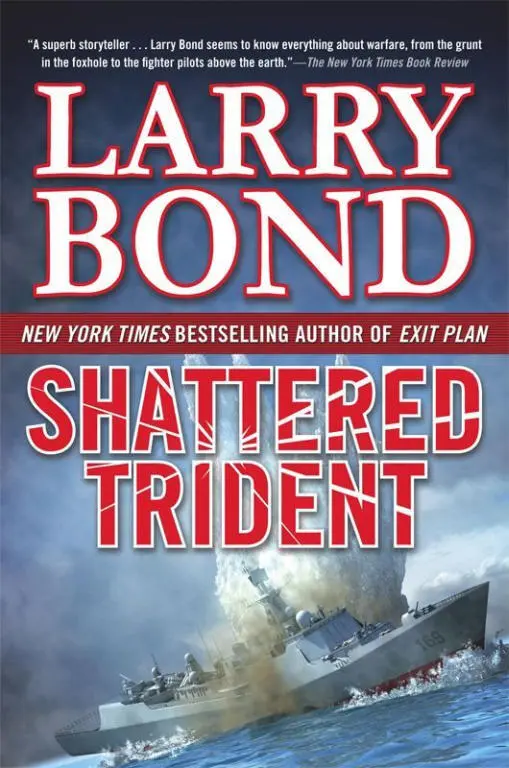
- Название:Shattered Trident
- Автор:
- Издательство:Forge Books
- Жанр:
- Год:2013
- Город:New York
- ISBN:978-0-7653-3147-2
- Рейтинг книги:5 / 5. Голосов: 1
-
Избранное:Добавить в избранное
- Отзывы:
-
Ваша оценка:
Shattered Trident: краткое содержание, описание и аннотация
Предлагаем к чтению аннотацию, описание, краткое содержание или предисловие (зависит от того, что написал сам автор книги «Shattered Trident»). Если вы не нашли необходимую информацию о книге — напишите в комментариях, мы постараемся отыскать её.
is shocked to see the Chinese boat torpedo a Vietnamese merchant ship.
This blatant act of aggression is the opening gambit in a war that has blindsided the U.S. and quickly embroiled all nations in the western Pacific. These nations, bound together in the newly formed Littoral Alliance, have begun a covert submarine campaign aimed at crippling China’s economy before China can set in motion its own plot to dominate the region.
In a desperate attempt to buy the president enough time to resolve the crisis diplomatically, Mitchell’s submarine squadron is ordered to interfere with attacks by both sides. China and the Littoral Alliance are both determined to win, no matter the cost, and as each side increases the level of violence, they approach a dangerous tipping point. In a race against time, the submarines of Mitchell’s squadron must execute their mission before the world witnesses an economic catastrophe—or worse, a nuclear exchange.
Shattered Trident — читать онлайн бесплатно полную книгу (весь текст) целиком
Ниже представлен текст книги, разбитый по страницам. Система сохранения места последней прочитанной страницы, позволяет с удобством читать онлайн бесплатно книгу «Shattered Trident», без необходимости каждый раз заново искать на чём Вы остановились. Поставьте закладку, и сможете в любой момент перейти на страницу, на которой закончили чтение.
Интервал:
Закладка:
The patch of water remained disturbed, like a ship’s wake, for several minutes, until the waves finally erased the last traces.
All thought of work was gone from his mind as he tried to grasp what he had just seen. The vessel had been painted black overall, with no way to tell who it belonged to.
Xing had been raised on the sea, and he accepted its wonders as a part of normal life. But now his mind whirled as he tried to imagine some colossal struggle, taking place in the depths right below him.
USS North Dakota
“Minot is not responding,” the UUV operator announced. He sounded like a heart surgeon searching for a nonexistent pulse.
“Understood,” Covey answered. He looked at his skipper, still seated calmly in the chair.
“Open the range, OOD, before he stabilizes his depth and starts looking for us. It’s time to report in.”
7 September 2016
1000 Local Time
Okutama, Nishitama District
Tokyo, Japan
There was a car waiting at the Okutama station, the driver holding a sign saying HIRANO. Komamura was not the only passenger. A Korean in civilian clothes named Choi Jang-Kang was already in the car. One of the staff for the Korean delegation, he recognized Komamura immediately, and asked respectful questions about his book as they drove away from the train station. The professor pushed himself to answer intelligently, but his fatigue made speaking an effort.
The car quickly left the small town behind and began climbing through the thickly forested foothills.
Although technically part of Tokyo, Okutama was in the Nishitama District, the westernmost district in Tokyo. It had taken the professor forty-five minutes by train to reach Okutama station, the end of the Ome line.
The mountainous terrain was sparsely settled, and the area was laced with deep valleys and sharp peaks. The slopes were completely covered by trees, now brilliant with their fall colors.
The road took them north and west of town, first simply climbing, then switching back and forth through dense woods several times before coming to a pair of soldiers manning a barrier. After the driver and passengers had produced identification, they were allowed to pass. One final switchback took them to a timber-covered carport and a set of worn stone steps.
Their driver led the way up. “Please excuse the climb, but right now it is the only way to reach the estate. I understand a sloped path will be added in a few weeks.”
“This was a private estate?” Komamura asked, steeling himself for the ascent.
“Yes, sensei . The alliance purchased it because of its privacy and because it is relatively close to Tokyo. It is also within the footprint of Tokyo’s ballistic missile defenses.”
“But away from any population centers,” the Korean added.
“That, too,” acknowledged the guide. “Security here is very strict. Please refrain from making any cell phone calls or using the Internet until you have been briefed by Captain Madarame. That’s scheduled right after the meeting.”
The house was hidden by the hill until they were almost on top of it. The stairs took a hard turn to the left, leading around a sharp corner in the hillside, almost a wall of rock, before becoming a more or less level path.
Komamura, grateful to be at the end of his quest, looked up to see a large tile-roofed structure, in the Edo style, built into the hillside. Oversized eaves sheltered a wooden walkway that surrounded the structure and blended with the path. The wooden frame of the building, although well maintained, had weathered so that it appeared to be part of the forest. Many of the house’s outer walls had been folded back to take advantage of the warm weather.
Admiral Kubo, in uniform, and Hisagi Shuhei were both waiting on the veranda, along with several other members of the working group. Everyone bowed a welcome, and came forward to greet Komamura. After he’d said hello to Kubo and others he knew, a small, thin, dark-skinned man in uniform came forward. It took the professor a moment to recognize him, but then he greeted the newcomer warmly. “Captain Giring! You must have left for Japan immediately after my visit. I hope this means that Indonesia has made a decision.”
Giring nodded, smiling. “You were most persuasive, Doctor. I am the naval representative to the working group. Our civilian representative will be Minister Ganesha. He arrives tomorrow.”
Komamura smiled broadly. “You have made part of my report obsolete,” he said happily.
Kubo took his arm. “I’m sure you are very tired, but if you can last a short time longer, we would welcome your presence. Events are carrying us forward rapidly.”
The professor was exhausted, having visited three countries in a day and a half. It was possible that parts of him resided in different time zones. All he wanted was a quiet cup of sake and a long soak, but his obligations came first.
They walked into the central hall. Dark polished wooden floors contrasted with the brightly painted wall screens. They mirrored the fall scenes outside, making the room feel spacious, almost open.
Each delegation sat at a low table, with support staff behind them, and Komamura saw a table with the Indonesian flag and Captain Giring already seated. Another held the two representatives from the Republic of the Philippines, who had joined immediately after the Littoral Alliance had declared its existence.
More ships to add to the new crest, thought Komamura. He wondered what colors they would use.
The working group had a rotating chair. This time Minister Nehru, from the Indian delegation, ran the meeting. Gray-haired and just a little overweight, he wasted no time on formality. “Welcome back, Professor. We’ve received your reports during your travels. Do you wish to add anything?”
The professor stood and bowed. “I was going to say that my proposals were warmly received and that I was optimistic about all three countries joining our alliance.” He turned to Giring. “I am very pleased to be proven at least partially correct so quickly, and I am also pleased that I can thank Captain Giring personally for his hospitality during my visit.”
He sat down as the other members applauded, and Nehru announced, “We must decide on priorities for those submarines capable of firing land-attack cruise missiles…”
Suddenly very tired, Komamura poured himself a cup of tea from a pot by his elbow. He wanted to be pleased with the results of his trip. Indonesia had immediately joined, and he believed the other two nations, Malaysia and Singapore, would also. But that meant their armed forces would join the fight, and the war would grow. There were rumors that Pakistan’s military was assisting the Chinese, and Iran and North Korea were noisily promising their assistance. The economic costs…
“Professor?” Minister Nehru’s question startled him from a half-doze. “I’m sorry, sir. I know it isn’t within your expertise, but what do you think? Given the increasing lack of tanker targets, should submarines capable of firing land-attack missiles start attacking naval bases, or continue to use torpedoes against warships and what merchants they can find?”
“Neither,” Komamura answered quickly. “Please excuse me, but sinking warships will not hurt the Chinese economy. And the loss of merchant ships carrying random cargoes will have only a superficial effect. China has already suffered deep wounds in her energy sector—specifically oil. I respectfully suggest that we remain focused on that goal.
“If there are few productive merchant targets at sea, cruise missiles should destroy oil facilities within their range, especially oil refineries. The distillation units would be particularly vulnerable to precision munitions. We must continue to hunt down tankers, even if they are empty, and sink them, even in harbor. We should also consider attacking China’s deep-ocean oil-drilling rigs. Naval experts can provide guidance on the best method of attack.
Читать дальшеИнтервал:
Закладка:
Похожие книги на «Shattered Trident»
Представляем Вашему вниманию похожие книги на «Shattered Trident» списком для выбора. Мы отобрали схожую по названию и смыслу литературу в надежде предоставить читателям больше вариантов отыскать новые, интересные, ещё непрочитанные произведения.
![Никки Сикс - Героиновые дневники. Год из жизни павшей рок-звезды[The Heroin Diaries - A Year in the Life of a Shattered Rock Star]](/books/78612/nikki-siks-geroinovye-dnevniki-god-iz-zhizni-pavshej-rok-zvezdy-the-heroin-diaries-a-yea-thumb.webp)





Обсуждение, отзывы о книге «Shattered Trident» и просто собственные мнения читателей. Оставьте ваши комментарии, напишите, что Вы думаете о произведении, его смысле или главных героях. Укажите что конкретно понравилось, а что нет, и почему Вы так считаете.