Larry Bond - Shattered Trident
Здесь есть возможность читать онлайн «Larry Bond - Shattered Trident» весь текст электронной книги совершенно бесплатно (целиком полную версию без сокращений). В некоторых случаях можно слушать аудио, скачать через торрент в формате fb2 и присутствует краткое содержание. Город: New York, Год выпуска: 2013, ISBN: 2013, Издательство: Forge Books, Жанр: prose_military, thriller_techno, на английском языке. Описание произведения, (предисловие) а так же отзывы посетителей доступны на портале библиотеки ЛибКат.
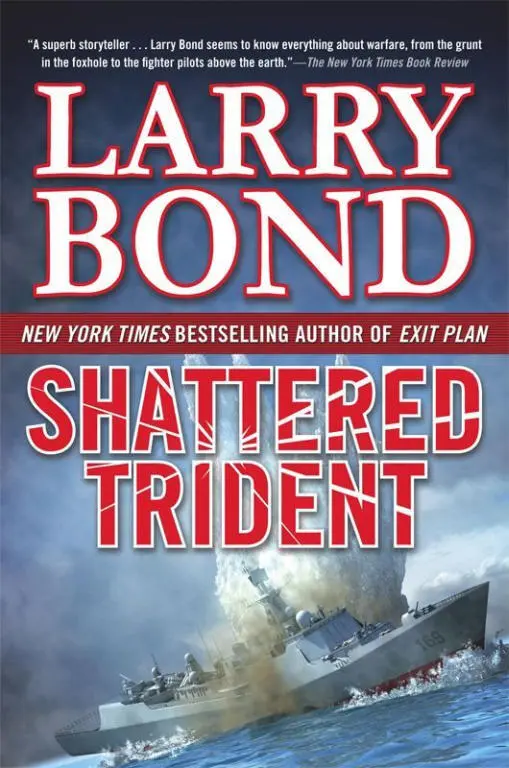
- Название:Shattered Trident
- Автор:
- Издательство:Forge Books
- Жанр:
- Год:2013
- Город:New York
- ISBN:978-0-7653-3147-2
- Рейтинг книги:5 / 5. Голосов: 1
-
Избранное:Добавить в избранное
- Отзывы:
-
Ваша оценка:
Shattered Trident: краткое содержание, описание и аннотация
Предлагаем к чтению аннотацию, описание, краткое содержание или предисловие (зависит от того, что написал сам автор книги «Shattered Trident»). Если вы не нашли необходимую информацию о книге — напишите в комментариях, мы постараемся отыскать её.
is shocked to see the Chinese boat torpedo a Vietnamese merchant ship.
This blatant act of aggression is the opening gambit in a war that has blindsided the U.S. and quickly embroiled all nations in the western Pacific. These nations, bound together in the newly formed Littoral Alliance, have begun a covert submarine campaign aimed at crippling China’s economy before China can set in motion its own plot to dominate the region.
In a desperate attempt to buy the president enough time to resolve the crisis diplomatically, Mitchell’s submarine squadron is ordered to interfere with attacks by both sides. China and the Littoral Alliance are both determined to win, no matter the cost, and as each side increases the level of violence, they approach a dangerous tipping point. In a race against time, the submarines of Mitchell’s squadron must execute their mission before the world witnesses an economic catastrophe—or worse, a nuclear exchange.
Shattered Trident — читать онлайн бесплатно полную книгу (весь текст) целиком
Ниже представлен текст книги, разбитый по страницам. Система сохранения места последней прочитанной страницы, позволяет с удобством читать онлайн бесплатно книгу «Shattered Trident», без необходимости каждый раз заново искать на чём Вы остановились. Поставьте закладку, и сможете в любой момент перейти на страницу, на которой закончили чтение.
Интервал:
Закладка:
“So you expect us to just absorb the losses inflicted by your allies, and then throw ourselves at your mercy. I seriously doubt my government will see any advantage in that.”
“I concede that it’s not the most palatable solution, but the alternative is far, far worse,” pushed Myles. “We have not supplied any of this information to any of our allies. Not even the British know what we know. I’m offering the People’s Republic of China the ‘right of first refusal.’
“I also don’t appreciate the position you’ve put me in by invading territories belonging to nonbelligerent nations that have security agreements with the United States; in particular, the Republic of the Philippines, which has absolutely no ability to threaten your country. If China continues down the current path, I sincerely doubt I’ll be able to keep my country neutral. And if that happens, then the information I’ve shared with you will be used against China. This will undoubtedly tip Western Europe over into the Littoral Alliance’s camp. You’ve seen the news reports as well as I; there are many who are already advocating such an action.”
“Are you now threatening us, President Myles?” Yang shouted angrily.
“No, Ambassador, I’m just trying to minimize the possibility of a misunderstanding. Your job is to faithfully inform your leaders where the United States stands on this matter. I need to be clear if you are to perform your duty properly.
“But consider this. With the rest of Asia’s trade already lost to you, if Western Europe and the United States join them, China’s economy will implode. This will plunge your country into chaos, along with the rest of the world. We don’t want to see that happen any more than you do. The economic and political repercussions would be severe, affecting virtually every nation on the globe, including my own country. And I doubt Russia would come to your aid. They would welcome seeing both our nations knocked down a notch.”
Myles noted that Yang was visibly shaking. The ambassador was incensed with the president’s message. But after an awkward moment, the elderly diplomat nodded his understanding, rose, and said, “I will convey your message to the Central Committee.”
“Thank you, Mr. Ambassador,” replied Myles as he stood. “I abhor being so blunt. It’s not my normal modus operandi to deal with a foreign government’s representative in such an unpleasant manner, but the current situation demands that I do nothing less.”
Yang nodded, looking depressed and suddenly much older. He extended his hand. Myles grasped it firmly and said, “Good evening, Mr. Ambassador.”
As Yang was escorted out of the Oval Office, Lloyd leaned over and whispered, “You were awfully generous with our information, Mr. President. Was it really necessary?”
Myles sighed. “I know, Andy. And that decision may come back to bite us in the future, but I had to convince Yang that we had detailed knowledge on everything China was up to. That information is one of the few weapons I can use. I can only hope he’s running a little scared right now.”
“Well, if it’s any consolation, he looked pretty miserable to me,” observed Lloyd.
Myles smiled and patted his friend on the shoulder. “Yes, I’m afraid our friend Yang looked none too happy. And his night will undoubtedly get worse.”
5 September 2016
1100 Local Time
INS Chakra
South China Sea
Captain Girish Samant surveyed his central post: the control room on a Russian-designed submarine. Everything was as it should be. The men were alert and attending to their duties as expected, despite the fact they’d been at action stations for several hours now. The war with China was only six days old and Chakra had already bagged four tankers, including one VLCC. Samant judged their performance thus far as adequate, but tankers are easy prey. Now they were hunting bigger game, a more elusive adversary, one that could fight back. Looking to his left at the Omnibus fire control consoles, he could see his first officer huddled with the two operators. The three men were having an animated discussion, their voices raised and excited. One of the operators pointed toward his circular display and commented on the target’s lack of proficiency. Samant frowned at such undisciplined behavior.
“Status, Number One,” he demanded sternly.
“Yes, sir. Contact four seven is heading westerly at four knots. Range estimate is ten thousand four hundred meters and opening. Recommend changing course to three one zero to intercept.”
“Very well, Number One. Helmsman, starboard fifteen, steer three one zero.”
The Indian captain was certain the fire control solution was inaccurate; he seriously doubted they could detect a new Type 041 Yuan-class submarine on the battery at ten kilometers. Still, the recommended turn was in the correct direction, and while Chakra swung to her new heading, he mentally ran through the math.
Girish Samant’s reputation as the finest submariner in the Indian Navy was not without justification. Not only did he finish at the top of his class in every course of instruction, he consistently had the highest ratings on the submarines he served on. But far and away his greatest accomplishment was that he was the first Indian naval officer to successfully complete the Royal Navy’s Submarine Command Course, or “Perisher.” Initially one of five officers in his class, and the lone foreign officer, he was one of only three who successfully made it through the demanding six-month course. The other two failed, or “perished.” Upon graduation, Samant was cited for possessing an exceptionally ordered mind and coolness under duress.
When he had been selected as Chakra ’s second commanding officer a little over a year earlier, Samant considered it to be the pinnacle of his career. But then India joined the Littoral Alliance and he suddenly found his submarine thrust into war. With this change in perspective, his peacetime accomplishments abruptly seemed unimportant, trivial. Being the best submariner in the Indian Navy was no longer good enough. Now he was determined to become India’s most successful captain ever. So driven, he set out to sink as many ships as fast as he possibly could. And while tankers ran up the tonnage, sinking combatants, particularly submarines, brought more glory. This Chinese boat would not escape him.
As he studied the fire control solution at his command desk, a nagging feeling began poking at him. The bearing rate seemed a little too high, and this reinforced his earlier thoughts; the contact was closer to him. “Number One, reduce the contact’s range to seven thousand meters and recompute target course and speed,” he ordered.
“Aye, aye, sir,” replied Lieutenant Commander Maahir Jain. Within moments he reported back to Samant. “Captain, sir, revised target course is two eight zero, speed three knots. The starboard flank array has also picked up the contact, revised range estimate is seven thousand eight hundred meters.”
Samant’s expression remained an impassionate mask. Even though his range estimate was vindicated as accurate, the flank array’s information merely confirmed a fact. There would be no premature congratulations; it would have to wait until the target was sunk. “Very well, Number One, stand by for target setup. Helmsman, right fifteen, steer three four zero. Deck officer, set combat quiet condition.”
USS North Dakota
“Confirm target zig, Sierra two-nine has changed course to the right,” reported Thigpen.
Jerry looked up at the port large-screen display. It didn’t take a lot of imagination to guess where the Indian was going. “Well, that cinches it. He’s heading straight for the Yuan.”
Читать дальшеИнтервал:
Закладка:
Похожие книги на «Shattered Trident»
Представляем Вашему вниманию похожие книги на «Shattered Trident» списком для выбора. Мы отобрали схожую по названию и смыслу литературу в надежде предоставить читателям больше вариантов отыскать новые, интересные, ещё непрочитанные произведения.
![Никки Сикс - Героиновые дневники. Год из жизни павшей рок-звезды[The Heroin Diaries - A Year in the Life of a Shattered Rock Star]](/books/78612/nikki-siks-geroinovye-dnevniki-god-iz-zhizni-pavshej-rok-zvezdy-the-heroin-diaries-a-yea-thumb.webp)






Обсуждение, отзывы о книге «Shattered Trident» и просто собственные мнения читателей. Оставьте ваши комментарии, напишите, что Вы думаете о произведении, его смысле или главных героях. Укажите что конкретно понравилось, а что нет, и почему Вы так считаете.