Joseph Roth - The Silent Prophet
Здесь есть возможность читать онлайн «Joseph Roth - The Silent Prophet» весь текст электронной книги совершенно бесплатно (целиком полную версию без сокращений). В некоторых случаях можно слушать аудио, скачать через торрент в формате fb2 и присутствует краткое содержание. Год выпуска: 2003, Издательство: The Overlook Press, Жанр: Классическая проза, на английском языке. Описание произведения, (предисловие) а так же отзывы посетителей доступны на портале библиотеки ЛибКат.
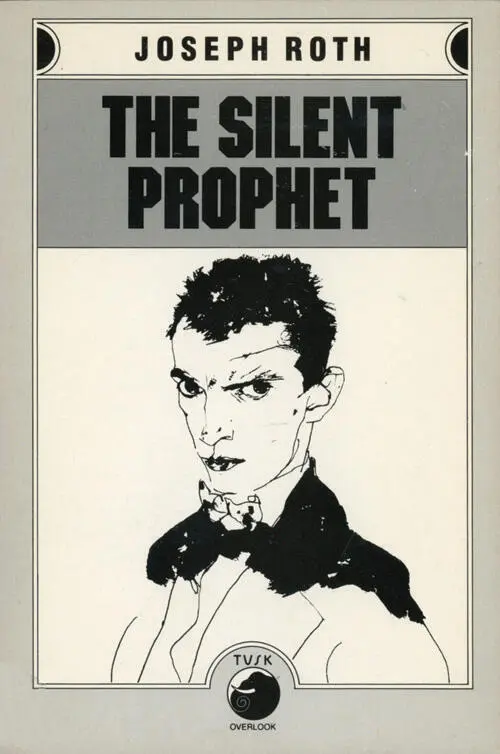
- Название:The Silent Prophet
- Автор:
- Издательство:The Overlook Press
- Жанр:
- Год:2003
- ISBN:нет данных
- Рейтинг книги:3 / 5. Голосов: 1
-
Избранное:Добавить в избранное
- Отзывы:
-
Ваша оценка:
The Silent Prophet: краткое содержание, описание и аннотация
Предлагаем к чтению аннотацию, описание, краткое содержание или предисловие (зависит от того, что написал сам автор книги «The Silent Prophet»). Если вы не нашли необходимую информацию о книге — напишите в комментариях, мы постараемся отыскать её.
The Silent Prophet — читать онлайн бесплатно полную книгу (весь текст) целиком
Ниже представлен текст книги, разбитый по страницам. Система сохранения места последней прочитанной страницы, позволяет с удобством читать онлайн бесплатно книгу «The Silent Prophet», без необходимости каждый раз заново искать на чём Вы остановились. Поставьте закладку, и сможете в любой момент перейти на страницу, на которой закончили чтение.
Интервал:
Закладка:
For some time Lion had been drawing restless curves in the air with his pince-nez. ‘Do you imagine,’ he shouted, ‘that we can shut ourselves off from the West? We can’t compete with world economy.
‘Russia is not going to remain a nation of peasants. It is becoming industrialized. But industry dictates the political set-up. Two-thirds of our industries are in foreign hands. We produce our iron and petroleum so slowly that they do not suffice even for our own feeble production. Our coalmines deliver only 2,250 million poods as against 18 milliards in Germany and 32 milliards in the United States. The average income of a Russian subject amounts to 53 roubles a year, of a Frenchman 233, an Englishman 273, an American 345. The average Russian saves only 16 roubles a year. Our national debt amounts to 9 milliards, that is 2 roubles 80 kopecks a head. But England, which in your view belongs to the degenerate West, has a national budget of 160 million pounds sterling and underpins its economy with a further 170 millions.’
Nothing availed against Lion’s figures, which he recited without the least hesitation, like a poem. As he uttered them, he drew them briskly in the air as if writing them with chalk on a blackboard. Efrejnov shook his head. Evidently he considered statistics, like Marxism, to be a product of the West and figures as crimes like assassinations. Lion had probably been sent to Siberia with more justification than the others. He regarded the ikon in the corner and the small red lamp lit a soothing gentle consolation in his heart.
5
Friedrich lit the slender candle of transparent paraffin wax.
From the ground the earth’s frozen breath entered the room like a steeply rising wind. Around the house sang the still, aching cold. It was like the singing of telegraph wires. Friedrich imagined to himself that there, in front of the house, in the impenetrable darkness, stood the smooth-planed tall posts topped with their flowers of white porcelain, linked by wires with the living world, whose forlorn voice they transformed into the clear, comforting and trustful monotony of a lullaby. When he lay down to sleep there flashed through his first slumber a rapid fancy, less than a thought and more than a dream, that his sleep would carry him towards a morning in the middle of the lively and bustling city. Berzejev still spoke to him for long stretches and did not wait for a reply. He loved his quiet younger comrade, his thin face and reserved look, and the courage with which he had joined the Revolution. ‘He has no discretion,’ observed Berzejev. ‘His rashness hinders him from anticipating situations. But when they come he bears them steadfastly. He is easily inspired and easily disillusioned. But despondency and enthusiasm are only physiological phenomena. In reality he is melancholy, uniformly melancholy.’ And Berzejev said out loud:
‘This poor Efrejnov is confused by Lion. He is too unsuspecting to find arguments. I could have found them for him. Russia’s faults are really the consequence of hasty endeavours to copy the West. In all probability, Russia would be sound and rich without the stupid aspiration held by a certain section of its ruling class to become civilized, and to be regarded in the fashionable spas of Western Europe as proper Europeans. The bigoted Agrarians are no less right than we ourselves, the thoroughgoing revolutionaries. They lack only understanding. Everything that lies in the middle, between thoroughgoing reaction and thoroughgoing revolution, is foolish in Russia. The bourgeois class has developed before there was a place ready for it. Now it is demanding its industries. The Tsar is helpless. He is turning himself into an Emperor on the old Western model, rather like the present German Kaiser. Autocracy gives way to bureaucracy and the officials are the vanguard of the bourgeoisie. It begins with the entry of the sons of the nobility and the rich bourgeoisie into official posts, that is, into the great cities. And the cities are the enemy of the countryside. The intelligentsia follows. It is the outpost of the Revolution. The semi-revolutionary ideals of the intelligentsia are foreign to the instincts of the Russian people. The cruelty of the Agrarian autocracy is really closer to them. You see, therefore, the imminence of an explosion. The intellectual bureaucrat renders the Agrarians impotent. He can topple the Tsar but not govern the people. His dominance will be an insignificant intermission. It is we who hold the power. Russia can only become a proletarian, not a bourgeois, republic. Only a war is needed, and the old Russia is done for. And the war is coming; we shan’t be staying in Siberia much longer.’
Flour was unaffordable. In this region the housewives could bake only three times a year. Bread was scarcer than meat. For the first time Friedrich felt the immediate relation between sun and earth. For the first time he understood the simple meaning of the prayer man addresses to Heaven for his daily bread. At the breadless table where he sat down twice a day he thought of the bakers’ shops in the bustling towns. He closed his eyes. He conjured up the different colours of the flour and the different shapes of the loaves.
‘What are you dreaming about?’ asked Berzejev.
‘Of bread. When I picture the world from which we are exiled, I think of quite trivial things — flat matches, for instance, for the waistcoat pocket and round lids for beer-mugs, inkwells one can open by pressing, celluloid paper-knives and quite ordinary things like a picture-postcard. I remember one that used to hang in the shop-window of the stationer’s on the corner of the street where I lived. It was old and yellowed, had been in the window for years. It was a miserable little stationer’s and an ugly card. It had a wide gold edge, speckled black by flies. It showed a well-known picture. On the globe, poised in space — the space, if I remember rightly, was pale blue — sits a woman with a blindfold on the North Pole.’
‘Yes, yes,’ said Berzejev, ‘I’ve seen that picture too. Wait a minute, I think the woman held something in her hand and she wore a watery blue dress. But I don’t recall the wide gold margin.’
‘But it was a wide gold margin,’ insisted Friedrich, ‘and fly-speckled, and there was a yellow post-box at the street-corner. You could stick down a letter and push it inside and even hear the way it fell — with a thud if the box was empty and with a rustle if there were letters already inside.’
‘Let’s stick to bread,’ said Berzejev. ‘You’re distracting me from it. To begin with, there were two main kinds, white and black. Once in France — I was there with my father when I was fourteen — I ate hard, white, long batons of bread with a golden-brown crust. But the Russian country bread, black and reddish, with rather coarse soft grains, is the one I like best.’
‘I remember,’ continued Friedrich, ‘how it smelled when one passed a baker’s shop.’
‘Especially at night!’ cried Berzejev.
‘Yes, at night, when it was winter, you were struck all of a sudden by a warmth from the cellars, almost like an animal warmth.’
‘A bread-like warmth,’ exulted Berzejev.
‘And in the morning, in summer, when I woke very early and went into the street, the white baker’s boys were trotting around with covered baskets. How those baskets smelled! And you could hear the birds singing then, because the streets were still quiet.’
They fell silent for a time.
Suddenly Berzejev said: ‘How stupid we have become!’
‘No, not stupid,’ cried Friedrich, ‘only human. We were ideologists, not human beings. We wanted to reshape the world and we are dependent on postcards and must eat bread.’
‘It’s because not everyone has bread,’ said Berzejev quietly, ‘that we are sitting here. How simple it all is. One doesn’t need theory or economics. Because not everyone has bread — very simple and quite stupid.’
Читать дальшеИнтервал:
Закладка:
Похожие книги на «The Silent Prophet»
Представляем Вашему вниманию похожие книги на «The Silent Prophet» списком для выбора. Мы отобрали схожую по названию и смыслу литературу в надежде предоставить читателям больше вариантов отыскать новые, интересные, ещё непрочитанные произведения.
Обсуждение, отзывы о книге «The Silent Prophet» и просто собственные мнения читателей. Оставьте ваши комментарии, напишите, что Вы думаете о произведении, его смысле или главных героях. Укажите что конкретно понравилось, а что нет, и почему Вы так считаете.