Charles Dickens - The Pickwick Papers
Здесь есть возможность читать онлайн «Charles Dickens - The Pickwick Papers» весь текст электронной книги совершенно бесплатно (целиком полную версию без сокращений). В некоторых случаях можно слушать аудио, скачать через торрент в формате fb2 и присутствует краткое содержание. Жанр: Классическая проза, Юмористическая проза, на английском языке. Описание произведения, (предисловие) а так же отзывы посетителей доступны на портале библиотеки ЛибКат.
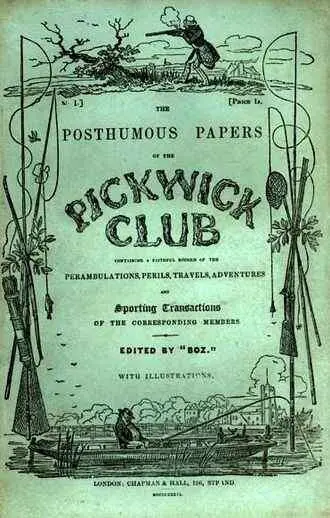
- Название:The Pickwick Papers
- Автор:
- Жанр:
- Год:неизвестен
- ISBN:нет данных
- Рейтинг книги:4 / 5. Голосов: 1
-
Избранное:Добавить в избранное
- Отзывы:
-
Ваша оценка:
The Pickwick Papers: краткое содержание, описание и аннотация
Предлагаем к чтению аннотацию, описание, краткое содержание или предисловие (зависит от того, что написал сам автор книги «The Pickwick Papers»). Если вы не нашли необходимую информацию о книге — напишите в комментариях, мы постараемся отыскать её.
Mr Samuel Pickwick is the founder and chairman of the absurd Pickwick Club which consists of Tupman, Snodgrass and Winkle who go through various amusing and often quite ridiculous adventures that are scantily interconnected and never amount to a complex sequence of events until perhaps Pickwick’s disastrous misunderstanding with Mrs Bardell.
The Pickwick Papers — читать онлайн бесплатно полную книгу (весь текст) целиком
Ниже представлен текст книги, разбитый по страницам. Система сохранения места последней прочитанной страницы, позволяет с удобством читать онлайн бесплатно книгу «The Pickwick Papers», без необходимости каждый раз заново искать на чём Вы остановились. Поставьте закладку, и сможете в любой момент перейти на страницу, на которой закончили чтение.
Интервал:
Закладка:
‘My friends, the gentleman I was speaking of — Mr. Magnus,’ said Mr. Pickwick.
‘Your servant, gentlemen,’ said Mr. Magnus, evidently in a high state of excitement; ‘Mr. Pickwick, allow me to speak to you one moment, sir.’
As he said this, Mr. Magnus harnessed his forefinger to Mr. Pickwick’s buttonhole, and, drawing him to a window recess, said—
‘Congratulate me, Mr. Pickwick; I followed your advice to the very letter.’
‘And it was all correct, was it?’ inquired Mr. Pickwick.
‘It was, Sir. Could not possibly have been better,’ replied Mr. Magnus. ‘Mr. Pickwick, she is mine.’
‘I congratulate you, with all my heart,’ replied Mr. Pickwick, warmly shaking his new friend by the hand.
‘You must see her. Sir,’ said Mr. Magnus; ‘this way, if you please. Excuse us for one instant, gentlemen.’ Hurrying on in this way, Mr. Peter Magnus drew Mr. Pickwick from the room. He paused at the next door in the passage, and tapped gently thereat.
‘Come in,’ said a female voice. And in they went.
‘Miss Witherfield,’ said Mr. Magnus, ‘allow me to introduce my very particular friend, Mr. Pickwick. Mr. Pickwick, I beg to make you known to Miss Witherfield.’
The lady was at the upper end of the room. As Mr. Pickwick bowed, he took his spectacles from his waistcoat pocket, and put them on; a process which he had no sooner gone through, than, uttering an exclamation of surprise, Mr. Pickwick retreated several paces, and the lady, with a half–suppressed scream, hid her face in her hands, and dropped into a chair; whereupon Mr. Peter Magnus was stricken motionless on the spot, and gazed from one to the other, with a countenance expressive of the extremities of horror and surprise. This certainly was, to all appearance, very unaccountable behaviour; but the fact is, that Mr. Pickwick no sooner put on his spectacles, than he at once recognised in the future Mrs. Magnus the lady into whose room he had so unwarrantably intruded on the previous night; and the spectacles had no sooner crossed Mr. Pickwick’s nose, than the lady at once identified the countenance which she had seen surrounded by all the horrors of a nightcap. So the lady screamed, and Mr. Pickwick started.
‘Mr. Pickwick!’ exclaimed Mr. Magnus, lost in astonishment, ‘what is the meaning of this, Sir? What is the meaning of it, Sir?’ added Mr. Magnus, in a threatening, and a louder tone.
‘Sir,’ said Mr. Pickwick, somewhat indignant at the very sudden manner in which Mr. Peter Magnus had conjugated himself into the imperative mood, ‘I decline answering that question.’
‘You decline it, Sir?’ said Mr. Magnus.
‘I do, Sir,’ replied Mr. Pickwick; ‘I object to say anything which may compromise that lady, or awaken unpleasant recollections in her breast, without her consent and permission.’
‘Miss Witherfield,’ said Mr. Peter Magnus, ‘do you know this person?’
‘Know him!’ repeated the middle–aged lady, hesitating.
‘Yes, know him, ma’am; I said know him,’ replied Mr. Magnus, with ferocity.
‘I have seen him,’ replied the middle–aged lady.
‘Where?’ inquired Mr. Magnus, ‘where?’
‘That,’ said the middle–aged lady, rising from her seat, and averting her head — ‘that I would not reveal for worlds.’
‘I understand you, ma’am,’ said Mr. Pickwick, ‘and respect your delicacy; it shall never be revealed by me depend upon it.’
‘Upon my word, ma’am,’ said Mr. Magnus, ‘considering the situation in which I am placed with regard to yourself, you carry this matter off with tolerable coolness — tolerable coolness, ma’am.’
‘Cruel Mr. Magnus!’ said the middle–aged lady; here she wept very copiously indeed.
‘Address your observations to me, sir,’ interposed Mr. Pickwick; ‘I alone am to blame, if anybody be.’
‘Oh! you alone are to blame, are you, sir?’ said Mr. Magnus; ‘I — I — see through this, sir. You repent of your determination now, do you?’
‘My determination!’ said Mr. Pickwick.
‘Your determination, Sir. Oh! don’t stare at me, Sir,’ said Mr. Magnus; ‘I recollect your words last night, Sir. You came down here, sir, to expose the treachery and falsehood of an individual on whose truth and honour you had placed implicit reliance — eh?’ Here Mr. Peter Magnus indulged in a prolonged sneer; and taking off his green spectacles — which he probably found superfluous in his fit of jealousy — rolled his little eyes about, in a manner frightful to behold.
‘Eh?’ said Mr. Magnus; and then he repeated the sneer with increased effect. ‘But you shall answer it, Sir.’
‘Answer what?’ said Mr. Pickwick.
‘Never mind, sir,’ replied Mr. Magnus, striding up and down the room. ‘Never mind.’
There must be something very comprehensive in this phrase of ‘Never mind,’ for we do not recollect to have ever witnessed a quarrel in the street, at a theatre, public room, or elsewhere, in which it has not been the standard reply to all belligerent inquiries. ‘Do you call yourself a gentleman, sir?’ — ‘Never mind, sir.’ ‘Did I offer to say anything to the young woman, sir?’ — ‘Never mind, sir.’ ‘Do you want your head knocked up against that wall, sir?’ — ‘Never mind, sir.’ It is observable, too, that there would appear to be some hidden taunt in this universal ‘Never mind,’ which rouses more indignation in the bosom of the individual addressed, than the most lavish abuse could possibly awaken.
We do not mean to assert that the application of this brevity to himself, struck exactly that indignation to Mr. Pickwick’s soul, which it would infallibly have roused in a vulgar breast. We merely record the fact that Mr. Pickwick opened the room door, and abruptly called out, ‘Tupman, come here!’
Mr. Tupman immediately presented himself, with a look of very considerable surprise.
‘Tupman,’ said Mr. Pickwick, ‘a secret of some delicacy, in which that lady is concerned, is the cause of a difference which has just arisen between this gentleman and myself. When I assure him, in your presence, that it has no relation to himself, and is not in any way connected with his affairs, I need hardly beg you to take notice that if he continue to dispute it, he expresses a doubt of my veracity, which I shall consider extremely insulting.’ As Mr. Pickwick said this, he looked encyclopedias at Mr. Peter Magnus.
Mr. Pickwick’s upright and honourable bearing, coupled with that force and energy of speech which so eminently distinguished him, would have carried conviction to any reasonable mind; but, unfortunately, at that particular moment, the mind of Mr. Peter Magnus was in anything but reasonable order. Consequently, instead of receiving Mr. Pickwick’s explanation as he ought to have done, he forthwith proceeded to work himself into a red–hot, scorching, consuming passion, and to talk about what was due to his own feelings, and all that sort of thing; adding force to his declamation by striding to and fro, and pulling his hair — amusements which he would vary occasionally, by shaking his fist in Mr. Pickwick’s philanthropic countenance.
Mr. Pickwick, in his turn, conscious of his own innocence and rectitude, and irritated by having unfortunately involved the middle–aged lady in such an unpleasant affair, was not so quietly disposed as was his wont. The consequence was, that words ran high, and voices higher; and at length Mr. Magnus told Mr. Pickwick he should hear from him; to which Mr. Pickwick replied, with laudable politeness, that the sooner he heard from him the better; whereupon the middle–aged lady rushed in terror from the room, out of which Mr. Tupman dragged Mr. Pickwick, leaving Mr. Peter Magnus to himself and meditation.
Читать дальшеИнтервал:
Закладка:
Похожие книги на «The Pickwick Papers»
Представляем Вашему вниманию похожие книги на «The Pickwick Papers» списком для выбора. Мы отобрали схожую по названию и смыслу литературу в надежде предоставить читателям больше вариантов отыскать новые, интересные, ещё непрочитанные произведения.








Обсуждение, отзывы о книге «The Pickwick Papers» и просто собственные мнения читателей. Оставьте ваши комментарии, напишите, что Вы думаете о произведении, его смысле или главных героях. Укажите что конкретно понравилось, а что нет, и почему Вы так считаете.