Charles Dickens - The Pickwick Papers
Здесь есть возможность читать онлайн «Charles Dickens - The Pickwick Papers» весь текст электронной книги совершенно бесплатно (целиком полную версию без сокращений). В некоторых случаях можно слушать аудио, скачать через торрент в формате fb2 и присутствует краткое содержание. Жанр: Классическая проза, Юмористическая проза, на английском языке. Описание произведения, (предисловие) а так же отзывы посетителей доступны на портале библиотеки ЛибКат.
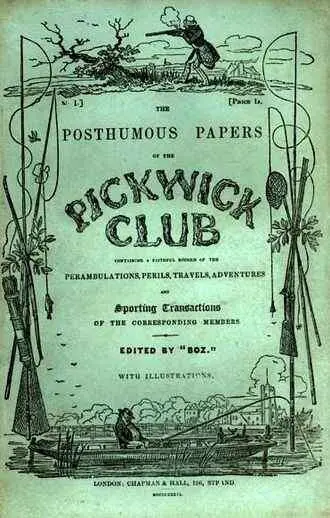
- Название:The Pickwick Papers
- Автор:
- Жанр:
- Год:неизвестен
- ISBN:нет данных
- Рейтинг книги:4 / 5. Голосов: 1
-
Избранное:Добавить в избранное
- Отзывы:
-
Ваша оценка:
The Pickwick Papers: краткое содержание, описание и аннотация
Предлагаем к чтению аннотацию, описание, краткое содержание или предисловие (зависит от того, что написал сам автор книги «The Pickwick Papers»). Если вы не нашли необходимую информацию о книге — напишите в комментариях, мы постараемся отыскать её.
Mr Samuel Pickwick is the founder and chairman of the absurd Pickwick Club which consists of Tupman, Snodgrass and Winkle who go through various amusing and often quite ridiculous adventures that are scantily interconnected and never amount to a complex sequence of events until perhaps Pickwick’s disastrous misunderstanding with Mrs Bardell.
The Pickwick Papers — читать онлайн бесплатно полную книгу (весь текст) целиком
Ниже представлен текст книги, разбитый по страницам. Система сохранения места последней прочитанной страницы, позволяет с удобством читать онлайн бесплатно книгу «The Pickwick Papers», без необходимости каждый раз заново искать на чём Вы остановились. Поставьте закладку, и сможете в любой момент перейти на страницу, на которой закончили чтение.
Интервал:
Закладка:
‘I am very sorry to put you to any inconvenience, Mrs. Raddle,’ said Bob Sawyer deferentially, ‘but—’
‘Oh, it isn’t any inconvenience,’ replied the little woman, with a shrill titter. ‘I didn’t want it particular before to–day; leastways, as it has to go to my landlord directly, it was as well for you to keep it as me. You promised me this afternoon, Mr. Sawyer, and every gentleman as has ever lived here, has kept his word, Sir, as of course anybody as calls himself a gentleman does.’ Mrs. Raddle tossed her head, bit her lips, rubbed her hands harder, and looked at the wall more steadily than ever. It was plain to see, as Mr. Bob Sawyer remarked in a style of Eastern allegory on a subsequent occasion, that she was ‘getting the steam up.’
‘I am very sorry, Mrs. Raddle,’ said Bob Sawyer, with all imaginable humility, ‘but the fact is, that I have been disappointed in the City to–day.’ — Extraordinary place that City. An astonishing number of men always are getting disappointed there.
‘Well, Mr. Sawyer,’ said Mrs. Raddle, planting herself firmly on a purple cauliflower in the Kidderminster carpet, ‘and what’s that to me, Sir?’
‘I — I — have no doubt, Mrs. Raddle,’ said Bob Sawyer, blinking this last question, ‘that before the middle of next week we shall be able to set ourselves quite square, and go on, on a better system, afterwards.’
This was all Mrs. Raddle wanted. She had bustled up to the apartment of the unlucky Bob Sawyer, so bent upon going into a passion, that, in all probability, payment would have rather disappointed her than otherwise. She was in excellent order for a little relaxation of the kind, having just exchanged a few introductory compliments with Mr. R. in the front kitchen.
‘Do you suppose, Mr. Sawyer,’ said Mrs. Raddle, elevating her voice for the information of the neighbours — ‘do you suppose that I’m a–going day after day to let a fellar occupy my lodgings as never thinks of paying his rent, nor even the very money laid out for the fresh butter and lump sugar that’s bought for his breakfast, and the very milk that’s took in, at the street door? Do you suppose a hard–working and industrious woman as has lived in this street for twenty year (ten year over the way, and nine year and three–quarters in this very house) has nothing else to do but to work herself to death after a parcel of lazy idle fellars, that are always smoking and drinking, and lounging, when they ought to be glad to turn their hands to anything that would help ’em to pay their bills? Do you—’
‘My good soul,’ interposed Mr. Benjamin Allen soothingly.
‘Have the goodness to keep your observashuns to yourself, Sir, I beg,’ said Mrs. Raddle, suddenly arresting the rapid torrent of her speech, and addressing the third party with impressive slowness and solemnity. ‘I am not aweer, Sir, that you have any right to address your conversation to me. I don’t think I let these apartments to you, Sir.’
‘No, you certainly did not,’ said Mr. Benjamin Allen.
‘Very good, Sir,’ responded Mrs. Raddle, with lofty politeness. ‘Then p’raps, Sir, you’ll confine yourself to breaking the arms and legs of the poor people in the hospitals, and keep yourself to yourself, Sir, or there may be some persons here as will make you, Sir.’
‘But you are such an unreasonable woman,’ remonstrated Mr. Benjamin Allen.
‘I beg your parding, young man,’ said Mrs. Raddle, in a cold perspiration of anger. ‘But will you have the goodness just to call me that again, sir?’
‘I didn’t make use of the word in any invidious sense, ma’am,’ replied Mr. Benjamin Allen, growing somewhat uneasy on his own account.
‘I beg your parding, young man,’ demanded Mrs. Raddle, in a louder and more imperative tone. ‘But who do you call a woman? Did you make that remark to me, sir?’
‘Why, bless my heart!’ said Mr. Benjamin Allen.
‘Did you apply that name to me, I ask of you, sir?’ interrupted Mrs. Raddle, with intense fierceness, throwing the door wide open.
‘Why, of course I did,’ replied Mr. Benjamin Allen.
‘Yes, of course you did,’ said Mrs. Raddle, backing gradually to the door, and raising her voice to its loudest pitch, for the special behoof of Mr. Raddle in the kitchen. ‘Yes, of course you did! And everybody knows that they may safely insult me in my own ‘ouse while my husband sits sleeping downstairs, and taking no more notice than if I was a dog in the streets. He ought to be ashamed of himself (here Mrs. Raddle sobbed) to allow his wife to be treated in this way by a parcel of young cutters and carvers of live people’s bodies, that disgraces the lodgings (another sob), and leaving her exposed to all manner of abuse; a base, faint–hearted, timorous wretch, that’s afraid to come upstairs, and face the ruffinly creatures — that’s afraid — that’s afraid to come!’ Mrs. Raddle paused to listen whether the repetition of the taunt had roused her better half; and finding that it had not been successful, proceeded to descend the stairs with sobs innumerable; when there came a loud double knock at the street door; whereupon she burst into an hysterical fit of weeping, accompanied with dismal moans, which was prolonged until the knock had been repeated six times, when, in an uncontrollable burst of mental agony, she threw down all the umbrellas, and disappeared into the back parlour, closing the door after her with an awful crash.
‘Does Mr. Sawyer live here?’ said Mr. Pickwick, when the door was opened.
‘Yes,’ said the girl, ‘first floor. It’s the door straight afore you, when you gets to the top of the stairs.’ Having given this instruction, the handmaid, who had been brought up among the aboriginal inhabitants of Southwark, disappeared, with the candle in her hand, down the kitchen stairs, perfectly satisfied that she had done everything that could possibly be required of her under the circumstances.
Mr. Snodgrass, who entered last, secured the street door, after several ineffectual efforts, by putting up the chain; and the friends stumbled upstairs, where they were received by Mr. Bob Sawyer, who had been afraid to go down, lest he should be waylaid by Mrs. Raddle.
‘How are you?’ said the discomfited student. ‘Glad to see you — take care of the glasses.’ This caution was addressed to Mr. Pickwick, who had put his hat in the tray.
‘Dear me,’ said Mr. Pickwick, ‘I beg your pardon.’
‘Don’t mention it, don’t mention it,’ said Bob Sawyer. ‘I’m rather confined for room here, but you must put up with all that, when you come to see a young bachelor. Walk in. You’ve seen this gentleman before, I think?’ Mr. Pickwick shook hands with Mr. Benjamin Allen, and his friends followed his example. They had scarcely taken their seats when there was another double knock.
‘I hope that’s Jack Hopkins!’ said Mr. Bob Sawyer. ‘Hush. Yes, it is. Come up, Jack; come up.’
A heavy footstep was heard upon the stairs, and Jack Hopkins presented himself. He wore a black velvet waistcoat, with thunder–and–lightning buttons; and a blue striped shirt, with a white false collar.
‘You’re late, Jack?’ said Mr. Benjamin Allen.
‘Been detained at Bartholomew’s,’ replied Hopkins.
‘Anything new?’
‘No, nothing particular. Rather a good accident brought into the casualty ward.’
‘What was that, sir?’ inquired Mr. Pickwick.
‘Only a man fallen out of a four pair of stairs’ window; but it’s a very fair case indeed.’
‘Do you mean that the patient is in a fair way to recover?’ inquired Mr. Pickwick. ‘No,’ replied Mr. Hopkins carelessly. ‘No, I should rather say he wouldn’t. There must be a splendid operation, though, to–morrow — magnificent sight if Slasher does it.’
Читать дальшеИнтервал:
Закладка:
Похожие книги на «The Pickwick Papers»
Представляем Вашему вниманию похожие книги на «The Pickwick Papers» списком для выбора. Мы отобрали схожую по названию и смыслу литературу в надежде предоставить читателям больше вариантов отыскать новые, интересные, ещё непрочитанные произведения.








Обсуждение, отзывы о книге «The Pickwick Papers» и просто собственные мнения читателей. Оставьте ваши комментарии, напишите, что Вы думаете о произведении, его смысле или главных героях. Укажите что конкретно понравилось, а что нет, и почему Вы так считаете.