Charles Dickens - The Pickwick Papers
Здесь есть возможность читать онлайн «Charles Dickens - The Pickwick Papers» весь текст электронной книги совершенно бесплатно (целиком полную версию без сокращений). В некоторых случаях можно слушать аудио, скачать через торрент в формате fb2 и присутствует краткое содержание. Жанр: Классическая проза, Юмористическая проза, на английском языке. Описание произведения, (предисловие) а так же отзывы посетителей доступны на портале библиотеки ЛибКат.
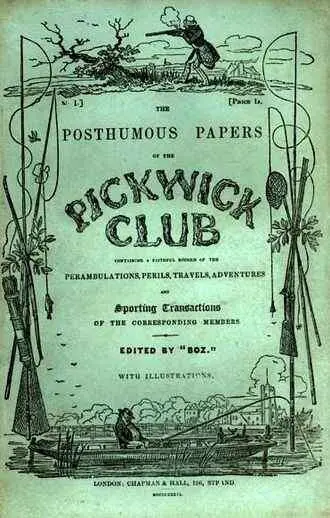
- Название:The Pickwick Papers
- Автор:
- Жанр:
- Год:неизвестен
- ISBN:нет данных
- Рейтинг книги:4 / 5. Голосов: 1
-
Избранное:Добавить в избранное
- Отзывы:
-
Ваша оценка:
The Pickwick Papers: краткое содержание, описание и аннотация
Предлагаем к чтению аннотацию, описание, краткое содержание или предисловие (зависит от того, что написал сам автор книги «The Pickwick Papers»). Если вы не нашли необходимую информацию о книге — напишите в комментариях, мы постараемся отыскать её.
Mr Samuel Pickwick is the founder and chairman of the absurd Pickwick Club which consists of Tupman, Snodgrass and Winkle who go through various amusing and often quite ridiculous adventures that are scantily interconnected and never amount to a complex sequence of events until perhaps Pickwick’s disastrous misunderstanding with Mrs Bardell.
The Pickwick Papers — читать онлайн бесплатно полную книгу (весь текст) целиком
Ниже представлен текст книги, разбитый по страницам. Система сохранения места последней прочитанной страницы, позволяет с удобством читать онлайн бесплатно книгу «The Pickwick Papers», без необходимости каждый раз заново искать на чём Вы остановились. Поставьте закладку, и сможете в любой момент перейти на страницу, на которой закончили чтение.
Интервал:
Закладка:
‘But, Mr. Mallard, my dear friend,’ said Perker, suddenly recovering his gravity, and drawing the great man’s great man into a Corner, by the lappel of his coat; ‘you must persuade the Serjeant to see me, and my client here.’
‘Come, come,’ said the clerk, ‘that’s not bad either. See the Serjeant! come, that’s too absurd.’ Notwithstanding the absurdity of the proposal, however, the clerk allowed himself to be gently drawn beyond the hearing of Mr. Pickwick; and after a short conversation conducted in whispers, walked softly down a little dark passage, and disappeared into the legal luminary’s sanctum, whence he shortly returned on tiptoe, and informed Mr. Perker and Mr. Pickwick that the Serjeant had been prevailed upon, in violation of all established rules and customs, to admit them at once.
Mr. Serjeant Snubbins was a lantern–faced, sallow–complexioned man, of about five–and–forty, or — as the novels say — he might be fifty. He had that dull–looking, boiled eye which is often to be seen in the heads of people who have applied themselves during many years to a weary and laborious course of study; and which would have been sufficient, without the additional eyeglass which dangled from a broad black riband round his neck, to warn a stranger that he was very near–sighted. His hair was thin and weak, which was partly attributable to his having never devoted much time to its arrangement, and partly to his having worn for five–and–twenty years the forensic wig which hung on a block beside him. The marks of hairpowder on his coat–collar, and the ill–washed and worse tied white neckerchief round his throat, showed that he had not found leisure since he left the court to make any alteration in his dress; while the slovenly style of the remainder of his costume warranted the inference that his personal appearance would not have been very much improved if he had. Books of practice, heaps of papers, and opened letters, were scattered over the table, without any attempt at order or arrangement; the furniture of the room was old and rickety; the doors of the book–case were rotting in their hinges; the dust flew out from the carpet in little clouds at every step; the blinds were yellow with age and dirt; the state of everything in the room showed, with a clearness not to be mistaken, that Mr. Serjeant Snubbin was far too much occupied with his professional pursuits to take any great heed or regard of his personal comforts.
The Serjeant was writing when his clients entered; he bowed abstractedly when Mr. Pickwick was introduced by his solicitor; and then, motioning them to a seat, put his pen carefully in the inkstand, nursed his left leg, and waited to be spoken to.
‘Mr. Pickwick is the defendant in Bardell and Pickwick, Serjeant Snubbin,’ said Perker.
‘I am retained in that, am I?’ said the Serjeant.
‘You are, Sir,’ replied Perker.
The Serjeant nodded his head, and waited for something else.
‘Mr. Pickwick was anxious to call upon you, Serjeant Snubbin,’ said Perker, ‘to state to you, before you entered upon the case, that he denies there being any ground or pretence whatever for the action against him; and that unless he came into court with clean hands, and without the most conscientious conviction that he was right in resisting the plaintiff’s demand, he would not be there at all. I believe I state your views correctly; do I not, my dear Sir?’ said the little man, turning to Mr. Pickwick.
‘Quite so,’ replied that gentleman.
Mr. Serjeant Snubbin unfolded his glasses, raised them to his eyes; and, after looking at Mr. Pickwick for a few seconds with great curiosity, turned to Mr. Perker, and said, smiling slightly as he spoke — ‘Has Mr. Pickwick a strong case?’
The attorney shrugged his shoulders.
‘Do you propose calling witnesses?’
‘No.’
The smile on the Serjeant’s countenance became more defined; he rocked his leg with increased violence; and, throwing himself back in his easy–chair, coughed dubiously.
These tokens of the Serjeant’s presentiments on the subject, slight as they were, were not lost on Mr. Pickwick. He settled the spectacles, through which he had attentively regarded such demonstrations of the barrister’s feelings as he had permitted himself to exhibit, more firmly on his nose; and said with great energy, and in utter disregard of all Mr. Perker’s admonitory winkings and frownings—
‘My wishing to wait upon you, for such a purpose as this, Sir, appears, I have no doubt, to a gentleman who sees so much of these matters as you must necessarily do, a very extraordinary circumstance.’
The Serjeant tried to look gravely at the fire, but the smile came back again.
‘Gentlemen of your profession, Sir,’ continued Mr. Pickwick, ‘see the worst side of human nature. All its disputes, all its ill–will and bad blood, rise up before you. You know from your experience of juries (I mean no disparagement to you, or them) how much depends upon effect; and you are apt to attribute to others, a desire to use, for purposes of deception and Self–interest, the very instruments which you, in pure honesty and honour of purpose, and with a laudable desire to do your utmost for your client, know the temper and worth of so well, from constantly employing them yourselves. I really believe that to this circumstance may be attributed the vulgar but very general notion of your being, as a body, suspicious, distrustful, and over–cautious. Conscious as I am, sir, of the disadvantage of making such a declaration to you, under such circumstances, I have come here, because I wish you distinctly to understand, as my friend Mr. Perker has said, that I am innocent of the falsehood laid to my charge; and although I am very well aware of the inestimable value of your assistance, Sir, I must beg to add, that unless you sincerely believe this, I would rather be deprived of the aid of your talents than have the advantage of them.’
Long before the close of this address, which we are bound to say was of a very prosy character for Mr. Pickwick, the Serjeant had relapsed into a state of abstraction. After some minutes, however, during which he had reassumed his pen, he appeared to be again aware of the presence of his clients; raising his head from the paper, he said, rather snappishly—
‘Who is with me in this case?’
‘Mr. Phunky, Serjeant Snubbin,’ replied the attorney.
‘Phunky — Phunky,’ said the Serjeant, ‘I never heard the name before. He must be a very young man.’
‘Yes, he is a very young man,’ replied the attorney. ‘He was only called the other day. Let me see — he has not been at the Bar eight years yet.’
‘Ah, I thought not,’ said the Serjeant, in that sort of pitying tone in which ordinary folks would speak of a very helpless little child. ‘Mr. Mallard, send round to Mr. — Mr.—’
‘Phunky’s — Holborn Court, Gray’s Inn,’ interposed Perker. (Holborn Court, by the bye, is South Square now.) ‘Mr. Phunky, and say I should be glad if he’d step here, a moment.’
Mr. Mallard departed to execute his commission; and Serjeant Snubbin relapsed into abstraction until Mr. Phunky himself was introduced.
Although an infant barrister, he was a full–grown man. He had a very nervous manner, and a painful hesitation in his speech; it did not appear to be a natural defect, but seemed rather the result of timidity, arising from the consciousness of being ‘kept down’ by want of means, or interest, or connection, or impudence, as the case might be. He was overawed by the Serjeant, and profoundly courteous to the attorney.
‘I have not had the pleasure of seeing you before, Mr. Phunky,’ said Serjeant Snubbin, with haughty condescension.
Mr. Phunky bowed. He had had the pleasure of seeing the Serjeant, and of envying him too, with all a poor man’s envy, for eight years and a quarter.
Читать дальшеИнтервал:
Закладка:
Похожие книги на «The Pickwick Papers»
Представляем Вашему вниманию похожие книги на «The Pickwick Papers» списком для выбора. Мы отобрали схожую по названию и смыслу литературу в надежде предоставить читателям больше вариантов отыскать новые, интересные, ещё непрочитанные произведения.






Обсуждение, отзывы о книге «The Pickwick Papers» и просто собственные мнения читателей. Оставьте ваши комментарии, напишите, что Вы думаете о произведении, его смысле или главных героях. Укажите что конкретно понравилось, а что нет, и почему Вы так считаете.