Герман Мелвилл - Typee
Здесь есть возможность читать онлайн «Герман Мелвилл - Typee» весь текст электронной книги совершенно бесплатно (целиком полную версию без сокращений). В некоторых случаях можно слушать аудио, скачать через торрент в формате fb2 и присутствует краткое содержание. Год выпуска: 2014, Издательство: epubBooks Classics, Жанр: Классическая проза, на английском языке. Описание произведения, (предисловие) а так же отзывы посетителей доступны на портале библиотеки ЛибКат.
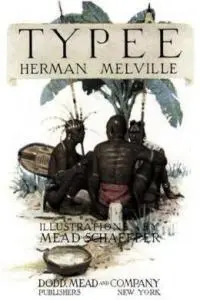
- Название:Typee
- Автор:
- Издательство:epubBooks Classics
- Жанр:
- Год:2014
- ISBN:нет данных
- Рейтинг книги:4 / 5. Голосов: 1
-
Избранное:Добавить в избранное
- Отзывы:
-
Ваша оценка:
Typee: краткое содержание, описание и аннотация
Предлагаем к чтению аннотацию, описание, краткое содержание или предисловие (зависит от того, что написал сам автор книги «Typee»). Если вы не нашли необходимую информацию о книге — напишите в комментариях, мы постараемся отыскать её.
Typee — читать онлайн бесплатно полную книгу (весь текст) целиком
Ниже представлен текст книги, разбитый по страницам. Система сохранения места последней прочитанной страницы, позволяет с удобством читать онлайн бесплатно книгу «Typee», без необходимости каждый раз заново искать на чём Вы остановились. Поставьте закладку, и сможете в любой момент перейти на страницу, на которой закончили чтение.
Интервал:
Закладка:
Pop, Pop, Pop, Pop! green guavas, seeds, and berries were flying about in every direction, and during this dangerous state of affairs, I was half afraid that, like the man and his brazen bull, I should fall a victim to my own ingenuity. Like everything else, however, the excitement gradually wore away, though ever after occasionally pop–guns might be heard at all hours of the day.
It was towards the close of the pop–gun war, that I was infinitely diverted with a strange freak of Marheyo’s.
I had worn, when I quitted the ship, a pair of thick pumps, which, from the rough usage they had received in scaling precipices and sliding down gorges, were so dilapidated as to be altogether unfit for use—so, at least, would have thought the generality of people, and so they most certainly were, when considered in the light of shoes. But things unserviceable in one way, may with advantage be applied in another—that is, if one has genius enough for the purpose. This genius Marheyo possessed in a superlative degree, as he abundantly evinced by the use to which he put these sorely bruised and battered old shoes.
Every article, however trivial, which belonged to me, the natives appeared to regard as sacred; and I observed that for several days after becoming an inmate of the house, my pumps were suffered to remain, untouched, where I had first happened to throw them. I remembered, however, that after awhile I had missed them from their accustomed place; but the matter gave me no concern, supposing that Tinor—like any other tidy housewife, having come across them in some of her domestic occupations—had pitched the useless things out of the house. But I was soon undeceived.
One day I observed old Marheyo bustling about me with unusual activity, and to such a degree as almost to supersede Kory–Kory in the functions of his office. One moment he volunteered to trot off with me on his back to the stream; and when I refused, noways daunted by the repulse, he continued to frisk about me like a superannuated house–dog. I could not for the life of me conjecture what possessed the old gentleman, until all at once, availing himself of the temporary absence of the household, he went through a variety of uncouth gestures, pointing eagerly down to my feet, and then up to a little bundle which swung from the ridge–pole overhead. At last I caught a faint idea of his meaning, and motioned him to lower the package. He executed the order in the twinkling of an eye, and unrolling a piece of tappa, displayed to my astonished gaze the identical pumps which I thought had been destroyed long before.
I immediately comprehended his desire, and very generously gave him the shoes, which had become quite mouldy, wondering for what earthly purpose he could want them.
The same afternoon I descried the venerable warrior approaching the house, with a slow, stately gait, earrings in ears, and spear in hand, with this highly ornamental pair of shoes suspended from his neck by a strip of bark, and swinging backwards and forwards on his capacious chest. In the gala costume of the tasteful Marheyo, these calf–skin pendants ever after formed the most striking feature.
But to turn to something a little more important. Although the whole existence of the inhabitants of the valley seemed to pass away exempt from toil, yet there were some light employments which, although amusing rather than labourious as occupations, contributed to their comfort and luxury. Among these, the most important was the manufacture of the native cloth—“tappa”—so well known, under various modifications, throughout the whole Polynesian Archipelago. As is generally understood, this useful and sometimes elegant article is fabricated from the bark of different trees. But, as I believe that no description of its manufacture has ever been given, I shall state what I know regarding it.
In the manufacture of the beautiful white tappa generally worn on the Marquesan Islands, the preliminary operation consists in gathering a certain quantity of the young branches of the cloth–tree. The exterior green bark being pulled off as worthless, there remains a slender fibrous substance, which is carefully stripped from the stick, to which it closely adheres. When a sufficient quantity of it has been collected, the various strips are enveloped in a covering of large leaves, which the natives use precisely as we do wrapping–paper, and which are secured by a few turns of a line passed round them. The package is then laid in the bed of some running stream, with a heavy stone placed over it, to prevent its being swept away. After it has remained for two or three days in this state, it is drawn out, and exposed for a short time to the action of the air, every distinct piece being attentively inspected, with a view of ascertaining whether it has yet been sufficiently affected by the operation. This is repeated again and again, until the desired result is obtained.
When the substance is in a proper state for the next process, it betrays evidences of incipient decomposition; the fibres are relaxed and softened, and rendered perfectly malleable. The different strips are now extended, one by one, in successive layers, upon some smooth surface—generally the prostrate trunk of a cocoa–nut tree—and the heap thus formed is subjected, at every new increase, to a moderate beating, with a sort of wooden mallet, leisurely applied. The mallet is made of a hard heavy wood resembling ebony, is about twelve inches in length, and perhaps two in breadth, with a rounded handle at one end, and in shape is the exact counterpart of one of our four–sided razor–strops. The flat surfaces of the implement are marked with shallow parallel indentations, varying in depth on the different sides, so as to be adapted to the several stages of the operation. These marks produce the corduroy sort of stripes descernible in the tappa in its finished state. After being beaten in the manner I have described, the material soon becomes blended in one mass, which, moistened occasionally with water, is at intervals hammered out, by a kind of gold–beating process, to any degree of thinness required. In this way the cloth is easily made to vary in strength and thickness, so as to suit the numerous purposes to which it is applied.
When the operation last described has been concluded, the new–made tappa is spread out on the grass to bleach and dry, and soon becomes of a dazzling whiteness. Sometimes, in the first stages of the manufacture, the substance is impregnated with a vegetable juice, which gives it a permanent colour. A rich brown and a bright yellow are occasionally seen, but the simple taste of the Typee people inclines them to prefer the natural tint.
The notable wife of Kammahammaha, the renowned conqueror and king of the Sandwich Islands, used to pride herself in the skill she displayed in dyeing her tappa with contrasting colours disposed in regular figures; and, in the midst of the innovations of the times, was regarded, towards the decline of her life, as a lady of the old school, clinging as she did to the national cloth, in preference to the frippery of the European calicoes. But the art of printing the tappa is unknown upon the Marquesan Islands.
In passing along the valley, I was often attracted by the noise of the mallet, which, when employed in the manufacture of the cloth, produces at every stroke of its hard, heavy wood, a clear, ringing, and musical sound, capable of being heard at a great distance. When several of these implements happen to be in operation at the same time, and near one another, the effect upon the ear of a person, at a little distance, is really charming.
Chapter XIX
History of a Day as Usually Spent in the Typee Valley—dances of the Marquesan Girls.
Nothing can be more uniform and undiversified than the life of the Typees; one tranquil day of ease and happiness follows another in quiet succession; and with these unsophisticated savages the history of a day is the history of a life. I will therefore, as briefly as I can, describe one of our days in the valley.
Читать дальшеИнтервал:
Закладка:
Похожие книги на «Typee»
Представляем Вашему вниманию похожие книги на «Typee» списком для выбора. Мы отобрали схожую по названию и смыслу литературу в надежде предоставить читателям больше вариантов отыскать новые, интересные, ещё непрочитанные произведения.



Обсуждение, отзывы о книге «Typee» и просто собственные мнения читателей. Оставьте ваши комментарии, напишите, что Вы думаете о произведении, его смысле или главных героях. Укажите что конкретно понравилось, а что нет, и почему Вы так считаете.