Arnold Bennett - The Old Wives' Tale
Здесь есть возможность читать онлайн «Arnold Bennett - The Old Wives' Tale» весь текст электронной книги совершенно бесплатно (целиком полную версию без сокращений). В некоторых случаях можно слушать аудио, скачать через торрент в формате fb2 и присутствует краткое содержание. Год выпуска: 2005, ISBN: 2005, Издательство: Kessinger Publishing, Жанр: Классическая проза, на английском языке. Описание произведения, (предисловие) а так же отзывы посетителей доступны на портале библиотеки ЛибКат.
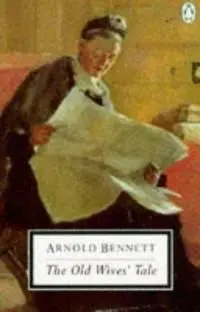
- Название:The Old Wives' Tale
- Автор:
- Издательство:Kessinger Publishing
- Жанр:
- Год:2005
- ISBN:9781417903672
- Рейтинг книги:5 / 5. Голосов: 1
-
Избранное:Добавить в избранное
- Отзывы:
-
Ваша оценка:
The Old Wives' Tale: краткое содержание, описание и аннотация
Предлагаем к чтению аннотацию, описание, краткое содержание или предисловие (зависит от того, что написал сам автор книги «The Old Wives' Tale»). Если вы не нашли необходимую информацию о книге — напишите в комментариях, мы постараемся отыскать её.
The Old Wives' Tale — читать онлайн бесплатно полную книгу (весь текст) целиком
Ниже представлен текст книги, разбитый по страницам. Система сохранения места последней прочитанной страницы, позволяет с удобством читать онлайн бесплатно книгу «The Old Wives' Tale», без необходимости каждый раз заново искать на чём Вы остановились. Поставьте закладку, и сможете в любой момент перейти на страницу, на которой закончили чтение.
Интервал:
Закладка:
"So this is the new railway!" said she.
"Yes," said he. "This is your new railway. You can see it better from the bridge."
"But it's very sludgy up there," she objected with a pout.
"Further on it's quite dry," he reassured her.
From the bridge they had a sudden view of a raw gash in the earth; and hundreds of men were crawling about in it, busy with minute operations, like flies in a great wound. There was a continuous rattle of picks, resembling a muffled shower of hail, and in the distance a tiny locomotive was leading a procession of tiny waggons.
"And those are the navvies!" she murmured.
The unspeakable doings of the navvies in the Five Towns had reached even her: how they drank and swore all day on Sundays, how their huts and houses were dens of the most appalling infamy, how they were the curse of a God-fearing and respectable district! She and Gerald Scales glanced down at these dangerous beasts of prey in their yellow corduroys and their open shirts revealing hairy chests. No doubt they both thought how inconvenient it was that railways could not be brought into existence without the aid of such revolting and swinish animals. They glanced down from the height of their nice decorum and felt the powerful attraction of similar superior manners. The manners of the navvies were such that Sophia could not even regard them, nor Gerald Scales permit her to regard them, without blushing.
In a united blush they turned away, up the gradual slope. Sophia knew no longer what she was doing. For some minutes she was as helpless as though she had been in a balloon with him.
"I got my work done early," he said; and added complacently, "As a matter of fact I've had a pretty good day."
She was reassured to learn that he was not neglecting his duties. To be philandering with a commercial traveller who has finished a good day's work seemed less shocking than dalliance with a neglecter of business; it seemed indeed, by comparison, respectable.
"It must be very interesting," she said primly.
"What, my trade?"
"Yes. Always seeing new places and so on."
"In a way it is," he admitted judicially. "But I can tell you it was much more agreeable being in Paris."
"Oh! Have you been to Paris?"
"Lived there for nearly two years," he said carelessly. Then, looking at her, "Didn't you notice I never came for a long time?"
"I didn't know you were in Paris," she evaded him.
"I went to start a sort of agency for Birkinshaws," he said.
"I suppose you talk French like anything."
"Of course one has to talk French," said he. "I learnt French when I was a child from a governess--my uncle made me--but I forgot most of it at school, and at the Varsity you never learn anything --precious little, anyhow! Certainly not French!"
She was deeply impressed. He was a much greater personage than she had guessed. It had never occurred to her that commercial travellers had to go to a university to finish their complex education. And then, Paris! Paris meant absolutely nothing to her but pure, impossible, unattainable romance. And he had been there! The clouds of glory were around him. He was a hero, dazzling. He had come to her out of another world. He was her miracle. He was almost too miraculous to be true.
She, living her humdrum life at the shop! And he, elegant, brilliant, coming from far cities! They together, side by side, strolling up the road towards the Moorthorne ridge! There was nothing quite like this in the stories of Miss Sewell.
"Your uncle ...?" she questioned vaguely.
"Yes, Mr. Boldero. He's a partner in Birkinshaws."
"Oh!"
"You've heard of him? He's a great Wesleyan."
"Oh yes," she said. "When we had the Wesleyan Conference here, he--"
"He's always very great at Conferences," said Gerald Scales.
"I didn't know he had anything to do with Birkinshaws."
"He isn't a working partner of course," Mr. Scales explained. "But he means me to be one. I have to learn the business from the bottom. So now you understand why I'm a traveller."
"I see," she said, still more deeply impressed.
"I'm an orphan," said Gerald. "And Uncle Boldero took me in hand when I was three."
"I SEE!" she repeated.
It seemed strange to her that Mr. Scales should be a Wesleyan-- just like herself. She would have been sure that he was 'Church.' Her notions of Wesleyanism, with her notions of various other things, were sharply modified.
"Now tell me about you," Mr. Scales suggested.
"Oh! I'm nothing!" she burst out.
The exclamation was perfectly sincere. Mr. Scales's disclosures concerning himself, while they excited her, discouraged her.
"You're the finest girl I've ever met, anyhow," said Mr. Scales with gallant emphasis, and he dug his stick into the soft ground.
She blushed and made no answer.
They walked on in silence, each wondering apprehensively what might happen next.
Suddenly Mr. Scales stopped at a dilapidated low brick wall, built in a circle, close to the side of the road.
"I expect that's an old pit-shaft," said he.
"Yes, I expect it is."
He picked up a rather large stone and approached the wall.
"Be careful!" she enjoined him.
"Oh! It's all right," he said lightly. "Let's listen. Come near and listen."
She reluctantly obeyed, and he threw the stone over the dirty ruined wall, the top of which was about level with his hat. For two or three seconds there was no sound. Then a faint reverberation echoed from the depths of the shaft. And on Sophia's brain arose dreadful images of the ghosts of miners wandering for ever in subterranean passages, far, far beneath. The noise of the falling stone had awakened for her the secret terrors of the earth. She could scarcely even look at the wall without a spasm of fear.
"How strange," said Mr. Scales, a little awe in his voice, too, "that that should be left there like that! I suppose it's very deep."
"Some of them are," she trembled.
"I must just have a look," he said, and put his hands on the top of the wall.
"Come away!" she cried.
"Oh! It's all right!" he said again, soothingly. "The wall's as firm as a rock." And he took a slight spring and looked over.
She shrieked loudly. She saw him at the distant bottom of the shaft, mangled, drowning. The ground seemed to quake under her feet. A horrible sickness seized her. And she shrieked again. Never had she guessed that existence could be such pain.
He slid down from the wall, and turned to her. "No bottom to be seen!" he said. Then, observing her transformed face, he came close to her, with a superior masculine smile. "Silly little thing!" he said coaxingly, endearingly, putting forth all his power to charm.
He perceived at once that he had miscalculated the effects of his action. Her alarm changed swiftly to angry offence. She drew back with a haughty gesture, as if he had intended actually to touch her. Did he suppose, because she chanced to be walking with him, that he had the right to address her familiarly, to tease her, to call her 'silly little thing' and to put his face against hers? She resented his freedom with quick and passionate indignation.
She showed him her proud back and nodding head and wrathful skirts; and hurried off without a word, almost running. As for him, he was so startled by unexpected phenomena that he did nothing for a moment--merely stood looking and feeling foolish.
Then she heard him in pursuit. She was too proud to stop or even to reduce her speed.
"I didn't mean to--" he muttered behind her.
No recognition from her.
"I suppose I ought to apologize," he said.
"I should just think you ought," she answered, furious.
"Well, I do!" said he. "Do stop a minute."
"I'll thank you not to follow me, Mr. Scales." She paused, and scorched him with her displeasure. Then she went forward. And her heart was in torture because it could not persuade her to remain with him, and smile and forgive, and win his smile.
Читать дальшеИнтервал:
Закладка:
Похожие книги на «The Old Wives' Tale»
Представляем Вашему вниманию похожие книги на «The Old Wives' Tale» списком для выбора. Мы отобрали схожую по названию и смыслу литературу в надежде предоставить читателям больше вариантов отыскать новые, интересные, ещё непрочитанные произведения.










Обсуждение, отзывы о книге «The Old Wives' Tale» и просто собственные мнения читателей. Оставьте ваши комментарии, напишите, что Вы думаете о произведении, его смысле или главных героях. Укажите что конкретно понравилось, а что нет, и почему Вы так считаете.