Arnold Bennett - The Old Wives' Tale
Здесь есть возможность читать онлайн «Arnold Bennett - The Old Wives' Tale» весь текст электронной книги совершенно бесплатно (целиком полную версию без сокращений). В некоторых случаях можно слушать аудио, скачать через торрент в формате fb2 и присутствует краткое содержание. Год выпуска: 2005, ISBN: 2005, Издательство: Kessinger Publishing, Жанр: Классическая проза, на английском языке. Описание произведения, (предисловие) а так же отзывы посетителей доступны на портале библиотеки ЛибКат.
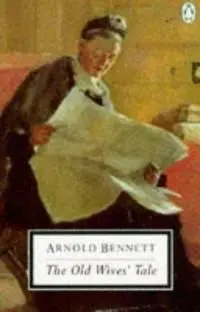
- Название:The Old Wives' Tale
- Автор:
- Издательство:Kessinger Publishing
- Жанр:
- Год:2005
- ISBN:9781417903672
- Рейтинг книги:5 / 5. Голосов: 1
-
Избранное:Добавить в избранное
- Отзывы:
-
Ваша оценка:
The Old Wives' Tale: краткое содержание, описание и аннотация
Предлагаем к чтению аннотацию, описание, краткое содержание или предисловие (зависит от того, что написал сам автор книги «The Old Wives' Tale»). Если вы не нашли необходимую информацию о книге — напишите в комментариях, мы постараемся отыскать её.
The Old Wives' Tale — читать онлайн бесплатно полную книгу (весь текст) целиком
Ниже представлен текст книги, разбитый по страницам. Система сохранения места последней прочитанной страницы, позволяет с удобством читать онлайн бесплатно книгу «The Old Wives' Tale», без необходимости каждый раз заново искать на чём Вы остановились. Поставьте закладку, и сможете в любой момент перейти на страницу, на которой закончили чтение.
Интервал:
Закладка:
The immediate effect of his arrival on Constance was miraculous. His presence almost cured her for a moment, just as though her malady had been toothache and he a dentist. Then, when he had finished his examination, the pain resumed its sway over her.
In talking to her and to Sophia, he listened very seriously to all that they said; he seemed to regard the case as the one case that had ever aroused his genuine professional interest; but as it unfolded itself, in all its difficulty and urgency, so he seemed, in his mind, to be discovering wondrous ways of dealing with it; these mysterious discoveries seemed to give him confidence, and his confidence was communicated to the patient by means of faint sallies of humour. He was a highly skilled doctor. This fact, however, had no share in his popularity; which was due solely to his rare gift of taking a case very seriously while remaining cheerful.
He said he would return in a quarter of an hour, and he returned in thirteen minutes with a hypodermic syringe, with which he attacked the pain in its central strongholds.
"What is it?" asked Constance, breathing gratitude for the relief.
He paused, looking at her roguishly from under lowered eyelids.
"I'd better not tell ye," he said. "It might lead ye into mischief."
"Oh, but you must tell me, doctor," Constance insisted, anxious that he should live up to his reputation for Sophia's benefit.
"It's hydrochloride of cocaine," he said, and lifted a finger. "Beware of the cocaine habit. It's ruined many a respectable family. But if I hadn't had a certain amount of confidence in yer strength of character, Mrs. Povey, I wouldn't have risked it."
"He will have his joke, will the doctor!" Constance smiled, in a brighter world.
He said he should come again about half-past five, and he arrived about half-past six, and injected more cocaine. The special importance of the case was thereby established. On this second visit, he and Sophia soon grew rather friendly. When she conducted him downstairs again he stopped chatting with her in the parlour for a long time, as though he had nothing else on earth to do, while his coachman walked the horse to and fro in front of the door.
His attitude to her flattered Sophia, for it showed that he took her for no ordinary woman. It implied a continual assumption that she must be a mine of interest for any one who was privileged to delve into her memory. So far, among Constance's acquaintance, Sophia had met no one who showed more than a perfunctory curiosity as to her life. Her return was accepted with indifference. Her escapade of thirty years ago had entirely lost its dramatic quality. Many people indeed had never heard that she had run away from home to marry a commercial traveller; and to those who remembered, or had been told, it seemed a sufficiently banal exploit--after thirty years! Her fear, and Constance's, that the town would be murmurous with gossip was ludicrously unfounded. The effect of time was such that even Mr. Critchlow appeared to have forgotten even that she had been indirectly responsible for her father's death. She had nearly forgotten it herself; when she happened to think of it she felt no shame, no remorse, seeing the death as purely accidental, and not altogether unfortunate. On two points only was the town inquisitive: as to her husband, and as to the precise figure at which she had sold the pension. The town knew that she was probably not a widow, for she had been obliged to tell Mr. Critchlow, and Mr. Critchlow in some hour of tenderness had told Maria. But nobody had dared to mention the name of Gerald Scales to her. With her fashionable clothes, her striking mien of command, and the legend of her wealth, she inspired respect, if not awe, in the townsfolk. In the doctor's attitude there was something of amaze; she felt it. Though the dull apathy of the people she had hitherto met was assuredly not without its advantageous side for her tranquillity of mind, it had touched her vanity, and the gaze of the doctor soothed the smart. He had so obviously divined her interestingness; he so obviously wanted to enjoy it.
"I've just been reading Zola's 'Downfall,'" he said.
Her mind searched backwards, and recalled a poster.
"Oh!" she replied. "'La Debacle'?"
"Yes. What do ye think of it?" His eyes lighted at the prospect of a talk. He was even pleased to hear her give him the title in French.
"I haven't read it," she said, and she was momentarily sorry that she had not read it, for she could see that he was dashed. The doctor had supposed that residence in a foreign country involved a knowledge of the literature of that country. Yet he had never supposed that residence in England involved a knowledge of English literature. Sophia had read practically nothing since 1870; for her the latest author was Cherbuliez. Moreover, her impression of Zola was that he was not at all nice, and that he was the enemy of his race, though at that date the world had scarcely heard of Dreyfus. Dr. Stirling had too hastily assumed that the opinions of the bourgeois upon art differ in different countries.
"And ye actually were in the siege of Paris?" he questioned, trying again.
"Yes."
"AND the commune?"
"Yes, the commune too."
"Well!" he exclaimed. "It's incredible! When I was reading the 'Downfall' the night before last, I said to myself that you must have been through a lot of all that. I didn't know I was going to have the pleasure of a chat with ye so soon."
She smiled. "But how did you know I was in the siege of Paris?" she asked, curious.
"How do I know? I know because I've seen that birthday card ye sent to Mrs. Povey in 1871, after it was over. It's one of her possessions, that card is. She showed it me one day when she told me ye were coming."
Sophia started. She had quite forgotten that card. It had not occurred to her that Constance would have treasured all those cards that she had despatched during the early years of her exile. She responded as well as she could to his eagerness for personal details concerning the siege and the commune. He might have been disappointed at the prose of her answers, had he not been determined not to be disappointed.
"Ye seem to have taken it all very quietly," he observed.
"Eh yes!" she agreed, not without pride. "But it's a long time since."
Those events, as they existed in her memory, scarcely warranted the tremendous fuss subsequently made about them. What were they, after all? Such was her secret thought. Chirac himself was now nothing but a faint shadow. Still, were the estimate of those events true or false, she was a woman who had been through them, and Dr. Stirling's high appreciation of that fact was very pleasant to her. Their friendliness approached intimacy. Night had fallen. Outside could be heard the champing of a bit.
"I must be getting on," he said at last; but he did not move.
"Then there is nothing else I am to do for my sister?" Sophia inquired.
"I don't think so," said he. "It isn't a question of medicine."
"Then what is it a question of?" Sophia demanded bluntly.
"Nerves," he said. "It's nearly all nerves. I know something about Mrs. Povey's constitution now, and I was hoping that your visit would do her good."
"She's been quite well--I mean what you may call quite well--until the day before yesterday, when she sat in that draught. She was better last night, and then this morning I find her ever so much worse."
"No worries?" The doctor looked at her confidentially.
"What CAN she have in the way of worries?" exclaimed Sophia. "That's to say--real worries."
"Exactly!" the doctor agreed.
"I tell her she doesn't know what worry is," said Sophia.
"So do I!" said the doctor, his eyes twinkling.
"She was a little upset because she didn't receive her usual Sunday letter from Cyril yesterday. But then she was weak and low."
Читать дальшеИнтервал:
Закладка:
Похожие книги на «The Old Wives' Tale»
Представляем Вашему вниманию похожие книги на «The Old Wives' Tale» списком для выбора. Мы отобрали схожую по названию и смыслу литературу в надежде предоставить читателям больше вариантов отыскать новые, интересные, ещё непрочитанные произведения.







Обсуждение, отзывы о книге «The Old Wives' Tale» и просто собственные мнения читателей. Оставьте ваши комментарии, напишите, что Вы думаете о произведении, его смысле или главных героях. Укажите что конкретно понравилось, а что нет, и почему Вы так считаете.