Arnold Bennett - The Old Wives' Tale
Здесь есть возможность читать онлайн «Arnold Bennett - The Old Wives' Tale» весь текст электронной книги совершенно бесплатно (целиком полную версию без сокращений). В некоторых случаях можно слушать аудио, скачать через торрент в формате fb2 и присутствует краткое содержание. Год выпуска: 2005, ISBN: 2005, Издательство: Kessinger Publishing, Жанр: Классическая проза, на английском языке. Описание произведения, (предисловие) а так же отзывы посетителей доступны на портале библиотеки ЛибКат.
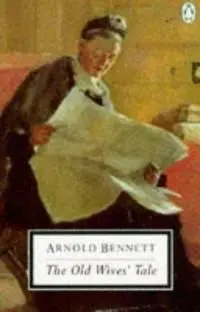
- Название:The Old Wives' Tale
- Автор:
- Издательство:Kessinger Publishing
- Жанр:
- Год:2005
- ISBN:9781417903672
- Рейтинг книги:5 / 5. Голосов: 1
-
Избранное:Добавить в избранное
- Отзывы:
-
Ваша оценка:
The Old Wives' Tale: краткое содержание, описание и аннотация
Предлагаем к чтению аннотацию, описание, краткое содержание или предисловие (зависит от того, что написал сам автор книги «The Old Wives' Tale»). Если вы не нашли необходимую информацию о книге — напишите в комментариях, мы постараемся отыскать её.
The Old Wives' Tale — читать онлайн бесплатно полную книгу (весь текст) целиком
Ниже представлен текст книги, разбитый по страницам. Система сохранения места последней прочитанной страницы, позволяет с удобством читать онлайн бесплатно книгу «The Old Wives' Tale», без необходимости каждый раз заново искать на чём Вы остановились. Поставьте закладку, и сможете в любой момент перейти на страницу, на которой закончили чтение.
Интервал:
Закладка:
Sophia was downstairs first, and Constance found her looking at the blank wall beyond the door leading to the kitchen steps.
"So this is where you had it bricked up?" said Sophia.
"Yes," said Constance. "That's the place."
"It makes me feel like people feel when they have tickling in a limb that's been cut off!" said Sophia.
"Oh, Sophia!"
The tea received a great deal of praise from Sophia, but neither of them ate much. Constance found that Sophia was like herself: she had to be particular about her food. She tasted dainties for the sake of tasting, but it was a bird's pecking. Not the twelfth part of the tea was consumed. They dared not indulge caprices. Only their eyes could feed.
After tea they went up to the drawing-room, and in the corridor had the startling pleasure of seeing two dogs who scurried about after each other in amity. Spot had found Fossette, with the aid of Amy's incurable carelessness, and had at once examined her with great particularity. She seemed to be of an amiable disposition, and not averse from the lighter distractions. For a long time the sisters sat chatting together in the lit drawing-room to the agreeable sound of happy dogs playing in the dark corridor. Those dogs saved the situation, because they needed constant attention. When the dogs dozed, the sisters began to look through photograph albums, of which Constance had several, bound in plush or morocco. Nothing will sharpen the memory, evoke the past, raise the dead, rejuvenate the ageing, and cause both sighs and smiles, like a collection of photographs gathered together during long years of life. Constance had an astonishing menagerie of unknown cousins and their connections, and of townspeople; she had Cyril at all ages; she had weird daguerreotypes of her parents and their parents. The strangest of all was a portrait of Samuel Povey as an infant in arms. Sophia checked an impulse to laugh at it. But when Constance said: "Isn't it funny?" she did allow herself to laugh. A photograph of Samuel in the year before his death was really imposing. Sophia stared at it, impressed. It was the portrait of an honest man.
"How long have you been a widow?" Constance asked in a low voice, glancing at upright Sophia over her spectacles, a leaf of the album raised against her finger.
Sophia unmistakably flushed. "I don't know that I am a widow," said she, with an air. "My husband left me in 1870, and I've never seen nor heard of him since."
"Oh, my dear!" cried Constance, alarmed and deafened as by a clap of awful thunder. "I thought ye were a widow. Mr. Peel-Swynnerton said he was told positively ye were a widow. That's why I never. ..." She stopped. Her face was troubled.
"Of course I always passed for a widow, over there," said Sophia.
"Of course," said Constance quickly. "I see. ..."
"And I may be a widow," said Sophia.
Constance made no remark. This was a blow. Bursley was such a particular place. Doubtless, Gerald Scales had behaved like a scoundrel. That was sure!
When, immediately afterwards, Amy opened the drawing-room door (having first knocked--the practice of encouraging a servant to plunge without warning of any kind into a drawing-room had never been favoured in that house) she saw the sisters sitting rather near to each other at the walnut oval table, Mrs. Scales very upright, and staring into the fire, and Mrs. Povey 'bunched up' and staring at the photograph album; both seeming to Amy aged and apprehensive; Mrs. Povey's hair was quite grey, though Mrs. Scales' hair was nearly as black as Amy's own. Mrs. Scales started at the sound of the knock, and turned her head.
"Here's Mr. and Mrs. Critchlow, m'm," announced Amy.
The sisters glanced at one another, with lifted foreheads. Then Mrs. Povey spoke to Amy as though visits at half-past eight at night were a customary phenomenon of the household. Nevertheless, she trembled to think what outrageous thing Mr. Critchlow might say to Sophia after thirty years' absence. The occasion was great, and it might also be terrible.
"Ask them to come up," she said calmly.
But Amy had the best of that encounter. "I have done," she replied, and instantly produced them out of the darkness of the corridor. It was providential: the sisters had made no remark that the Critchlows might not hear.
Then Maria Critchlow, simpering, had to greet Sophia. Mrs. Critchlow was very agitated, from sheer nervousness. She curvetted; she almost pranced; and she made noises with her mouth as though she saw some one eating a sour apple. She wanted to show Sophia how greatly she had changed from the young, timid apprentice. Certainly since her marriage she had changed. As manager of other people's business she had not felt the necessity of being effusive to customers, but as proprietress, anxiety to succeed had dragged her out of her capable and mechanical indifference. It was a pity. Her consistent dullness had had a sort of dignity; but genial, she was merely ridiculous. Animation cruelly displayed her appalling commonness and physical shabbiness. Sophia's demeanour was not chilly; but it indicated that Sophia had no wish to be eyed over as a freak of nature.
Mr. Critchlow advanced very slowly into the room. "Ye still carry your head on a stiff neck," said he, deliberately examining Sophia. Then with great care he put out his long thin arm and took her hand. "Well, I'm rare and glad to see ye!"
Every one was thunderstruck at this expression of joy. Mr. Critchlow had never been known to be glad to see anybody.
"Yes," twittered Maria, "Mr. Critchlow would come in to-night. Nothing would do but he must come in to-night."
"You didn't tell me this afternoon," said Constance, "that you were going to give us the pleasure of your company like this."
He looked momentarily at Constance. "No," he grated, "I don't know as I did."
His gaze flattered Sophia. Evidently he treated this experienced and sad woman of fifty as a young girl. And in presence of his extreme age she felt like a young girl, remembering the while how as a young girl she had hated him. Repulsing the assistance of his wife, he arranged an armchair in front of the fire and meticulously put himself into it. Assuredly he was much older in a drawing-room than behind the counter of his shop. Constance had noticed that in the afternoon. A live coal fell out of the fire. He bent forward, wet his fingers, picked up the coal and threw it back into the fire.
"Well," said Sophia. "I wouldn't have done that."
"I never saw Mr. Critchlow's equal for picking up hot cinders," Maria giggled.
Mr. Critchlow deigned no remark. "When did ye leave this Paris?" he demanded of Sophia, leaning back, and putting his hands on the arms of the chair.
"Yesterday morning," said Sophia,
"And what'n ye been doing with yeself since yesterday morning?"
"I spent last night in London," Sophia replied.
"Oh, in London, did ye?"
"Yes. Cyril and I had an evening together."
"Eh? Cyril! What's yer opinion o' Cyril, Sophia?"
"I'm very proud to have Cyril for a nephew," said Sophia.
"Oh! Are ye?" The old man was obviously ironic.
"Yes I am," Sophia insisted sharply. "I'm not going to hear a word said against Cyril."
She proceeded to an enthusiastic laudation of Cyril which rather overwhelmed his mother. Constance was pleased; she was delighted. And yet somewhere in her mind was an uncomfortable feeling that Cyril, having taken a fancy to his brilliant aunt, had tried to charm her as he seldom or never tried to charm his mother. Cyril and Sophia had dazzled and conquered each other; they were of the same type; whereas she, Constance, being but a plain person, could not glitter.
She rang the bell and gave instructions to Amy about food--fruit cakes, coffee and hot milk, on a tray; and Sophia also spoke to Amy murmuring a request as to Fossette.
Читать дальшеИнтервал:
Закладка:
Похожие книги на «The Old Wives' Tale»
Представляем Вашему вниманию похожие книги на «The Old Wives' Tale» списком для выбора. Мы отобрали схожую по названию и смыслу литературу в надежде предоставить читателям больше вариантов отыскать новые, интересные, ещё непрочитанные произведения.







Обсуждение, отзывы о книге «The Old Wives' Tale» и просто собственные мнения читателей. Оставьте ваши комментарии, напишите, что Вы думаете о произведении, его смысле или главных героях. Укажите что конкретно понравилось, а что нет, и почему Вы так считаете.