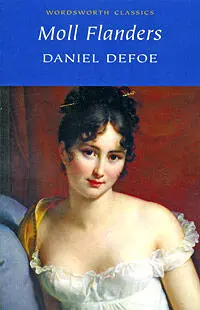
Daniel Defoe - Moll Flanders
Здесь есть возможность читать онлайн «Daniel Defoe - Moll Flanders» — ознакомительный отрывок электронной книги совершенно бесплатно, а после прочтения отрывка купить полную версию. В некоторых случаях можно слушать аудио, скачать через торрент в формате fb2 и присутствует краткое содержание. Год выпуска: 1722, Жанр: Классическая проза, на английском языке. Описание произведения, (предисловие) а так же отзывы посетителей доступны на портале библиотеки ЛибКат.
- Название:Moll Flanders
- Автор:
- Жанр:
- Год:1722
- ISBN:нет данных
- Рейтинг книги:5 / 5. Голосов: 1
-
Избранное:Добавить в избранное
- Отзывы:
-
Ваша оценка:
Moll Flanders: краткое содержание, описание и аннотация
Предлагаем к чтению аннотацию, описание, краткое содержание или предисловие (зависит от того, что написал сам автор книги «Moll Flanders»). Если вы не нашли необходимую информацию о книге — напишите в комментариях, мы постараемся отыскать её.
Defoe wrote this after his work as a journalist and pamphleteer. By 1722, Defoe had become recognized as a novelist, with the success of Robinson Crusoe in 1719. His political work was tapering off at this point, due to the fall of both Whig and Tory party leaders with whom he had been associated; Robert Walpole was beginning his rise, and Defoe was never fully at home with the Walpole group. Defoe's Whig views are nevertheless evident in the story of Moll, and the novel's full title gives some insight into this and the outline of the plot:
"The Fortunes and Misfortunes of the Famous Moll Flanders, Etc. Who Was Born In Newgate, and During a Life of Continu'd Variety For Threescore Years, Besides Her Childhood, Was Twelve Year a Whore, Five Times a Wife [Whereof Once To Her Own Brother], Twelve Year a Thief, Eight Year a Transported Felon In Virginia, At Last Grew Rich, Liv'd Honest, and Died a Penitent. Written from her own Memorandums."
Moll Flanders — читать онлайн ознакомительный отрывок
Ниже представлен текст книги, разбитый по страницам. Система сохранения места последней прочитанной страницы, позволяет с удобством читать онлайн бесплатно книгу «Moll Flanders», без необходимости каждый раз заново искать на чём Вы остановились. Поставьте закладку, и сможете в любой момент перейти на страницу, на которой закончили чтение.
Интервал:
Закладка:
Not a man was ever seen to come upstairs, except to visit the lying–in ladies within their month, nor then without the old lady with them, who made it a piece of honour of her management that no man should touch a woman, no, not his own wife, within the month; nor would she permit any man to lie in the house upon any pretence whatever, no, not though she was sure it was with his own wife; and her general saying for it was, that she cared not how many children were born in her house, but she would have none got there if she could help it.
It might perhaps be carried further than was needful, but it was an error of the right hand if it was an error, for by this she kept up the reputation, such as it was, of her business, and obtained this character, that though she did take care of the women when they were debauched, yet she was not instrumental to their being debauched at all; and yet it was a wicked trade she drove too.
While I was there, and before I was brought to bed, I received a letter from my trustee at the bank, full of kind, obliging things, and earnestly pressing me to return to London. It was near a fortnight old when it came to me, because it had been first sent into Lancashire, and then returned to me. He concludes with telling me that he had obtained a decree, I think he called it, against his wife, and that he would be ready to make good his engagement to me, if I would accept of him, adding a great many protestations of kindness and affection, such as he would have been far from offering if he had known the circumstances I had been in, and which as it was I had been very far from deserving.
I returned an answer to his letter, and dated it at Liverpool, but sent it by messenger, alleging that it came in cover to a friend in town. I gave him joy of his deliverance, but raised some scruples at the lawfulness of his marrying again, and told him I supposed he would consider very seriously upon that point before he resolved on it, the consequence being too great for a man of his judgment to venture rashly upon a thing of that nature; so concluded, wishing him very well in whatever he resolved, without letting him into anything of my own mind, or giving any answer to his proposal of my coming to London to him, but mentioned at a distance my intention to return the latter end of the year, this being dated in April.
I was brought to bed about the middle of May and had another brave boy, and myself in as good condition as usual on such occasions. My governess did her part as a midwife with the greatest art and dexterity imaginable, and far beyond all that ever I had had any experience of before.
Her care of me in my travail, and after in my lying in, was such, that if she had been my own mother it could not have been better. Let none be encouraged in their loose practices from this dexterous lady's management, for she is gone to her place, and I dare say has left nothing behind her that can or will come up on it.
I think I had been brought to bed about twenty–two days when I received another letter from my friend at the bank, with the surprising news that he had obtained a final sentence of divorce against his wife, and had served her with it on such a day, and that he had such an answer to give to all my scruples about his marrying again, as I could not expect, and as he had no desire of; for that his wife, who had been under some remorse before for her usage of him, as soon as she had the account that he had gained his point, had very unhappily destroyed herself that same evening.
He expressed himself very handsomely as to his being concerned at her disaster, but cleared himself of having any hand in it, and that he had only done himself justice in a case in which he was notoriously injured and abused. However, he said that he was extremely afflicted at it, and had no view of any satisfaction left in his world, but only in the hope that I would come and relieve him by my company; and then he pressed me violently indeed to give him some hopes that I would at least come up to town and let him see me, when he would further enter into discourse about it.
I was exceedingly surprised at the news, and began now seriously to reflect on my present circumstances, and the inexpressible misfortune it was to me to have a child upon my hands, and what to do in it I knew not. At last I opened my case at a distance to my governess. I appeared melancholy and uneasy for several days, and she lay at me continually to know what trouble me. I could not for my life tell her that I had an offer of marriage, after I had so often told her that I had a husband, so that I really knew not what to say to her. I owned I had something which very much troubled me, but at the same time told her I could not speak of it to any one alive.
She continued importuning me several days, but it was impossible, I told her, for me to commit the secret to anybody. This, instead of being an answer to her, increased her importunities; she urged her having been trusted with the greatest secrets of this nature, that it was her business to conceal everything, and that to discover things of that nature would be her ruin. She asked me if ever I had found her tattling to me of other people's affairs, and how could I suspect her? She told me, to unfold myself to her was telling it to nobody; that she was silent as death; that it must be a very strange case indeed that she could not help me out of; but to conceal it was to deprive myself of all possible help, or means of help, and to deprive her of the opportunity of serving me. In short, she had such a bewitching eloquence, and so great a power of persuasion that there was no concealing anything from her.
So I resolved to unbosom myself to her. I told her the history of my Lancashire marriage, and how both of us had been disappointed; how we came together, and how we parted; how he absolutely discharged me, as far as lay in him, free liberty to marry again, protesting that if he knew it he would never claim me, or disturb or expose me; that I thought I was free, but was dreadfully afraid to venture, for fear of the consequences that might follow in case of a discovery.
Then I told her what a good offer I had; showed her my friend's two last letters, inviting me to come to London, and let her see with what affection and earnestness they were written, but blotted out the name, and also the story about the disaster of his wife, only that she was dead.
She fell a–laughing at my scruples about marrying, and told me the other was no marriage, but a cheat on both sides; and that, as we were parted by mutual consent, the nature of the contract was destroyed, and the obligation was mutually discharged. She had arguments for this at the tip of her tongue; and, in short, reasoned me out of my reason; not but that it was too by the help of my own inclination.
But then came the great and main difficulty, and that was the child; this, she told me in so many words, must be removed, and that so as that it should never be possible for any one to discover it. I knew there was no marrying without entirely concealing that I had had a child, for he would soon have discovered by the age of it that it was born, nay, and gotten too, since my parley with him, and that would have destroyed all the affair.
But it touched my heart so forcibly to think of parting entirely with the child, and, for aught I knew, of having it murdered, or starved by neglect and ill–usage (which was much the same), that I could not think of it without horror. I wish all those women who consent to the disposing their children out of the way, as it is called, for decency sake, would consider that 'tis only a contrived method for murder; that is to say, a–killing their children with safety.
It is manifest to all that understand anything of children, that we are born into the world helpless, and incapable either to supply our own wants or so much as make them known; and that without help we must perish; and this help requires not only an assisting hand, whether of the mother or somebody else, but there are two things necessary in that assisting hand, that is, care and skill; without both which, half the children that are born would die, nay, though they were not to be denied food; and one half more of those that remained would be cripples or fools, lose their limbs, and perhaps their sense. I question not but that these are partly the reasons why affection was placed by nature in the hearts of mothers to their children; without which they would never be able to give themselves up, as 'tis necessary they should, to the care and waking pains needful to the support of their children.
Читать дальшеИнтервал:
Закладка:
Похожие книги на «Moll Flanders»
Представляем Вашему вниманию похожие книги на «Moll Flanders» списком для выбора. Мы отобрали схожую по названию и смыслу литературу в надежде предоставить читателям больше вариантов отыскать новые, интересные, ещё непрочитанные произведения.












Обсуждение, отзывы о книге «Moll Flanders» и просто собственные мнения читателей. Оставьте ваши комментарии, напишите, что Вы думаете о произведении, его смысле или главных героях. Укажите что конкретно понравилось, а что нет, и почему Вы так считаете.