Daniel Defoe - Moll Flanders
Здесь есть возможность читать онлайн «Daniel Defoe - Moll Flanders» — ознакомительный отрывок электронной книги совершенно бесплатно, а после прочтения отрывка купить полную версию. В некоторых случаях можно слушать аудио, скачать через торрент в формате fb2 и присутствует краткое содержание. Год выпуска: 1722, Жанр: Классическая проза, на английском языке. Описание произведения, (предисловие) а так же отзывы посетителей доступны на портале библиотеки ЛибКат.
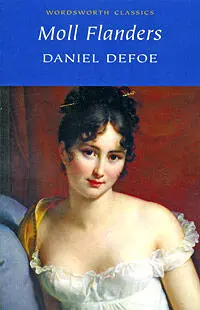
- Название:Moll Flanders
- Автор:
- Жанр:
- Год:1722
- ISBN:нет данных
- Рейтинг книги:5 / 5. Голосов: 1
-
Избранное:Добавить в избранное
- Отзывы:
-
Ваша оценка:
Moll Flanders: краткое содержание, описание и аннотация
Предлагаем к чтению аннотацию, описание, краткое содержание или предисловие (зависит от того, что написал сам автор книги «Moll Flanders»). Если вы не нашли необходимую информацию о книге — напишите в комментариях, мы постараемся отыскать её.
Defoe wrote this after his work as a journalist and pamphleteer. By 1722, Defoe had become recognized as a novelist, with the success of Robinson Crusoe in 1719. His political work was tapering off at this point, due to the fall of both Whig and Tory party leaders with whom he had been associated; Robert Walpole was beginning his rise, and Defoe was never fully at home with the Walpole group. Defoe's Whig views are nevertheless evident in the story of Moll, and the novel's full title gives some insight into this and the outline of the plot:
"The Fortunes and Misfortunes of the Famous Moll Flanders, Etc. Who Was Born In Newgate, and During a Life of Continu'd Variety For Threescore Years, Besides Her Childhood, Was Twelve Year a Whore, Five Times a Wife [Whereof Once To Her Own Brother], Twelve Year a Thief, Eight Year a Transported Felon In Virginia, At Last Grew Rich, Liv'd Honest, and Died a Penitent. Written from her own Memorandums."
Moll Flanders — читать онлайн ознакомительный отрывок
Ниже представлен текст книги, разбитый по страницам. Система сохранения места последней прочитанной страницы, позволяет с удобством читать онлайн бесплатно книгу «Moll Flanders», без необходимости каждый раз заново искать на чём Вы остановились. Поставьте закладку, и сможете в любой момент перейти на страницу, на которой закончили чтение.
Интервал:
Закладка:
He was surprised at my discourse; for we made it the whole subject of our conversation for near a week together, in which time I laid it down in black and white, as we say, that it was morally impossible, with a supposition of any reasonable good conduct, but that we must thrive there and do very well.
Then I told him what measures I would take to raise such a sum of #300 or thereabouts; and I argued with him how good a method it would be to put an end to our misfortunes and restore our circumstances in the world, to what we had both expected; and I added, that after seven years, if we lived, we might be in a posture to leave our plantations in good hands, and come over again and receive the income of it, and live here and enjoy it; and I gave him examples of some that had done so, and lived now in very good circumstances in London.
In short, I pressed him so to it, that he almost agreed to it, but still something or other broke it off again; till at last he turned the tables, and he began to talk almost to the same purpose of Ireland.
He told me that a man that could confine himself to country life, and that could find but stock to enter upon any land, should have farms there for #50 a year, as good as were here let for #200 a year; that the produce was such, and so rich the land, that if much was not laid up, we were sure to live as handsomely upon it as a gentleman of #3000 a year could do in England and that he had laid a scheme to leave me in London, and go over and try; and if he found he could lay a handsome foundation of living suitable to the respect he had for me, as he doubted not he should do, he would come over and fetch me.
I was dreadfully afraid that upon such a proposal he would have taken me at my word, viz. to sell my little income as I called it, and turn it into money, and let him carry it over into Ireland and try his experiment with it; but he was too just to desire it, or to have accepted it if I had offered it; and he anticipated me in that, for he added, that he would go and try his fortune that way, and if he found he could do anything at it to live, then, by adding mine to it when I went over, we should live like ourselves; but that he would not hazard a shilling of mine till he had made the experiment with a little, and he assured me that if he found nothing to be done in Ireland, he would then come to me and join in my project for Virginia.
He was so earnest upon his project being to be tried first, that I could not withstand him; however, he promised to let me hear from him in a very little time after his arriving there, to let me know whether his prospect answered his design, that if there was not a possibility of success, I might take the occasion to prepare for our other voyage, and then, he assured me, he would go with me to America with all his heart.
I could bring him to nothing further than this. However, those consultations entertained us near a month, during which I enjoyed his company, which indeed was the most entertaining that ever I met in my life before. In this time he let me into the whole story of his own life, which was indeed surprising, and full of an infinite variety sufficient to fill up a much brighter history, for its adventures and incidents, than any I ever say in print; but I shall have occasion to say more of him hereafter.
We parted at last, though with the utmost reluctance on my side; and indeed he took his leave very unwillingly too, but necessity obliged him, for his reasons were very good why he would not come to London, as I understood more fully some time afterwards.
I gave him a direction how to write to me, though still I reserved the grand secret, and never broke my resolution, which was not to let him ever know my true name, who I was, or where to be found; he likewise let me know how to write a letter to him, so that, he said, he would be sure to receive it.
I came to London the next day after we parted, but did not go directly to my old lodgings; but for another nameless reason took a private lodging in St. John's Street, or, as it is vulgarly called, St. Jones's, near Clerkenwell; and here, being perfectly alone, I had leisure to sit down and reflect seriously upon the last seven months' ramble I had made, for I had been abroad no less. The pleasant hours I had with my last husband I looked back on with an infinite deal of pleasure; but that pleasure was very much lessened when I found some time after that I was really with child.
This was a perplexing thing, because of the difficulty which was before me where I should get leave to lie in; it being one of the nicest things in the world at that time of day for a woman that was a stranger, and had no friends, to be entertained in that circumstance without security, which, by the way, I had not, neither could I procure any.
I had taken care all this while to preserve a correspondence with my honest friend at the bank, or rather he took care to correspond with me, for he wrote to me once a week; and though I had not spent my money so fast as to want any from him, yet I often wrote also to let him know I was alive. I had left directions in Lancashire, so that I had these letters, which he sent, conveyed to me; and during my recess at St. Jones's received a very obliging letter from him, assuring me that his process for a divorce from his wife went on with success, though he met with some difficulties in it that he did not expect.
I was not displeased with the news that his process was more tedious than he expected; for though I was in no condition to have him yet, not being so foolish to marry him when I knew myself to be with child by another man, as some I know have ventured to do, yet I was not willing to lose him, and, in a word, resolved to have him if he continued in the same mind, as soon as I was up again; for I saw apparently I should hear no more from my husband; and as he had all along pressed to marry, and had assured me he would not be at all disgusted at it, or ever offer to claim me again, so I made no scruple to resolve to do it if I could, and if my other friend stood to his bargain; and I had a great deal of reason to be assured that he would stand to it, by the letters he wrote to me, which were the kindest and most obliging that could be.
I now grew big, and the people where I lodged perceived it, and began to take notice of it to me, and, as far as civility would allow, intimated that I must think of removing. This put me to extreme perplexity, and I grew very melancholy, for indeed I knew not what course to take. I had money, but no friends, and was like to have a child upon my hands to keep, which was a difficulty I had never had upon me yet, as the particulars of my story hitherto make appear.
In the course of this affair I fell very ill, and my melancholy really increased my distemper; my illness proved at length to be only an ague, but my apprehensions were really that I should miscarry. I should not say apprehensions, for indeed I would have been glad to miscarry, but I could never be brought to entertain so much as a thought of endeavouring to miscarry, or of taking any thing to make me miscarry; I abhorred, I say, so much as the thought of it.
However, speaking of it in the house, the gentlewoman who kept the house proposed to me to send for a midwife. I scrupled it at first, but after some time consented to it, but told her I had no particular acquaintance with any midwife, and so left it to her.
It seems the mistress of the house was not so great a stranger to such cases as mine was as I thought at first she had been, as will appear presently, and she sent for a midwife of the right sort—that is to say, the right sort for me.
The woman appeared to be an experienced woman in her business, I mean as a midwife; but she had another calling too, in which she was as expert as most women if not more. My landlady had told her I was very melancholy, and that she believed that had done me harm; and once, before me, said to her, 'Mrs. B——' (meaning the midwife), 'I believe this lady's trouble is of a kind that is pretty much in your way, and therefore if you can do anything for her, pray do, for she is a very civil gentlewoman'; and so she went out of the room.
Читать дальшеИнтервал:
Закладка:
Похожие книги на «Moll Flanders»
Представляем Вашему вниманию похожие книги на «Moll Flanders» списком для выбора. Мы отобрали схожую по названию и смыслу литературу в надежде предоставить читателям больше вариантов отыскать новые, интересные, ещё непрочитанные произведения.











Обсуждение, отзывы о книге «Moll Flanders» и просто собственные мнения читателей. Оставьте ваши комментарии, напишите, что Вы думаете о произведении, его смысле или главных героях. Укажите что конкретно понравилось, а что нет, и почему Вы так считаете.