John Steinbeck - Sweet Thursday
Здесь есть возможность читать онлайн «John Steinbeck - Sweet Thursday» весь текст электронной книги совершенно бесплатно (целиком полную версию без сокращений). В некоторых случаях можно слушать аудио, скачать через торрент в формате fb2 и присутствует краткое содержание. Год выпуска: 2008, ISBN: 2008, Издательство: Penguin Classics, Жанр: Классическая проза, на английском языке. Описание произведения, (предисловие) а так же отзывы посетителей доступны на портале библиотеки ЛибКат.
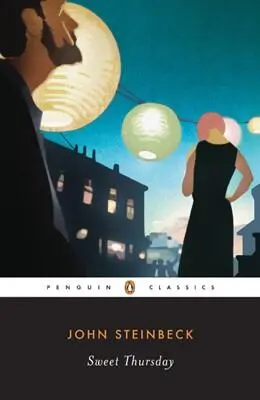
- Название:Sweet Thursday
- Автор:
- Издательство:Penguin Classics
- Жанр:
- Год:2008
- ISBN:1-4362-4126-X
- Рейтинг книги:5 / 5. Голосов: 1
-
Избранное:Добавить в избранное
- Отзывы:
-
Ваша оценка:
Sweet Thursday: краткое содержание, описание и аннотация
Предлагаем к чтению аннотацию, описание, краткое содержание или предисловие (зависит от того, что написал сам автор книги «Sweet Thursday»). Если вы не нашли необходимую информацию о книге — напишите в комментариях, мы постараемся отыскать её.
Cannery Row
Sweet Thursday — читать онлайн бесплатно полную книгу (весь текст) целиком
Ниже представлен текст книги, разбитый по страницам. Система сохранения места последней прочитанной страницы, позволяет с удобством читать онлайн бесплатно книгу «Sweet Thursday», без необходимости каждый раз заново искать на чём Вы остановились. Поставьте закладку, и сможете в любой момент перейти на страницу, на которой закончили чтение.
Интервал:
Закладка:
“Why don’t you write your paper?”
“I seem to be afraid to. A kind of terror comes over me when I start.”
“What have you got to lose if you fail?”
“Nothing.”
“What have you got to gain if you succeed?”
“I don’t know.”
Old Jingleballicks regarded Doc benignly. “Have you got enough beer in you so you aren’t quarrelsome?”
“I’m never quarrelsome.”
“The hell you aren’t! Took my head off last night. You hurt my feelings.”
“I’m sorry. What did you want to say?”
“Will you let me finish if I start?”
“I’ll try.”
Old Jay said, “You feel to me like a woman who has never had a baby but knows all the words. There’s a lack of fulfillment in you. I think you have violated something or withheld something from yourself—almost as though you were eating plenty but no Vitamin A. You aren’t hungry, but you’re starving. That’s what I think.”
“I can’t imagine anything I lack. I have freedom, comfort, and the work I like. What have I missed?”
“Well, last night, in every conversation, a girl named Suzy crept in—”
“For God’s sake!” said Doc. “Do you know what Suzy is? An illiterate little tramp, a whore! I took her out to dinner because Fauna asked me to. I found her interesting the way I’d find a new species of octopus interesting, that’s all. You’ve always been a goddam fool, Old Jingleballicks, but you’ve never been a romantic damn fool.”
“Who’s talking about romance? I was speaking of hunger. Maybe you can’t be wholly yourself because you’ve never given yourself wholly to someone else.”
“Of all the esoteric goddam nonsense!” Doc cried. “Why I give floor room to you I don’t know.”
“Then try to figure out why you get mad,” said Old Jay.
“What?”
“Well, aren’t you putting a lot of energy into denying something which, if it is not true, deserved no denial?”
“Sometimes I think you’re just plain nuts,” said Doc.
“Know what I’m going to do?” said Old Jay. “I’m going to buy a bottle of whisky.”
“I don’t believe it!” said Doc.
28
Where Alfred the Sacred River Ran [102] Where Alfred the Sacred River Ran: Parody of “…Where Alph, the sacred river, ran / Through caverns measureless to man…” from “Kubla Khan or, a Vision in a Dream: A Fragment” (1816), a poem by British Romantic poet Samuel Taylor Coleridge (1772–1834).
Very few people know that Hazel had given the Palace Flop house its name years ago when the boys had first moved in. Inspired by the glory of having a home, Hazel compounded the name of something he knew about and something he didn’t, the known and the unknown, the homely and the exotic; and, ever after, the name had stuck, so that it was known by certain people from one end of the state to the other. And the Palace Flop house had justified its name over the years. It had been shelter and home base to the boys. Also, some surprising events had occurred there.
The building itself was not impressive—redwood board and bat, tar-paper roof, twenty-eight feet long, fourteen feet wide, two square windows, and two doors, one on each side. Into this simple box Mack and the boys had moved some remarkable articles, the products of their wits, their work, and sometimes their misfortune. The great cast-iron stove was in excellent condition and bid fair to outlast the Colosseum which it resembled. The grandfather clock, once the home of a dog, stood empty now—and Eddie wanted to be buried in it. Each of the beds was canopied as a substitute for mending the roof, and Gay’s bed was kept just as it was when he went away—patchwork quilt turned down to reveal a gray tennis-flannel sheet. His copy of Amazing True Desert Stories, folded open to page 62, lay on top of the apple box just as Gay had left it; and his prize possession, a collector’s item, a ring gear and pinions of a 1914 Willys-Knight, [103] 1914 Willys-Knight: Willys-Knight automobiles were produced between 1914 and 1933 by Willys-Overland Company of Elyria and Toledo, Ohio. In an internal combustion engine, ring gear and pinions connect the car’s starter with the motor’s flywheel.
lay on a black velvet cloth in the bottom of the box. On the shelf over his bed the boys kept some kind of nosegay in a swanky swig glass, for Gay had loved flowers. He ate them—particularly red roses, mustard flowers, wild turnip blossoms, and the petals of one variety of dahlia. No one had ever been allowed to sit or sleep in Gay’s bed. He might return one day, the boys thought, even though he was reported dead and his Army insurance paid.
Now there had been tom-wallagers in the Palace Flophouse but never such a bull-bitch tom-wallager as was now in the process of exploding. The outside was freshly whitewashed. Beds were pushed together, and the interior was a bower of pine boughs crossed to make a canopy. The great stove was laid out as a bar and the oven was full of cracked ice. In front of the back door a little stage was built, with a painter’s dropcloth for a curtain and the door for an entrance—for certain theatrical effects, not counting the raffle itself, were planned for that area.
This forest bower was lighted by Japanese lanterns, and a string of lanterns led down to the chicken walk above the railroad track. The boys were pleased with their effort.
Mack surveyed the scene and put a name to it that was remembered. “A veritable fairyland,” [104] “A veritable fairyland”: According to Susan Shillinglaw in A Journey into Steinbeck’s California (2006), Steinbeck’s portrayal of the culminating costume party at the Palace Flop house may owe its inspiration to an outrageous benefit party, “Surrealistic Night in an Enchanted Forest,” thrown by artist Salvador Dalí at Monterey’s Hotel Del Monte on September 2, 1941 (pp. 76–77). See also the short film clip, “Dizzy Dali Dinner,” on YouTube at http://www.youtube.com/watch?v=vg6i4E0Woak .
he said.
The Patrón had contributed his prize group of musicians, the original Espaldas Mojadas—two guitars, gourds, bones, castanets, and Haitian drum, and last, a guitarón as big as a rowboat. Cacahuete Rivas, the nephew of the Patrón, was scheduled to join his trumpet to the band later, but now he was on the beach, practicing his solo softly.
As evening came to Cannery Row the boys were tired but content. Following Mack’s lead, they all agreed to be trees. After all, they were the hosts. Their one sorrow was that Hazel had left them. His yearning to be Prince Charming had overcome his love for his friends. In Joe Elegant’s tiny bedroom he was being transformed.
“Caught me with my pants down,” Mack apologized for the twentieth time. “Hazel’s such a mug you forget he’s sensitive. Hell, I could of worked out some kind of charming rig if I’d give it some thought. Don’t seem right without him here to mess things up.”
It is customary at most masquerades for the arriving guests to be shy, ill at ease, and sober, and to stand around uneasily for maybe an hour before the party warms up. In this matter of starting a party Cannery Row is far ahead of some other centers of culture. The party was to start at 9:00 P.M. sharp. The guests would be notified by the trumpet of Cacahuete Rivas, playing “Whistle While You Work.” [105] “Whistle While You Work”: Song featured in Walt Disney’s animated movie Snow White and the Seven Dwarfs (1937), with music by Frank Churchill (1901–42) and lyrics by Larry Morey.
At least two hours before the signal a series of small earnest parties, at Wide Ida’s, the Bear Flag, and in private homes, were practicing for the main event. This party was going to begin in full bloom. Of course Mack and the boys were so weighed down with responsibility that they didn’t get the best out of their liquor; still, they made progress, and they watched the big hand of the alarm clock on the back of the stove.
Читать дальшеИнтервал:
Закладка:
Похожие книги на «Sweet Thursday»
Представляем Вашему вниманию похожие книги на «Sweet Thursday» списком для выбора. Мы отобрали схожую по названию и смыслу литературу в надежде предоставить читателям больше вариантов отыскать новые, интересные, ещё непрочитанные произведения.


Обсуждение, отзывы о книге «Sweet Thursday» и просто собственные мнения читателей. Оставьте ваши комментарии, напишите, что Вы думаете о произведении, его смысле или главных героях. Укажите что конкретно понравилось, а что нет, и почему Вы так считаете.