John Steinbeck - A Russian Journal
Здесь есть возможность читать онлайн «John Steinbeck - A Russian Journal» весь текст электронной книги совершенно бесплатно (целиком полную версию без сокращений). В некоторых случаях можно слушать аудио, скачать через торрент в формате fb2 и присутствует краткое содержание. Жанр: Классическая проза, на английском языке. Описание произведения, (предисловие) а так же отзывы посетителей доступны на портале библиотеки ЛибКат.
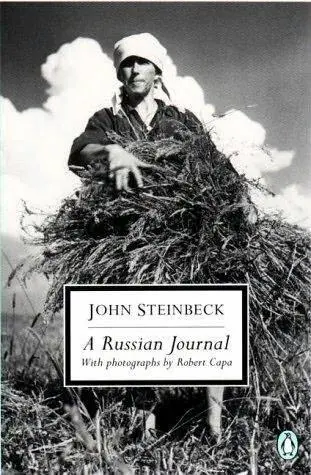
- Название:A Russian Journal
- Автор:
- Жанр:
- Год:неизвестен
- ISBN:нет данных
- Рейтинг книги:4.5 / 5. Голосов: 2
-
Избранное:Добавить в избранное
- Отзывы:
-
Ваша оценка:
A Russian Journal: краткое содержание, описание и аннотация
Предлагаем к чтению аннотацию, описание, краткое содержание или предисловие (зависит от того, что написал сам автор книги «A Russian Journal»). Если вы не нашли необходимую информацию о книге — напишите в комментариях, мы постараемся отыскать её.
A Russian Journal — читать онлайн бесплатно полную книгу (весь текст) целиком
Ниже представлен текст книги, разбитый по страницам. Система сохранения места последней прочитанной страницы, позволяет с удобством читать онлайн бесплатно книгу «A Russian Journal», без необходимости каждый раз заново искать на чём Вы остановились. Поставьте закладку, и сможете в любой момент перейти на страницу, на которой закончили чтение.
Интервал:
Закладка:
These Georgians are different-looking people. They are dark, almost gypsy-looking, with shining teeth, and long well-formed noses, and black curly hair. Nearly all the men wear mustaches, and they are handsomer than the women. They are lean and energetic, and their eyes are black and sparkling. We had read and.had been told that this is an ancient Semitic people, a people which had come originally from the Euphrates Valley, at a time before Babylon was a city; that they are Sumerians, and that their strain is one of the oldest remaining in the world. They are fiery, proud, fierce, and gay, and the other people of Russia have great admiration for them. They speak always of their strength and vitality, and of their abilities-great cavalry men and good fighters, they say. And the men are triumphant with the women of Russia. They are a people of poetry, of music and dancing, and, according to the tradition, great lovers. And surely they live in a country favored by nature, and just as surely they have had to fight for it for two thousand years.
Just before two o'clock our crew came back, their hair still wet from their swim in the Black Sea. And we wished we had been with them, for we were covered with sweat. It was very hot, and some of our passengers were beginning to feel the effect of an overindulgence in fresh fruit. A few children had been sick already.
We took off again and flew low over the sea, and then began to take on altitude, and climbed very high, and flew over mountains that were gaunt and brown, like the mountains of California. And deep in the creases there were little streams, and we could see the vegetation and the towns along the streams. The mountains were bleak here and forbidding, and they cast the light back blindingly. Then we flew through a pass, the mountaintops level with us, and came over the valley of Tiflis.
It is a huge and dry valley which looks like New Mexico. And when we landed the air was hot and dry, because it is far from the sea, but it was pleasant heat, there was no discomfort in it. And this great level valley, surrounded by the high mountains, seemed almost barren from the air.
We landed at a large airfield. There were many planes-Russian fighter planes. Two of them would take off as two came in, and they buzzed around the field constantly. Perhaps they were patrolling the Turkish border, which is not very far away.
On the high ridge to the west of us there was an ancient fortress, battlemented and huge, and black against the sky.
Mr. Chmarsky was with us again. We had declared a truce: we were nicer to him, and he was nicer to us, than we had been in Stalingrad. He had never been to Georgia either.
We were met by a delegation of the Tiflis section of Voks, and they had a fine big car, and they were nice people. We drove across the flat dry plain to a pass in the mountains. And in the pass lay Tiflis, a beautiful city which has been on the main route of travel from the south to the north for many centuries. The ranges on either side are lined with ancient fortifications, and even the city is dominated by a castle on the ridge. There is a fortress on the other side of the valley too, for through this narrow pass has come every movement and migration of people-Persians, Iranians, Iraqi from the south, and Tartars and other marauders from the north. And in this narrow pass the battles occurred and the fortifications were put up.
Part of the city is very old, and a river runs through the pass, with high cliffs on one side. And on the high cliffs are clustered ancient houses. It is truly an ancient city, for whereas Moscow celebrates this year its eight-hundredth anniversary, Tiflis next year will celebrate its fifteen-hundredth. And this is the new capital, the old capital is thirty kilometers farther along the river.
The streets of Tiflis are wide and tree-shaded, and many of its buildings are modern. The streets climb the hills on either side. And at the very top of the hill, to the west, there is a playground and park, with a funicular railroad that goes straight up the cliff. It is a giant park, with a large restaurant, and it overlooks the valley for many miles. And on the ridge, in the very center of the city, the huge round towers and high battlemented walls of the city fortress stand, ruinous and forbidding.
In the city and on the ridges there are old churches, for Christianity came to the Georgians in the fourth century, and churches which are still in use were built then. It is a city of many ancient stories, and probably many ancient ghosts. There is the story of the Moslem Iranian king who, massing his troops, forced the captive people of Tiflis to the bridge over the river, set up a picture of the Virgin, and allowed every one to go free who would spit on the picture. Every one who refused had his head chopped off, and the story is that thousands of heads bumped in the river that day.
The people of Tiflis were better dressed, better looking, and more full of spirit than any we saw in Russia. There was gaiety and color in the streets. The clothing was handsome, and the women wore colored kerchiefs on their heads.
This city is incredibly clean. It is the first clean oriental city I have ever seen. In the river that cuts through the center of the city hundreds of little boys swim. And here there is no destruction, except that which time does to the ancient buildings.
Voks has a very large and efficient organization in Tiflis. For this is a tourist city, and Voks operates not only with foreigners, but with visitors from the other republics of the Soviet Union. They invited us to their building, which is extremely impressive, and even though it was late at night, they served us wonderful cakes and fine Georgian wine, and they wanted to talk and drink with us. But we were awfully tired. We promised that we would talk as much as they wanted later, but we had to go to bed.
During our stay in Georgia Mr. Chmarsky's gremlin hardly operated at all, and that made us feel better toward him, and made him feel better toward us.
We had two large rooms in the Intourist Hotel. They overlooked the street, and there were windows on three sides, so that any moving breeze came through. It was very pleasant. There was only one difficulty: we could not get breakfast. During the whole time we were there we tried to get breakfast early, and we never succeeded. It came when they were ready.
In the morning we got up very early, for the city fascinated us, and we wanted to see a great deal of it. Our driver was, as usual, wonderful, an ex-cavalry man, and he had, of all things, a jeep. The jeep does not bring out the best in anyone, and in a cavalry man it brings out the cowboy. He loved it because it would climb almost straight uphill, because he could whip it around corners, and jump it over culverts. It plunged into streams, and splashed water, and came out on the other side. He drove like a mad man, he was afraid of no one. Again and again, in traffic, outraged drivers forced him to the curb, and there would be an exchange of violent Georgian language, and our man would smile and drive off. He won all engagements. We loved him. He was the first man we met in Russia who had the same feeling about policemen that we have. His black curly hair blew wildly about his head when he drove. He never wanted to stop.
He roared the jeep up the hill, into the most ancient part of the city, where the old Georgian wooden houses are preserved. They have a strange architecture, usually two to three stories high, with large open balconies. And the carving and the painting on the walls are exotic.
We climbed the ridge to the old fortification, which has round towers and high thick walls; it might have been impregnable forever if it had not been for artillery, for there was no way to attack it without artillery.
We walked through the tropical garden of the city, beautiful with flowering trees and rare plants, many of which we had never seen before. It was cool there, and a stream flowed beside it.
Читать дальшеИнтервал:
Закладка:
Похожие книги на «A Russian Journal»
Представляем Вашему вниманию похожие книги на «A Russian Journal» списком для выбора. Мы отобрали схожую по названию и смыслу литературу в надежде предоставить читателям больше вариантов отыскать новые, интересные, ещё непрочитанные произведения.










Обсуждение, отзывы о книге «A Russian Journal» и просто собственные мнения читателей. Оставьте ваши комментарии, напишите, что Вы думаете о произведении, его смысле или главных героях. Укажите что конкретно понравилось, а что нет, и почему Вы так считаете.