John Steinbeck - A Russian Journal
Здесь есть возможность читать онлайн «John Steinbeck - A Russian Journal» весь текст электронной книги совершенно бесплатно (целиком полную версию без сокращений). В некоторых случаях можно слушать аудио, скачать через торрент в формате fb2 и присутствует краткое содержание. Жанр: Классическая проза, на английском языке. Описание произведения, (предисловие) а так же отзывы посетителей доступны на портале библиотеки ЛибКат.
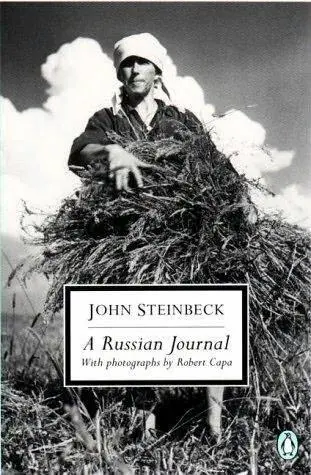
- Название:A Russian Journal
- Автор:
- Жанр:
- Год:неизвестен
- ISBN:нет данных
- Рейтинг книги:4.5 / 5. Голосов: 2
-
Избранное:Добавить в избранное
- Отзывы:
-
Ваша оценка:
A Russian Journal: краткое содержание, описание и аннотация
Предлагаем к чтению аннотацию, описание, краткое содержание или предисловие (зависит от того, что написал сам автор книги «A Russian Journal»). Если вы не нашли необходимую информацию о книге — напишите в комментариях, мы постараемся отыскать её.
A Russian Journal — читать онлайн бесплатно полную книгу (весь текст) целиком
Ниже представлен текст книги, разбитый по страницам. Система сохранения места последней прочитанной страницы, позволяет с удобством читать онлайн бесплатно книгу «A Russian Journal», без необходимости каждый раз заново искать на чём Вы остановились. Поставьте закладку, и сможете в любой момент перейти на страницу, на которой закончили чтение.
Интервал:
Закладка:
We said, "No, we do not think the United States will attack. We don't know, no one tells us these things, but we do not think that our people want to attack anyone." And we asked them where they got the idea that we might attack Russia.
Well, they said, they get it from our newspapers. Certain of our newspapers speak constantly of attacking Russia. And some of them speak of what they call preventive war. And, they said, that as far as they are concerned, preventive war is just like any other war. We told them that we do not believe that those newspapers they mention, and those columnists who speak only of war, are true representatives of the American people. We do not believe the American people want to go to war with anyone.
The old, old thing came up, that always comes up: "Then why does your government not control these newspapers and these men who talk war?" And we had to explain again, as we had many times before, that we do not believe in controlling our press, that We think the truth usually wins, and that control simply drives bad things underground. In our country we prefer that these people talk themselves to death in public, and write themselves to death, rather than bottle them up to slip their poison secretly through the dark.
They have a great deal of misinformation about America, for they have their yellow journalists too. They have their correspondents who write with little knowledge, and they have their fiery typewriter soldiers.
Our eyes were heavy and we were dying on the vine, and at last we had to excuse ourselves and go to bed. I had been walking a great deal, and my recently broken knee was giving me hell. The muscles at the back were as tight as ropes. I could barely stand on it. As much as I hated to, I had to lie down for a while.
We talked for a while before we went to sleep. If a war should break out between Russia and the United States, these people would believe that we are the villains. Whether it is through propaganda, or fear, or for whatever reason, they would blame us if there is a war. They speak only in terms of invasion of their country, and they are afraid of it, because they have had it. Again and again they ask, "Will the United States invade us? Will you send your bombers to destroy us more?" And never do they say, "We will send our bombers," or "We will invade."
I awakened early and got up to complete my notes. My leg was so stiff that I could barely walk on it at all. I sat down at our desk, which overlooked the street, and watched the people going by. And there was a girl policeman directing traffic in the street, and she wore boots, and a blue skirt and a white tunic with a military belt, and a cocky little beret on her head. Her nightstick was painted black and white, and she directed traffic with a military snap. She was very pretty.
I watched the women walking in the street, and they moved like dancers. They are light on their feet and they have a beautiful carriage. And many of them are very handsome. Much of the destruction that has been brought on this people is because their land is rich and productive and many conquerors have coveted it. If the United States were completely destroyed from New York to Kansas, we would have about the area of destruction the Ukraine has. If six million people were killed, not counting soldiers, fifteen per cent of the population, you would have an idea of the casualties of the Ukraine. Counting soldiers, there would be many more, but six million out of forty-five million civilians have been killed. There are mines which will never be opened because the Germans threw thousands of bodies down into the shafts. Every piece of machinery in the Ukraine has been destroyed or removed, so that now, until more can be made, everything must be done by hand. Every stone and brick of the ruined city must be lifted and carried with the hands, for there are no bulldozers. And while they are rebuilding, the Ukrainians must produce food, for theirs is the great granary of the nation.
They say that in harvest time there are no holidays, and now it is harvest time. On the farms there are no Sundays, there are no days off.
The work ahead of them is overwhelming. The buildings to be replaced must be torn down first. An amount of labor that the bulldozer could do in a few days takes weeks by hand, but they have no bulldozers yet. Everything must be replaced. And it must be done quickly.
We went through the blasted and destroyed center of the city, past the corner where the German sadists were hanged after the war. At the museum were the plans of the new city. More and more we were realizing how much the Russian people live on hope, hope that tomorrow will be better than today. Here in white plaster was a model of the new city. A grandiose, a fabulous city to be built of white marble, the lines classical, the buildings huge, columns, and domes, and arches, and giant memorials, all in white marble. The plaster model of the city-to-be covered a large section of one room. And the director of the museum pointed out the various buildings. This was to be the Palace of the Soviets, this the museum-always the museum.
Capa says that the museum is the church of the Russians. They seem to want great buildings and ornate structures. They like lavishness. In Moscow, where there is no reason for skyscrapers because the space is almost unlimited and the land level, they are nevertheless planning skyscrapers, almost in the New York manner, without the New York need. With a slow, antlike energy, they will build these cities. But now the people come through the wreckage, through the destroyed and tumbled buildings, people, men, women, and even children, they come to the museum to look at the plaster cities of the future. In Russia it is always the future that is thought of. It is the crops next year, it is the comfort that will come in ten years, it is the clothes that will be made very soon. If ever a people took its energy from hope, it is the Russian people.
We went from this little plaster city, so new that it has not even been built yet, to the ancient monastery on the cliff. Once it had been the center of the Russian Church, and one of the oldest religious structures in Russia. It had been magnificent, its buildings and its paintings dating from the twelfth century. But then the Germans came, and this monastery had been the repository of many of the treasures of the world. And when the Germans had stolen most of the treasures, they destroyed the buildings with shell fire to conceal their theft when they left the city. And now it is a great pile of fallen stones and tumbled domes, with little bits of wall paintings showing through. And it will not be rebuilt, it couldn't be. It took centuries to build, and now it is gone. The weeds that follow destruction have sprung up in the courtyards. In a half-ruined chapel, in front of the destroyed altar, we saw a ragged figure of a woman lying prostrate on the ground. And through an open gate, where once only the czar or his family could pass, a wild-eyed, half-crazed woman walked, crossing herself monotonously and mumbling.
One part of the monastery still stands, a chapel where for centuries only the czar and the nobles were permitted to worship. It is heavily painted, a dark and gloomy place. And each worshiper had his little carven stall, for this was the place of a very select religion, and it was easy to see in one's mind the old nobility, sitting in gloomy concentration on a noble future and on a noble heaven, a heaven which was probably as gloomy as this church, with its incense-blackened ceiling and its glimmering gold leaf. And Capa said, "All good churches are gloomy. That's what makes them good."
There is an older church in Kiev, one of the oldest in the world, that was built by Jaroslav the Wise in 1034, and it is still standing, probably because there was nothing of value to steal in it, and so the Germans let it alone. But it, again, is a high, gloomy place.
Читать дальшеИнтервал:
Закладка:
Похожие книги на «A Russian Journal»
Представляем Вашему вниманию похожие книги на «A Russian Journal» списком для выбора. Мы отобрали схожую по названию и смыслу литературу в надежде предоставить читателям больше вариантов отыскать новые, интересные, ещё непрочитанные произведения.






Обсуждение, отзывы о книге «A Russian Journal» и просто собственные мнения читателей. Оставьте ваши комментарии, напишите, что Вы думаете о произведении, его смысле или главных героях. Укажите что конкретно понравилось, а что нет, и почему Вы так считаете.