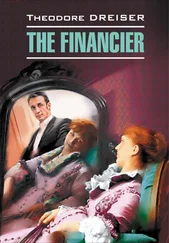
Theodore Dreiser - The Financier
Здесь есть возможность читать онлайн «Theodore Dreiser - The Financier» весь текст электронной книги совершенно бесплатно (целиком полную версию без сокращений). В некоторых случаях можно слушать аудио, скачать через торрент в формате fb2 и присутствует краткое содержание. Жанр: Классическая проза, на английском языке. Описание произведения, (предисловие) а так же отзывы посетителей доступны на портале библиотеки ЛибКат.
- Название:The Financier
- Автор:
- Жанр:
- Год:неизвестен
- ISBN:нет данных
- Рейтинг книги:5 / 5. Голосов: 1
-
Избранное:Добавить в избранное
- Отзывы:
-
Ваша оценка:
The Financier: краткое содержание, описание и аннотация
Предлагаем к чтению аннотацию, описание, краткое содержание или предисловие (зависит от того, что написал сам автор книги «The Financier»). Если вы не нашли необходимую информацию о книге — напишите в комментариях, мы постараемся отыскать её.
The Financier — читать онлайн бесплатно полную книгу (весь текст) целиком
Ниже представлен текст книги, разбитый по страницам. Система сохранения места последней прочитанной страницы, позволяет с удобством читать онлайн бесплатно книгу «The Financier», без необходимости каждый раз заново искать на чём Вы остановились. Поставьте закладку, и сможете в любой момент перейти на страницу, на которой закончили чтение.
Интервал:
Закладка:
“And you’re sure they won’t tell on you?”
“Oh, no; never, never!”
“Very well,” he concluded. “You know what you’re doing. I don’t want to advise you against your will. If I were you, though, I’d take your father’s advice and go away for a while. He’ll get over this then, and I’ll still be here. I can write you occasionally, and you can write me.”
The moment Cowperwood said this Aileen’s brow clouded. Her love for him was so great that there was something like a knife thrust in the merest hint at an extended separation. Her Frank here and in trouble—on trial maybe and she away! Never! What could he mean by suggesting such a thing? Could it be that he didn’t care for her as much as she did for him? Did he really love her? she asked herself. Was he going to desert her just when she was going to do the thing which would bring them nearer together? Her eyes clouded, for she was terribly hurt.
“Why, how you talk!” she exclaimed. “You know I won’t leave Philadelphia now. You certainly don’t expect me to leave you.”
Cowperwood saw it all very clearly. He was too shrewd not to. He was immensely fond of her. Good heaven, he thought, he would not hurt her feelings for the world!
“Honey,” he said, quickly, when he saw her eyes, “you don’t understand. I want you to do what you want to do. You’ve planned this out in order to be with me; so now you do it. Don’t think any more about me or anything I’ve said. I was merely thinking that it might make matters worse for both of us; but I don’t believe it will. You think your father loves you so much that after you’re gone he’ll change his mind. Very good; go. But we must be very careful, sweet—you and I—really we must. This thing is getting serious. If you should go and your father should charge me with abduction—take the public into his confidence and tell all about this, it would be serious for both of us—as much for you as for me, for I’d be convicted sure then, just on that account, if nothing else. And then what? You’d better not try to see me often for the present—not any oftener than we can possibly help. If we had used common sense and stopped when your father got that letter, this wouldn’t have happened. But now that it has happened, we must be as wise as we can, don’t you see? So, think it over, and do what you think best and then write me and whatever you do will be all right with me—do you hear?” He drew her to him and kissed her. “You haven’t any money, have you?” he concluded wisely.
Aileen, deeply moved by all he had just said, was none the less convinced once she had meditated on it a moment, that her course was best. Her father loved her too much. He would not do anything to hurt her publicly and so he would not attack Cowperwood through her openly. More than likely, as she now explained to Frank, he would plead with her to come back. And he, listening, was compelled to yield. Why argue? She would not leave him anyhow.
He went down in his pocket for the first time since he had known Aileen and produced a layer of bills. “Here’s two hundred dollars, sweet,” he said, “until I see or hear from you. I’ll see that you have whatever you need; and now don’t think that I don’t love you. You know I do. I’m crazy about you.”
Aileen protested that she did not need so much—that she did not really need any—she had some at home; but he put that aside. He knew that she must have money.
“Don’t talk, honey,” he said. “I know what you need.” She had been so used to receiving money from her father and mother in comfortable amounts from time to time that she thought nothing of it. Frank loved her so much that it made everything right between them. She softened in her mood and they discussed the matter of letters, reaching the conclusion that a private messenger would be safest. When finally they parted, Aileen, from being sunk in the depths by his uncertain attitude, was now once more on the heights. She decided that he did love her, and went away smiling. She had her Frank to fall back on—she would teach her father. Cowperwood shook his head, following her with his eyes. She represented an additional burden, but give her up, he certainly could not. Tear the veil from this illusion of affection and make her feel so wretched when he cared for her so much? No. There was really nothing for him to do but what he had done. After all, he reflected, it might not work out so badly. Any detective work that Butler might choose to do would prove that she had not run to him. If at any moment it became necessary to bring common sense into play to save the situation from a deadly climax, he could have the Butlers secretly informed as to Aileen’s whereabouts. That would show he had little to do with it, and they could try to persuade Aileen to come home again. Good might result—one could not tell. He would deal with the evils as they arose. He drove quickly back to his office, and Aileen returned to her home determined to put her plan into action. Her father had given her some little time in which to decide—possibly he would give her longer—but she would not wait. Having always had her wish granted in everything, she could not understand why she was not to have her way this time. It was about five o’clock now. She would wait until all the members of the family were comfortably seated at the dinner-table, which would be about seven o’clock, and then slip out.
On arriving home, however, she was greeted by an unexpected reason for suspending action. This was the presence of a certain Mr. and Mrs. Steinmetz—the former a well-known engineer who drew the plans for many of the works which Butler undertook. It was the day before Thanksgiving, and they were eager to have Aileen and Norah accompany them for a fortnight’s stay at their new home in West Chester—a structure concerning the charm of which Aileen had heard much. They were exceedingly agreeable people—comparatively young and surrounded by a coterie of interesting friends. Aileen decided to delay her flight and go. Her father was most cordial. The presence and invitation of the Steinmetzes was as much a relief to him as it was to Aileen. West Chester being forty miles from Philadelphia, it was unlikely that Aileen would attempt to meet Cowperwood while there.
She wrote Cowperwood of the changed condition and departed, and he breathed a sigh of relief, fancying at the time that this storm had permanently blown over.
Chapter XXXIX
In the meanwhile the day of Cowperwood’s trial was drawing near. He was under the impression that an attempt was going to be made to convict him whether the facts warranted it or not. He did not see any way out of his dilemma, however, unless it was to abandon everything and leave Philadelphia for good, which was impossible. The only way to guard his future and retain his financial friends was to stand trial as quickly as possible, and trust them to assist him to his feet in the future in case he failed. He discussed the possibilities of an unfair trial with Steger, who did not seem to think that there was so much to that. In the first place, a jury could not easily be suborned by any one. In the next place, most judges were honest, in spite of their political cleavage, and would go no further than party bias would lead them in their rulings and opinions, which was, in the main, not so far. The particular judge who was to sit in this case, one Wilbur Payderson, of the Court of Quarter Sessions, was a strict party nominee, and as such beholden to Mollenhauer, Simpson, and Butler; but, in so far as Steger had ever heard, he was an honest man.
“What I can’t understand,” said Steger, “is why these fellows should be so anxious to punish you, unless it is for the effect on the State at large. The election’s over. I understand there’s a movement on now to get Stener out in case he is convicted, which he will be. They have to try him. He won’t go up for more than a year, or two or three, and if he does he’ll be pardoned out in half the time or less. It would be the same in your case, if you were convicted. They couldn’t keep you in and let him out. But it will never get that far—take my word for it. We’ll win before a jury, or we’ll reverse the judgment of conviction before the State Supreme Court, certain. Those five judges up there are not going to sustain any such poppycock idea as this.”
Читать дальшеИнтервал:
Закладка:
Похожие книги на «The Financier»
Представляем Вашему вниманию похожие книги на «The Financier» списком для выбора. Мы отобрали схожую по названию и смыслу литературу в надежде предоставить читателям больше вариантов отыскать новые, интересные, ещё непрочитанные произведения.










Обсуждение, отзывы о книге «The Financier» и просто собственные мнения читателей. Оставьте ваши комментарии, напишите, что Вы думаете о произведении, его смысле или главных героях. Укажите что конкретно понравилось, а что нет, и почему Вы так считаете.