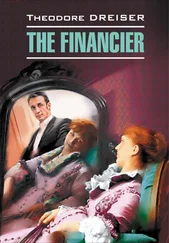
Theodore Dreiser - The Financier
Здесь есть возможность читать онлайн «Theodore Dreiser - The Financier» весь текст электронной книги совершенно бесплатно (целиком полную версию без сокращений). В некоторых случаях можно слушать аудио, скачать через торрент в формате fb2 и присутствует краткое содержание. Жанр: Классическая проза, на английском языке. Описание произведения, (предисловие) а так же отзывы посетителей доступны на портале библиотеки ЛибКат.
- Название:The Financier
- Автор:
- Жанр:
- Год:неизвестен
- ISBN:нет данных
- Рейтинг книги:5 / 5. Голосов: 1
-
Избранное:Добавить в избранное
- Отзывы:
-
Ваша оценка:
The Financier: краткое содержание, описание и аннотация
Предлагаем к чтению аннотацию, описание, краткое содержание или предисловие (зависит от того, что написал сам автор книги «The Financier»). Если вы не нашли необходимую информацию о книге — напишите в комментариях, мы постараемся отыскать её.
The Financier — читать онлайн бесплатно полную книгу (весь текст) целиком
Ниже представлен текст книги, разбитый по страницам. Система сохранения места последней прочитанной страницы, позволяет с удобством читать онлайн бесплатно книгу «The Financier», без необходимости каждый раз заново искать на чём Вы остановились. Поставьте закладку, и сможете в любой момент перейти на страницу, на которой закончили чтение.
Интервал:
Закладка:
Apparently Cowperwood was not very much frightened. He told her that he had powerful financial friends who would appeal to the governor to pardon him in case he was convicted; and, anyhow, that he did not think that the evidence was strong enough to convict him. He was merely a political scapegoat through public clamor and her father’s influence; since the latter’s receipt of the letter about them he had been the victim of Butler’s enmity, and nothing more. “If it weren’t for your father, honey,” he declared, “I could have this indictment quashed in no time. Neither Mollenhauer nor Simpson has anything against me personally, I am sure. They want me to get out of the street-railway business here in Philadelphia, and, of course, they wanted to make things look better for Stener at first; but depend upon it, if your father hadn’t been against me they wouldn’t have gone to any such length in making me the victim. Your father has this fellow Shannon and these minor politicians just where he wants them, too. That’s where the trouble lies. They have to go on.”
“Oh, I know,” replied Aileen. “It’s me, just me, that’s all. If it weren’t for me and what he suspects he’d help you in a minute. Sometimes, you know, I think I’ve been very bad for you. I don’t know what I ought to do. If I thought it would help you any I’d not see you any more for a while, though I don’t see what good that would do now. Oh, I love you, love you, Frank! I would do anything for you. I don’t care what people think or say. I love you.”
“Oh, you just think you do,” he replied, jestingly. “You’ll get over it. There are others.”
“Others!” echoed Aileen, resentfully and contemptuously. “After you there aren’t any others. I just want one man, my Frank. If you ever desert me, I’ll go to hell. You’ll see.”
“Don’t talk like that, Aileen,” he replied, almost irritated. “I don’t like to hear you. You wouldn’t do anything of the sort. I love you. You know I’m not going to desert you. It would pay you to desert me just now.”
“Oh, how you talk!” she exclaimed. “Desert you! It’s likely, isn’t it? But if ever you desert me, I’ll do just what I say. I swear it.”
“Don’t talk like that. Don’t talk nonsense.”
“I swear it. I swear by my love. I swear by your success—my own happiness. I’ll do just what I say. I’ll go to hell.”
Cowperwood got up. He was a little afraid now of this deep-seated passion he had aroused. It was dangerous. He could not tell where it would lead.
It was a cheerless afternoon in November, when Alderson, duly informed of the presence of Aileen and Cowperwood in the South Sixth Street house by the detective on guard drove rapidly up to Butler’s office and invited him to come with him. Yet even now Butler could scarcely believe that he was to find his daughter there. The shame of it. The horror. What would he say to her? How reproach her? What would he do to Cowperwood? His large hands shook as he thought. They drove rapidly to within a few doors of the place, where a second detective on guard across the street approached. Butler and Alderson descended from the vehicle, and together they approached the door. It was now almost four-thirty in the afternoon. In a room within the house, Cowperwood, his coat and vest off, was listening to Aileen’s account of her troubles.
The room in which they were sitting at the time was typical of the rather commonplace idea of luxury which then prevailed. Most of the “sets” of furniture put on the market for general sale by the furniture companies were, when they approached in any way the correct idea of luxury, imitations of one of the Louis periods. The curtains were always heavy, frequently brocaded, and not infrequently red. The carpets were richly flowered in high colors with a thick, velvet nap. The furniture, of whatever wood it might be made, was almost invariably heavy, floriated, and cumbersome. This room contained a heavily constructed bed of walnut, with washstand, bureau, and wardrobe to match. A large, square mirror in a gold frame was hung over the washstand. Some poor engravings of landscapes and several nude figures were hung in gold frames on the wall. The gilt-framed chairs were upholstered in pink-and-white-flowered brocade, with polished brass tacks. The carpet was of thick Brussels, pale cream and pink in hue, with large blue jardinieres containing flowers woven in as ornaments. The general effect was light, rich, and a little stuffy.
“You know I get desperately frightened, sometimes,” said Aileen. “Father might be watching us, you know. I’ve often wondered what I’d do if he caught us. I couldn’t lie out of this, could I?”
“You certainly couldn’t,” said Cowperwood, who never failed to respond to the incitement of her charms. She had such lovely smooth arms, a full, luxuriously tapering throat and neck; her golden-red hair floated like an aureole about her head, and her large eyes sparkled. The wondrous vigor of a full womanhood was hers—errant, ill-balanced, romantic, but exquisite, “but you might as well not cross that bridge until you come to it,” he continued. “I myself have been thinking that we had better not go on with this for the present. That letter ought to have been enough to stop us for the time.”
He came over to where she stood by the dressing-table, adjusting her hair.
“You’re such a pretty minx,” he said. He slipped his arm about her and kissed her pretty mouth. “Nothing sweeter than you this side of Paradise,” he whispered in her ear.
While this was enacting, Butler and the extra detective had stepped out of sight, to one side of the front door of the house, while Alderson, taking the lead, rang the bell. A negro servant appeared.
“Is Mrs. Davis in?” he asked, genially, using the name of the woman in control. “I’d like to see her.”
“Just come in,” said the maid, unsuspectingly, and indicated a reception-room on the right. Alderson took off his soft, wide-brimmed hat and entered. When the maid went up-stairs he immediately returned to the door and let in Butler and two detectives. The four stepped into the reception-room unseen. In a few moments the “madam” as the current word characterized this type of woman, appeared. She was tall, fair, rugged, and not at all unpleasant to look upon. She had light-blue eyes and a genial smile. Long contact with the police and the brutalities of sex in her early life had made her wary, a little afraid of how the world would use her. This particular method of making a living being illicit, and she having no other practical knowledge at her command, she was as anxious to get along peacefully with the police and the public generally as any struggling tradesman in any walk of life might have been. She had on a loose, blue-flowered peignoir, or dressing-gown, open at the front, tied with blue ribbons and showing a little of her expensive underwear beneath. A large opal ring graced her left middle finger, and turquoises of vivid blue were pendent from her ears. She wore yellow silk slippers with bronze buckles; and altogether her appearance was not out of keeping with the character of the reception-room itself, which was a composite of gold-flowered wall-paper, blue and cream-colored Brussels carpet, heavily gold-framed engravings of reclining nudes, and a gilt-framed pier-glass, which rose from the floor to the ceiling. Needless to say, Butler was shocked to the soul of him by this suggestive atmosphere which was supposed to include his daughter in its destructive reaches.
Alderson motioned one of his detectives to get behind the woman—between her and the door—which he did.
“Sorry to trouble you, Mrs. Davis,” he said, “but we are looking for a couple who are in your house here. We’re after a runaway girl. We don’t want to make any disturbance—merely to get her and take her away.” Mrs. Davis paled and opened her mouth. “Now don’t make any noise or try to scream, or we’ll have to stop you. My men are all around the house. Nobody can get out. Do you know anybody by the name of Cowperwood?”
Читать дальшеИнтервал:
Закладка:
Похожие книги на «The Financier»
Представляем Вашему вниманию похожие книги на «The Financier» списком для выбора. Мы отобрали схожую по названию и смыслу литературу в надежде предоставить читателям больше вариантов отыскать новые, интересные, ещё непрочитанные произведения.










Обсуждение, отзывы о книге «The Financier» и просто собственные мнения читателей. Оставьте ваши комментарии, напишите, что Вы думаете о произведении, его смысле или главных героях. Укажите что конкретно понравилось, а что нет, и почему Вы так считаете.