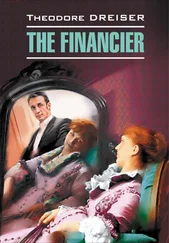
Theodore Dreiser - The Financier
Здесь есть возможность читать онлайн «Theodore Dreiser - The Financier» весь текст электронной книги совершенно бесплатно (целиком полную версию без сокращений). В некоторых случаях можно слушать аудио, скачать через торрент в формате fb2 и присутствует краткое содержание. Жанр: Классическая проза, на английском языке. Описание произведения, (предисловие) а так же отзывы посетителей доступны на портале библиотеки ЛибКат.
- Название:The Financier
- Автор:
- Жанр:
- Год:неизвестен
- ISBN:нет данных
- Рейтинг книги:5 / 5. Голосов: 1
-
Избранное:Добавить в избранное
- Отзывы:
-
Ваша оценка:
The Financier: краткое содержание, описание и аннотация
Предлагаем к чтению аннотацию, описание, краткое содержание или предисловие (зависит от того, что написал сам автор книги «The Financier»). Если вы не нашли необходимую информацию о книге — напишите в комментариях, мы постараемся отыскать её.
The Financier — читать онлайн бесплатно полную книгу (весь текст) целиком
Ниже представлен текст книги, разбитый по страницам. Система сохранения места последней прочитанной страницы, позволяет с удобством читать онлайн бесплатно книгу «The Financier», без необходимости каждый раз заново искать на чём Вы остановились. Поставьте закладку, и сможете в любой момент перейти на страницу, на которой закончили чтение.
Интервал:
Закладка:
His brow clouded, and he set his teeth with rage when he read her letter. He would have to do something about this—see Mollenhauer or Simpson, or both, and make some offer to the city. He could not promise them money for the present—only notes—but they might take them. Surely they could not be intending to make a scapegoat of him over such a trivial and uncertain matter as this check transaction! When there was the five hundred thousand advanced by Stener, to say nothing of all the past shady transactions of former city treasurers! How rotten! How political, but how real and dangerous.
But Simpson was out of the city for a period of ten days, and Mollenhauer, having in mind the suggestion made by Butler in regard to utilizing Cowperwood’s misdeed for the benefit of the party, had already moved as they had planned. The letters were ready and waiting. Indeed, since the conference, the smaller politicians, taking their cue from the overlords, had been industriously spreading the story of the sixty-thousand-dollar check, and insisting that the burden of guilt for the treasury defalcation, if any, lay on the banker. The moment Mollenhauer laid eyes on Cowperwood he realized, however, that he had a powerful personality to deal with. Cowperwood gave no evidence of fright. He merely stated, in his bland way, that he had been in the habit of borrowing money from the city treasury at a low rate of interest, and that this panic had involved him so that he could not possibly return it at present.
“I have heard rumors, Mr. Mollenhauer,” he said, “to the effect that some charge is to be brought against me as a partner with Mr. Stener in this matter; but I am hoping that the city will not do that, and I thought I might enlist your influence to prevent it. My affairs are not in a bad way at all, if I had a little time to arrange matters. I am making all of my creditors an offer of fifty cents on the dollar now, and giving notes at one, two, and three years; but in this matter of the city treasury loans, if I could come to terms, I would be glad to make it a hundred cents—only I would want a little more time. Stocks are bound to recover, as you know, and, barring my losses at this time, I will be all right. I realize that the matter has gone pretty far already. The newspapers are likely to start talking at any time, unless they are stopped by those who can control them.” (He looked at Mollenhauer in a complimentary way.) “But if I could be kept out of the general proceedings as much as possible, my standing would not be injured, and I would have a better chance of getting on my feet. It would be better for the city, for then I could certainly pay it what I owe it.” He smiled his most winsome and engaging smile. And Mollenhauer seeing him for the first time, was not unimpressed. Indeed he looked at this young financial David with an interested eye. If he could have seen a way to accept this proposition of Cowperwood’s, so that the money offered would have been eventually payable to him, and if Cowperwood had had any reasonable prospect of getting on his feet soon, he would have considered carefully what he had to say. For then Cowperwood could have assigned his recovered property to him. As it was, there was small likelihood of this situation ever being straightened out. The Citizens’ Municipal Reform Association, from all he could hear, was already on the move—investigating, or about to, and once they had set their hands to this, would unquestionably follow it closely to the end.
“The trouble with this situation, Mr. Cowperwood,” he said, affably, “is that it has gone so far that it is practically out of my hands. I really have very little to do with it. I don’t suppose, though, really, it is this matter of the five-hundred-thousand-dollar loan that is worrying you so much, as it is this other matter of the sixty-thousand-dollar check you received the other day. Mr. Stener insists that you secured that illegally, and he is very much wrought up about it. The mayor and the other city officials know of it now, and they may force some action. I don’t know.”
Mollenhauer was obviously not frank in his attitude—a little bit evasive in his sly reference to his official tool, the mayor; and Cowperwood saw it. It irritated him greatly, but he was tactful enough to be quite suave and respectful.
“I did get a check for sixty thousand dollars, that’s true,” he replied, with apparent frankness, “the day before I assigned. It was for certificates I had purchased, however, on Mr. Stener’s order, and was due me. I needed the money, and asked for it. I don’t see that there is anything illegal in that.”
“Not if the transaction was completed in all its details,” replied Mollenhauer, blandly. “As I understand it, the certificates were bought for the sinking-fund, and they are not there. How do you explain that?”
“An oversight, merely,” replied Cowperwood, innocently, and quite as blandly as Mollenhauer. “They would have been there if I had not been compelled to assign so unexpectedly. It was not possible for me to attend to everything in person. It has not been our custom to deposit them at once. Mr. Stener will tell you that, if you ask him.”
“You don’t say,” replied Mollenhauer. “He did not give me that impression. However, they are not there, and I believe that that makes some difference legally. I have no interest in the matter one way or the other, more than that of any other good Republican. I don’t see exactly what I can do for you. What did you think I could do?”
“I don’t believe you can do anything for me, Mr. Mollenhauer,” replied Cowperwood, a little tartly, “unless you are willing to deal quite frankly with me. I am not a beginner in politics in Philadelphia. I know something about the powers in command. I thought that you could stop any plan to prosecute me in this matter, and give me time to get on my feet again. I am not any more criminally responsible for that sixty thousand dollars than I am for the five hundred thousand dollars that I had as loan before it—not as much so. I did not create this panic. I did not set Chicago on fire. Mr. Stener and his friends have been reaping some profit out of dealing with me. I certainly was entitled to make some effort to save myself after all these years of service, and I can’t understand why I should not receive some courtesy at the hands of the present city administration, after I have been so useful to it. I certainly have kept city loan at par; and as for Mr. Stener’s money, he has never wanted for his interest on that, and more than his interest.”
“Quite so,” replied Mollenhauer, looking Cowperwood in the eye steadily and estimating the force and accuracy of the man at their real value. “I understand exactly how it has all come about, Mr. Cowperwood. No doubt Mr. Stener owes you a debt of gratitude, as does the remainder of the city administration. I’m not saying what the city administration ought or ought not do. All I know is that you find yourself wittingly or unwittingly in a dangerous situation, and that public sentiment in some quarters is already very strong against you. I personally have no feeling one way or the other, and if it were not for the situation itself, which looks to be out of hand, would not be opposed to assisting you in any reasonable way. But how? The Republican party is in a very bad position, so far as this election is concerned. In a way, however innocently, you have helped to put it there, Mr. Cowperwood. Mr. Butler, for some reason to which I am not a party, seems deeply and personally incensed. And Mr. Butler is a great power here—” (Cowperwood began to wonder whether by any chance Butler had indicated the nature of his social offense against himself, but he could not bring himself to believe that. It was not probable.) “I sympathize with you greatly, Mr. Cowperwood, but what I suggest is that you first See Mr. Butler and Mr. Simpson. If they agree to any program of aid, I will not be opposed to joining. But apart from that I do not know exactly what I can do. I am only one of those who have a slight say in the affairs of Philadelphia.”
Читать дальшеИнтервал:
Закладка:
Похожие книги на «The Financier»
Представляем Вашему вниманию похожие книги на «The Financier» списком для выбора. Мы отобрали схожую по названию и смыслу литературу в надежде предоставить читателям больше вариантов отыскать новые, интересные, ещё непрочитанные произведения.










Обсуждение, отзывы о книге «The Financier» и просто собственные мнения читателей. Оставьте ваши комментарии, напишите, что Вы думаете о произведении, его смысле или главных героях. Укажите что конкретно понравилось, а что нет, и почему Вы так считаете.